

Bioenergética · SN-BIO-045
Coherencia bioenergética y moduladores ambientales
Por Carlos J. Pérez Pulido · ISHEA Institute ·
La célula depende de señales del entorno: luz solar, exposición exterior, oxigenación y ritmos circadianos sincronizan el balance NAD+/NADH, las ROS y el ATP que sostienen la coherencia bioenergética.
Comunidad científica — Publicado en Springer Nature Communities: divulgación entre pares, sin revisión formal.
Pieza original en inglés.
Environmental Modulation of Bioenergetic Coherence: Light, Oxygenation and Circadian Regulation
Carlos J. Pérez Pulido
ISHEA Institute · 2026
Data repository: https://doi.org/10.17605/OSF.IO/YSUWD
Summary
Cellular energy systems operate within tightly regulated biochemical constraints. Emerging evidence from chronobiology, photobiology, and mitochondrial physiology suggests that environmental inputs—particularly light exposure, circadian alignment, and oxygen availability—may influence systemic bioenergetic organization.
This conceptual framework proposes that these inputs converge on a common functional outcome: bioenergetic coherence, defined as the coordinated regulation of redox balance (NAD⁺/NADH), ATP production, and reactive oxygen species (ROS) signaling.
Main Text
Snowflake symmetry reflects highly ordered molecular interactions within an ice lattice. While structurally distinct from living systems, this phenomenon illustrates how environmental conditions shape organized patterns. In biological systems, cellular function similarly depends on coordinated energetic processes rather than isolated molecular events.
Light and Redox Regulation
Natural light exposure entrains circadian rhythms through retinal and hypothalamic signaling pathways. Circadian regulation influences mitochondrial metabolism, including oscillations in NAD⁺ availability and redox state.
Experimental studies suggest that photobiomodulation (e.g., red-light exposure) may enhance local mitochondrial efficiency under specific conditions. However, localized interventions do not replace systemic circadian entrainment, which integrates hormonal, metabolic, and transcriptional cycles across tissues.
Rather than acting as a direct energy source, environmental light appears to function as a regulatory signal modulating metabolic timing and redox coordination.
Circadian Organization
Circadian rhythms represent a conserved evolutionary adaptation that temporally segregates metabolic activation and cellular repair processes.
Day-phase metabolism generally favors energy production and nutrient processing, whereas nighttime physiology supports repair, autophagy, and mitochondrial quality control. Epidemiological studies have associated circadian disruption—such as chronic exposure to artificial light at night or shift work—with increased risk of metabolic and cardiovascular disorders.
While mechanisms remain under investigation, these associations are consistent with the hypothesis that temporal misalignment may impair coordinated bioenergetic regulation.
Outdoor Exposure and Oxygenation
Time spent outdoors has been associated with improved cardiovascular parameters, reduced stress markers, and lower systemic inflammation in several cohort studies. Multiple mechanisms may contribute, including physical activity, light exposure, psychological effects, and air quality.
Oxygen availability remains central to mitochondrial oxidative phosphorylation. Impaired pulmonary function or chronic exposure to tobacco smoke has been shown to alter mitochondrial dynamics, increase ROS production, and affect ATP synthesis efficiency.
These findings suggest that effective oxygen utilization, rather than mere exposure to outdoor environments, is critical for maintaining metabolic stability.
Integration: The ISHEA-Bio Perspective
Within the ISHEA-Bio framework, environmental inputs are interpreted as modulators of energetic coordination rather than isolated variables.
When light exposure, circadian timing, and oxygen availability are aligned, cellular systems may maintain:
- Balanced NAD⁺/NADH ratios
- Regulated ROS signaling
- Efficient ATP production
- Proper protein folding and repair dynamics
Disruption of one or more inputs may contribute to redox imbalance and metabolic inefficiency. Importantly, this framework does not replace established mechanisms in chronobiology, pulmonology, or mitochondrial physiology; instead, it proposes a unifying energetic lens through which these disciplines can be integrated.
Implications
This perspective generates testable hypotheses:
- Does circadian alignment improve measurable NAD⁺ oscillation amplitude?
- Can combined light-oxygen interventions enhance mitochondrial efficiency more effectively than isolated strategies?
- Are markers of redox balance predictive of systemic resilience?
Future experimental and longitudinal studies are required to evaluate these questions rigorously.
Data Availability
Supporting conceptual documentation and datasets associated with this framework are available at:
https://doi.org/10.17605/OSF.IO/YSUWD
En la misma sala — Bioenergética
NOTA-BIO-001 · Bioenergética
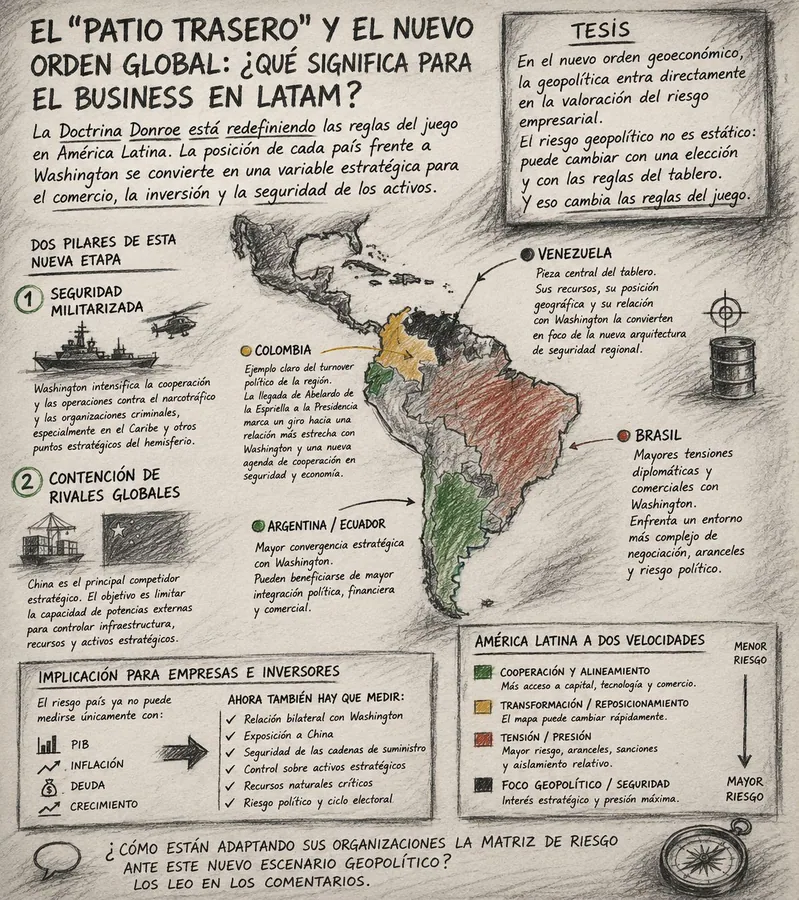
El «patio trasero» y el nuevo orden global: ¿qué significa para el business plan en Latam?
Un análisis de cómo la llamada Doctrina Donroe ha convertido en política explícita la metáfora del «patio trasero» y de lo que ese giro supone para cualquier plan de negocio en América Latina.

NOTA-BIO-002 · Bioenergética
¿Por qué los trabajadores más eficientes se vuelven más lentos a mitad de la jornada?
Para directores de operaciones y gerentes de logística: una lectura bioenergética de por qué los mejores trabajadores pierden productividad a mitad de jornada, un patrón que muchos ven y pocos explican.

NOTA-BIO-003 · Bioenergética
¿Amenaza u oportunidad? La inteligencia artificial y nuestra capacidad creativa
Frente al llamamiento de León XIV a «desarmar la IA», esta pieza sostiene que el riesgo no está en la tecnología, sino en el sistema humano que la usa: bien diseñada, puede liberar capacidad creativa.