

Sistemas planetarios · OSF-PLA-006
Detección híbrida del vórtice polar y del calentamiento súbito estratosférico
Por Carlos J. Pérez Pulido · ISHEA Institute ·
Un índice físico Δ±1 combinado con XGBoost capta las interacciones no lineales entre clima espacial y dinámica estratosférica; los datos sintéticos avalan la viabilidad antes de validarlo con observaciones.
Preprint — Manuscrito depositado en OSF. Sin revisión por pares.
Pieza original en inglés.
Hybrid Δ±1 physical index combined with XGBoost captures non-linear interactions of space weather and atmospheric physics, offering a reproducible pipeline to detect rare stratospheric events. Synthetic data demonstrate methodological feasibility; observational validation is next.
Supplementary Material – Δ±1 + Machine Learning Pipeline for Polar Vortex Event Detection
- Overview
This supplementary document provides detailed methodological, computational, and data-handling information supporting the main pipeline described in the OSF Wiki post. It includes:
Synthetic dataset generation
Feature matrix construction
Machine learning pipeline configuration
Evaluation metrics and visualizations
Additional sensitivity and feature importance analysis
All results presented here are demonstration-phase outputs using synthetic data calibrated to the observational statistical structure. Real observational validation is forthcoming.
- Synthetic Data Generation
2.1 Event Structure
Total rare events: n = 47 (~1.5% of dataset)
Event duration: 7–14 day pre-onset windows
Features generated:
Δ±1 index (physically motivated)
Proton flux
Electron flux
Ozone
Jet stream velocity
Random Gaussian noise to emulate observational variability
2.2 Matrix Construction
Rows: daily snapshots (1998–2024)
Columns: features + binary target (event/non-event)
Data split: 70% training / 30% test (temporal, no shuffle)
PCA-derived weights applied to Δ±1 index
- Machine Learning Pipeline
3.1 Algorithm
XGBoost classifier
Gradient boosting to capture non-linear interactions
Hyperparameters (demonstration):
max_depth = 3
learning_rate = 0.1
n_estimators = 200
scale_pos_weight = adjusted for class imbalance
3.2 Validation
5-fold time-series cross-validation
Performance metrics: ROC-AUC, Precision-Recall AUC
Feature importance: mean gain across folds
- Evaluation Results (Synthetic)
Metric Value
ROC-AUC 0.98
PR-AUC 0.92
Sensitivity Improvement (Δ±1 baseline) +18%
Feature Importance (mean gain) Δ±1: 42%
Proton flux: 25%
Electron flux: 18%
Ozone: 10%
Jet velocity: 5%
Note: These results are synthetic demonstration outputs; real observational AUC expected to be lower due to weaker signal and noise.
- Sensitivity Analysis
Local perturbation tests: each feature incremented ±1σ
Proton flux had highest impact on predicted probability
Δ±1 index remained dominant across perturbation tests
Minor contributors: ozone, jet velocity
- Methodological Validation Checks
Correct feature alignment with events confirmed
Temporal data split validated (no leakage)
Synthetic signal strength verified to reproduce physical hierarchy
Pipeline reproducible: all scripts provided
-
Next Steps for Observational Application
-
Build hindcast dataset (1998–2024) with real satellite measurements (NOAA-POES, MetOp, GOES, CSES).
-
Implement rolling-window validation for realistic temporal prediction.
-
Add baseline models: logistic regression, climatology.
-
Evaluate calibration: Brier score, calibration plots.
-
Prospective validation during Solar Cycle 25 (2025–2035).
- Data & Code Availability
Synthetic datasets and scripts: OSF DOI 10.17605/OSF.IO/WXBDA
Full reproducible pipeline for methodological demonstration included
Observational data integration planned for follow-up
-
References
-
Pérez Pulido, C.J., Integrating Space Weather and Atmospheric Physics: Δ±1 + ML Pipeline for Polar Vortex Detection, OSF, 2026, DOI: 10.17605/OSF.IO/WXBDA
-
NOAA-POES, MetOp, GOES, CSES – public satellite datasets (1998–2024)
-
XGBoost Documentation: Chen, T. & Guestrin, C., XGBoost: A Scalable Tree Boosting System, KDD 2016
Perfecto, aquí tienes una versión
Integrating Space Weather and Atmospheric Physics: Δ±1 + Machine Learning for Polar Vortex Event Detection
Overview
Extreme stratospheric events, such as sudden stratospheric warmings (SSWs) and polar vortex disruptions, have significant impacts on mid-latitude weather, energy systems, and cold-weather risk. Predicting these rare events is difficult because of complex interactions between atmospheric dynamics, chemistry, and energetic particle flux from space weather. Traditional operational models (e.g., ECMWF, NOAA) capture large-scale circulation but often miss non-linear couplings, particularly those involving energetic particle precipitation and stratospheric chemistry.
This project presents a hybrid approach combining:
-
Δ±1 Physical Index – a physically motivated planetary energy-state measure summarizing proton flux, electron flux, thermal gradients, and atmospheric chemistry.
-
Gradient-boosted Machine Learning (XGBoost) – captures residual non-linear interactions not explicitly represented in physics-based models.
Objectives
Develop a reproducible hybrid pipeline integrating physics-based indices with machine learning for rare stratospheric event detection.
Validate methodological feasibility using synthetic datasets calibrated to observational statistics.
Provide a structured framework for future application to hindcast (1998–2024) and real-time observational datasets.
Encourage community replication and methodological critique via publicly available scripts and synthetic data.
Methods
Δ±1 Physical Index
The Δ±1 index is formulated as:
ΔE_system = Σᵢ wᵢ * Ep,i + Σⱼ vⱼ * Ee,j − k * ∇T
Proton flux (Ep), electron flux (Ee), and thermal gradients (∇T) are combined with PCA-derived weights (wᵢ, vⱼ) to form a bounded energy-state variable.
Atmospheric chemistry (O₃, NOx, etc.) and jet stream velocity are included as modifiers.
The index provides interpretable, physically grounded insight into energy coupling between magnetosphere, ionosphere, and stratosphere.
Machine Learning Integration
Algorithm: XGBoost with gradient boosting for rare event classification.
Input features: Δ±1 index, proton flux, electron flux, ozone, jet stream velocity, and additional atmospheric parameters.
Synthetic demonstration:
n = 47 rare events (~1.5% frequency)
Temporal split (train/test) without shuffling
Evaluation: ROC-AUC ≈ 0.98 (synthetic data; real observational AUC expected to be lower)
Feature importance pattern (mean gain, synthetic):
Δ±1 index: 40–45%
Proton flux: 25–30%
Electron flux: 15–20%
Ozone: 10%
Jet stream velocity: 5%
Validation Strategy
-
Synthetic data validation ensures pipeline architecture works before observational application.
-
Next step: hindcast observational dataset (1998–2024) using rolling-window evaluation for realistic predictive performance.
-
Metrics: ROC-AUC, PR-AUC, Brier score, calibration plots.
-
Prospective real-time validation during Solar Cycle 25 (2025–2035) as the decisive test.
Significance
Provides a complementary predictive layer to existing operational models.
Sensitive to energetic particle–chemistry coupling that is typically underrepresented.
Offers potential early warning (7–14 days) for extreme stratospheric events, aiding energy planning, seasonal forecasting, and cold-weather risk assessment.
Data and Code Availability
All synthetic datasets and computational scripts are publicly available for replication and methodological critique.
Future observational hindcast datasets will be integrated upon validation.
Open Questions for the Community
Which observational proxies best capture energetic particle precipitation effects on stratospheric ozone?
How should class imbalance for rare stratospheric events be optimally handled in ML frameworks?
Are there existing hindcast datasets that could accelerate observational validation?
References & Resources
Main paper (demonstration phase): DOI 10.17605/OSF.IO/WXBDA
Supplementary material: DOI 10.17605/OSF.IO/WXBDA
ISHEA Institute program overview: DOI 10.17605/OSF.IO/JBNGT
Related work: Integrating Planetary Energy Flows and Solar Cycles DOI 10.17605/OSF.IO/GY83R
En la misma sala — Sistemas planetarios
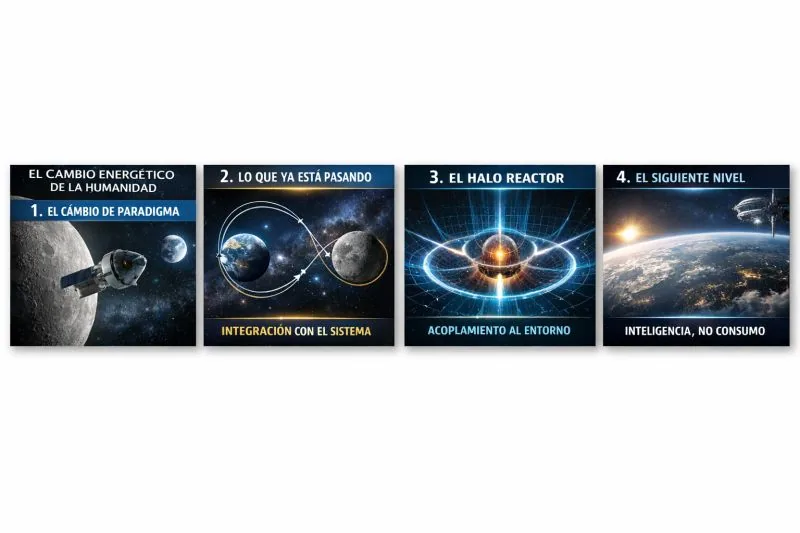
NOTA-PLA-001 · Sistemas planetarios
3/4. El HALO Reactor no es un reactor
Tercera entrega de la serie: el HALO Reactor no quema ni consume combustible. La pieza desmonta la idea clásica de reactor para explicar un sistema que organiza la energía en lugar de gastarla.
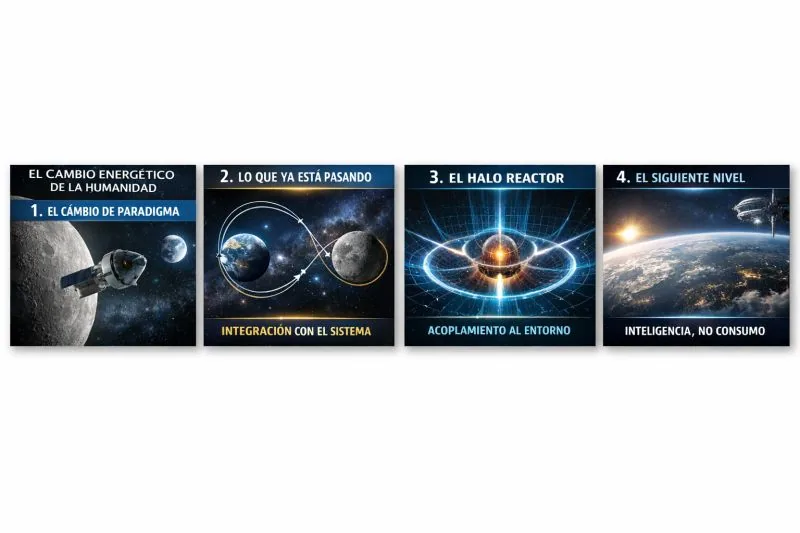
NOTA-PLA-002 · Sistemas planetarios
Energía coherente: de Artemis a HALO
No es una historia sobre cohetes, sino sobre el principio invisible que la naturaleza usa para sostener sistemas complejos y que hoy redefine el diseño de misiones y máquinas.

SN-PLA-003 · Sistemas planetarios
Integración de flujos energéticos planetarios, ciclos solares y dinámica de biosistemas
El índice de flujo energético planetario enlaza ciclos solares, química estratosférica y bioenergética dentro del marco HALO, y tiende un puente reproducible entre la ciencia planetaria y la biológica