

Economía 5.0 · OSF-ECO-138
El Modelo K: el conocimiento como motor de la cognición colectiva y el bienestar humano
Por Carlos J. Pérez Pulido · ISHEA Institute ·
Un marco transdisciplinar que entiende el conocimiento como mensaje puro y lo acopla a la tensión cognitiva (TACC) y la homeostasis para medir el progreso real más allá del PIB en unos 150 países.
Preprint — Manuscrito depositado en OSF. Sin revisión por pares.
Pieza original en inglés.
Abstract
Traditional metrics of human progress, such as GDP or the Human Development Index, fail to capture the cognitive, behavioral, and systemic dimensions of societal well-being. Here, we present the K Model, a transdisciplinary framework that operationalizes knowledge (K) as a pure message, integrating it with cognitive tension (TACC/ICC), homeostasis (IHC), and outcome measures (DevWell_PC1, GCSI2).
The model allows the measurement of real progress across economic, social, and cognitive domains, quantifies behavioral DNA reflecting patterns of collective action, and identifies cognitive tipping points in populations, institutions, and networks. Using longitudinal data from ~150 countries (2015–2024), the K Model predicts systemic resilience, guides interventions to optimize knowledge flow, and aligns collective cognition with sustainable human well-being.
All datasets, case studies, and analytic scripts are publicly available through the Open Science Framework (OSF) to ensure transparency and reproducibility. Our results demonstrate that knowledge as a core hard quantum variable can be operationalized to guide policy, foster social cohesion, and maximize benefits in health, governance, economy, and innovation.
Aquí tienes una versión estilo Wikipedia del texto
K Model
The K Model is a transdisciplinary framework designed to quantify and analyze knowledge as a core driver of collective cognition and human well-being. It integrates cognitive, behavioral, social, and economic indicators to measure knowledge flow, systemic tension, and equilibrium within societies and organizations. The model is based on the ISHEA–KTR–TACC–IHC framework, which operationalizes knowledge into measurable constructs, enabling predictive insights across multiple domains including health, governance, and economic productivity.
Overview
Traditional metrics such as Gross Domestic Product (GDP) and the Human Development Index (HDI) have been criticized for not adequately capturing the cognitive and behavioral dynamics of societies. The K Model addresses this limitation by treating knowledge as a “pure message” and analyzing its distribution, accessibility, and application. Cognitive tension and system homeostasis are measured alongside knowledge to assess societal resilience and progress.
Core Concepts
Knowledge (K)
Knowledge is defined as a pure message that can be measured via:
K_density: The concentration of functional knowledge within a system.
K_access: The availability and circulation of knowledge across infrastructures.
K_flow: The translation of knowledge into coherent collective action.
K serves as the foundational element, or “hard quantum,” for analyzing systems.
Collective Cognitive Tension (TACC / ICC)
Cognitive tension represents the pressure within a system caused by uncertainty, misinformation, polarization, or information overload. It is used to predict systemic vulnerability and potential tipping points.
Knowledge Tension Ratio (KTR)
KTR quantifies the relationship between knowledge and systemic tension:
\text{KTR} = K_{\text{density}} \cdot K_{\text{access}} \pm r
where represents variability due to external or internal factors.
Cognitive Process Cycle
The model defines a three-step cognitive process:
-
Thinking: Comprehension of knowledge (K).
-
Assimilation / Creative Action: Application of knowledge in behaviors, policies, or innovations.
-
Checking: Feedback and learning for system adjustment.
Applications
Measuring Economy and Progress
The K Model integrates economic, social, and cognitive indicators to assess real-world capacity for human well-being. Metrics include:
Adjusted GDP and productivity.
Innovation and cognitive employment.
Access to services and fiscal measures (Delta Tax).
Sustainability and ethical governance.
Behavioral DNA
Behavioral DNA captures patterns of action and reaction within a system, derived from KTR, IHC, and LEX subsystems. Metrics include social cohesion, cooperation, ethical alignment, and policy innovation.
Modulating Collective Cognition
The model suggests interventions to optimize knowledge flow and maintain system equilibrium:
Increasing K_density and K_access.
Optimizing K_flow through education, ethics programs, and policy.
Using feedback loops to maintain Index of Cognitive Homeostasis (IHC).
Benefits Across Domains
Domain Benefits
Health Enhanced mental and physical health through resilience and positive behaviors.
Governance Improved institutional effectiveness, transparency, and ethical standards.
Economy Increased innovation, efficiency, and high-cognition employment.
Society Greater social cohesion, cooperation, and value alignment.
Science & Culture Enhanced research, creativity, and knowledge transmission.
Discussion
The K Model offers a universal framework for studying knowledge flow and systemic stability. Its modular design and integration of cognitive, behavioral, and economic indicators allow for predictive modeling of societal well-being. By treating knowledge as a measurable entity, the framework supports policy-relevant insights and cross-context comparisons.
References
OSF Preregistration DOI: 10.17605/OSF.IO/WST24
World Values Survey (WVS)
World Bank, Education & Mobility Data
World Health Organization (Mental Health Statistics)
V-Dem Project (Freedom & Academic Independence)
International Telecommunication Union (Connectivity & Digital Access)
En la misma sala — Economía 5.0

NOTA-ECO-001 · Economía 5.0
¿Y si las variables con las que medimos el éxito de los países estuvieran al revés?
Durante décadas el progreso se ha medido con PIB, productividad, crecimiento y energía. Esta pieza plantea que esas variables podrían estar invertidas y pide repensar qué significa que un país prospere.
NOTA-ECO-002 · Economía 5.0
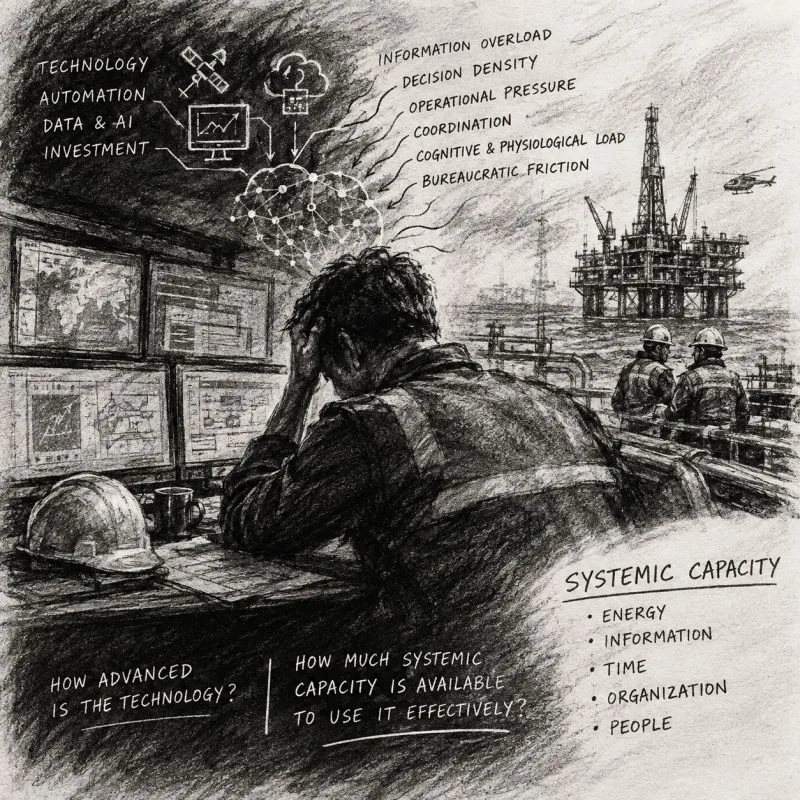
¿Por qué fallan los sistemas de alta ingeniería cuando la tecnología es más avanzada?
En Oil & Gas y otras operaciones complejas, más tecnología no garantiza mejores decisiones: esta pieza estudia la capacidad sistémica, lo que un sistema puede absorber y convertir en acción bajo presión.

NOTA-ECO-003 · Economía 5.0
Frankenstein y el petróleo: ¿por qué Venezuela vuelve a importar geopolíticamente?
Tercera entrega de la serie: tras el paso del capital a la IA y a la concentración financiera, llega el siguiente cuello de botella, el petróleo, y con él Venezuela vuelve al tablero geopolítico.