

Economía 5.0 · OSF-ECO-151
El Modelo K: marco central del bienestar humano y la cognición
Por Carlos J. Pérez Pulido · ISHEA Institute ·
Preregistro del Modelo K: hipótesis, criterios de falsación y diseño de un panel longitudinal de unos 150 países (2015–2024) que enlaza TACC, KTR y los subsistemas LEX con el comportamiento colectivo.
Preprint — Manuscrito depositado en OSF. Sin revisión por pares.
Pieza original en inglés.
This preregistration details the theoretical framework, central and secondary hypotheses, falsification criteria, and methodological design of the K Model — a modular and replicable system for predicting and optimizing collective and institutional behavior.
The study integrates structural, cognitive, and contextual variables (ICC ≡ TACC, KTR_Tensión+, DevWell_PC1, GCSI2, and LEX subsystems: Fin, Key, Pol, Gov, Estate, Salute, HR/HSE, Empresas, Avery) in a longitudinal observational panel covering ~150 countries (2015–2024).
Analytical methods include fixed-effects panel regression, penalized models (Ridge, Lasso), hierarchical linear models, and lead–lag analysis. Sensitivity tests (Sobol, Monte Carlo, spider analysis, Kondratiev-cycle stress) ensure robustness. All hypotheses and analytical procedures are pre-specified to guarantee transparency and reproducibility.
Policy Brief: Knowledge, Innovation, and Well-Being – Integrating Nobel 2025 and the K Model
Date: October 2025
Author: Carlos J. Pérez Pulido – ISHEA Institute
Executive Summary
The 2025 Nobel Prize in Economics recognizes innovation as a driver of economic growth. However, the ISHEA Institute’s K Model proposes that active knowledge should be managed not only to boost productivity but also to ensure human well-being, social resilience, and ethical sustainability.
Key message: Not all innovation is beneficial; cognitive and ethical management of knowledge is essential for sustainable, human-centered development.
-
Key Alignments and Strengths
Both approaches recognize knowledge as the core of progress.
Innovation generates tension and disruption, serving as signals about system status.
Institutions and cognitive culture are decisive: without openness, ethics, and freedom, progress stagnates.
K Model indicators for practical monitoring:
KTR: Level of collective cognitive processing.
IHC: Social integrity and cohesion.
TACC: Collective cognitive tension, early warning of vulnerabilities. -
Critical Differences
Dimension
Nobel 2025
K Model (policy-relevant)
Objective
Economic growth
Integral well-being and social resilience
Measurement
Patents, GDP-adjusted
KTR, IHC, TACC, behavioral DNA
Ethics
Implicit
Explicit, with sustainability and equity filters
Policy Action
Innovation incentives
Cognitive governance, cooperation, and ethical education policies -
Strategic Recommendations
Ethical innovation management
Implement cognitive and ethical filters in technological projects (AI, automation).
Strengthening cognitive cooperation
Create inter-institutional collaboration networks to safely and efficiently share knowledge.
Monitoring tension and vulnerability
Use TACC to anticipate risks of polarization, disinformation, or systemic failures.
Education and knowledge culture
Promote cognitive literacy, critical thinking, and institutional openness as long-term policies.
- Expected Impact
Greater social and economic resilience to global shocks.
Innovation aligned with human well-being and ethical sustainability.
Policies based on cognitive evidence, beyond mere economic productivity.
Conclusion
The K Model complements the 2025 Nobel framework by providing operational tools to transform knowledge and innovation into real well-being, ensuring that technological progress generates not only wealth but also social cohesion, resilience, and ethics.
Visual Brief: From Knowledge to Ethical Innovation and Well-Being
Title: Active Knowledge, Innovation, and Human Well-Being
Author: Carlos J. Pérez Pulido – ISHEA Institute
Audience: UN, OECD, Public Innovation Committees
1️⃣ Core Flows of the K Model
K_density → K_flow → IHC → Well-Being & Resilience
│ │ │
▼ ▼ ▼
Monitoring Cognitive Polarization
(TACC) Cooperation Reduction
K_density: Quantity and quality of available knowledge.
K_flow: Knowledge flow between social and institutional actors.
IHC: Social integrity and cohesion (collective cognitive processing).
TACC: Collective cognitive tension; early warning of systemic risks.
2️⃣ Strategic Principles for Public Policy
Principle
Recommended Action
Ethical innovation
Sustainability and equity filters in AI, automation, and emerging tech projects
Cognitive cooperation
Inter-institutional networks for knowledge sharing, global collaboration platforms
Tension monitoring
Implement TACC indicators to anticipate polarization, disinformation, and systemic failures
Knowledge culture & education
Cognitive literacy, critical thinking, and institutional openness as long-term policy
3️⃣ Expected Outcomes
✅ Innovation aligned with human well-being
✅ Social and economic resilience against shocks
✅ Policies grounded in cognitive evidence, beyond simple productivity
4️⃣ Conceptual Visualization
[Pure Knowledge]
│
▼
[Secure Cognitive Flow] → K_flow
│
▼
[Cooperation & Social Integrity] → IHC
│
▼
[Human Well-Being + Resilience]
│
▼
[Ethical Feedback & Governance] → LEX + Behavioral DNA
Insight: Innovation is not merely growth; it is optimized collective cognition and ethics, operationalized through measurable indicators.
Comparative Analysis: Nobel 2025 Innovation Framework vs. ISHEA-K Model
Author: Carlos J. Pérez Pulido
Institution: ISHEA Institute
DOI: https://doi.org/10.17605/OSF.IO/WST24
Date: 2025
- Introduction
The 2025 Nobel Prize in Economics was awarded to Joel Mokyr, Philippe Aghion, and Peter Howitt for their contribution to understanding economic growth driven by innovation. Their work consolidated endogenous growth theory, highlighting that innovation within the economic system is the primary driver of productivity and sustained prosperity.
The ISHEA-K model proposes a deeper layer: innovation is not the cause, but the manifestation of the fundamental energy Knowledge (K), which organizes human-ecological systems.
- Summary of the Nobel Framework
Dimension Core Idea
Theoretical Basis Endogenous Growth Theory: innovation arises internally in the economy.
Causal Mechanism R&D → technological innovation → productivity → economic growth.
Innovation Dynamics Creative destruction replaces old technologies.
Measurement of Success GDP growth, productivity indices.
Assumptions Rational agents; market internalizes innovation.
Epistemic Orientation Linear-causal, econometric.
2.1 Achievements
Endogenized technology into growth models.
Linked competition and innovation.
Integrated historical-cultural analysis.
2.2 Limitations
Knowledge reduced to a productive input.
Omits non-economic dimensions.
Innovation treated as a driver, not derived from cognitive coherence.
- ISHEA-K Model: Knowledge as Core Variable
The ISHEA-K model defines Knowledge (K) as a coherence energy that governs the evolution of human-ecological systems.
3.1 Components
Component Description
Kc Knowledge Coherence: relation between functional knowledge and cognitive noise.
Ke Knowledge Efficiency: ability to transform knowledge into utility without loss.
Kr Knowledge Regeneration: resilience of knowledge against obsolescence.
3.2 Principle
Innovation is the visible expression of Knowledge (K) resonance within a coherent system.
- Comparative Analysis
Dimension Nobel 2025 ISHEA-K
Causal Axis Innovation → Growth Knowledge → Innovation → Sustainable Growth
Epistemic Scope Economic/technological Human–ecological/energetic
Ontology of Knowledge Instrumental Structural
Systemic Dynamics Competitive destruction Integrative regeneration
Metric of Success GDP, productivity Human–Ecological Satisfaction Index
Temporal Orientation Short–medium term Long-term stability
Ethical Dimension Implicit Explicit
-
Conceptual Implications
-
Inversion of Causality: K generates innovation.
-
Non-linear Systems: growth as emergent property.
-
Integration of Human Ecology: holistic approach to development.
-
Meta-Epistemological Shift: from output to understanding.
- Empirical Correlations
Economies high in innovation but low K coherence: stagnation in subjective well-being.
Small systems with high K coherence: sustained human growth.
- Conclusion
The 2025 Nobel explains how innovation stimulates economic activity but not why certain systems sustain progress. ISHEA-K identifies Knowledge (K) as the generative energy that determines the quality, direction, and longevity of innovation.
- References
Aghion, P., & Howitt, P. (1992). A Model of Growth Through Creative Destruction. Econometrica, 60(2), 323–351.
Mokyr, J. (2002). The Gifts of Athena. Princeton University Press.
Pérez Pulido, C. J. (2025). ISHEA-K Model: Knowledge as the Core Variable of Human–Ecological Systems. ISHEA Institute.
Rigorous technical confrontation — Nobel (Mokyr / Aghion & Howitt) principles vs. ISHEA-K variables
Below I deliver a structured, scientific comparison. First I list the core principles commonly used in the Nobel-related endogenous-innovation framework (derived from Mokyr, Aghion & Howitt and standard endogenous growth literature). For each principle I give: (A) a short technical evaluation, (B) precise measurable variables/indicators and empirical tests, and (C) a formal confrontation vs. the ISHEA-K principles and variables you propose (Kc, Ke, Kr) including culture, market substitution, market conditions / state (estado) and how to operationalize them. I close with recommended hypothesis tests, robustness checks and a short note on expected empirical patterns.
- Core principles of the Nobel / Endogenous-Innovation framework — evaluation
Principle N1 — R&D and investment in knowledge generate technological innovation which increases productivity
A. Evaluation (technical):
This is causal: R&D expenditures and human capital → invention/innovation → productivity growth. The mechanism assumes knowledge production functions (R&D inputs → knowledge outputs) and spillovers.
B. Operationalization / indicators:
R&D intensity: R&D spending / GDP (GERD), R&D per researcher.
Human capital: years schooling, tertiary STEM share, patents per capita.
Innovation outputs: patent counts (triadic patents), patent citations, new product shares, TFP growth.
Productivity: labor productivity (GDP per hour), Total Factor Productivity (TFP).
C. Confrontation with ISHEA-K:
ISHEA-K reframes: R&D is an input, but the efficacy of that input depends on Knowledge Coherence (Kc) and Knowledge Efficiency (Ke).
Prediction difference: two economies with equal GERD may diverge in innovation outputs if Kc or Ke differ. So R&D alone is insufficient—must be conditioned on K variables.
Empirical test: interact GERD with measured Kc/Ke in a panel regression predicting patent quality or TFP growth. Expect significant positive interaction if ISHEA-K holds.
Principle N2 — Creative destruction: competition replaces obsolete technologies; market competition spurs innovation
A. Evaluation:
Markets under competition create incentives to innovate because incumbents are challenged; Schumpeterian dynamics formalized in models where incumbent profits motivate R&D.
B. Indicators / tests:
Market concentration: HHI, CR4, firm-level markups.
Entry/exit rates, firm turnover.
Measures of competitive pressure: price-cost margins, import penetration.
Relation to innovation: regress firm R&D on competition proxies.
C. Confrontation with ISHEA-K:
ISHEA-K expects competition to interact with Kc: in systems with low Kc competition may produce destructive churn without productive recombination (innovation becomes noise). In high Kc competition yields regenerative innovation.
Additional variable: Substitution in market (how easily new technologies substitute old). This must be measured (e.g., elasticity of substitution, adoption speed). High substitution + low Kc → social disruption; high substitution + high Kc → rapid welfare gains.
Empirical design: difference-in-differences around entry of a disruptive technology, splitting samples by measured Kc.
Principle N3 — Knowledge spillovers and public good character of ideas justify policy (subsidies, patents, public R&D)
A. Evaluation:
Ideas are nonrival → positive externalities → underinvestment in R&D absent policy. Patents and subsidies counteract.
B. Indicators / tests:
Citation networks (to measure spillovers).
Cross-region TFP spillovers (spatial econometrics).
Patent renewal rates, patent breadth.
C. Confrontation with ISHEA-K:
ISHEA-K reframes spillovers as quality of translation: an idea only spills beneficially if receiving system has Ke (can efficiently transform) and Kr (can regenerate/adapt). Thus policy effectiveness depends on K variables.
Policy implication difference: unconditional R&D subsidies less effective where Ke/Kr low. Instead, policies improving coherence (education, integrative institutions, symbolic frameworks) should be prioritized.
Empirical test: heterogeneous treatment effects of R&D subsidies by regional Kc/Ke/Kr.
Principle N4 — Human capital, institutions and incentives determine innovation rates
A. Evaluation:
Human capital supplies skills; institutions (property rights, competition policy) affect incentives.
B. Indicators:
Educational attainment, skill gaps, labor market rigidity indices, institutional quality (rule of law, regulatory quality).
Measures of incentives: corporate tax rates, IP strength.
C. Confrontation with ISHEA-K:
ISHEA-K collapses these into mediators of K: institutions and human capital form part of Kc (coherence) and Ke (efficiency). But ISHEA-K gives them a structural role: they shape resonance of knowledge.
Novel variables to add: cultural coherence index (see below), institutional alignment metric (how aligned institutions are with knowledge flows).
Empirical test: path analysis / structural equation models where institutions → Kc/Ke → innovation outcomes.
Principle N5 — Innovation as measurable by market outcomes (GDP, productivity, patents)
A. Evaluation:
Focus on output metrics (GDP, productivity) is pragmatic but neglects non-market dimensions (subjective well-being, ecosystem services).
B. Indicators: GDP growth, TFP, patent metrics, firm sales from new products.
C. Confrontation with ISHEA-K:
ISHEA-K proposes alternative outcomes: Human-Ecological Satisfaction Index (HESI), longer-term stability, resilience. This requires building composite indices combining well-being, environmental indicators, social cohesion.
Empirical consequence: some innovation trajectories boost GDP but reduce HESI; ISHEA-K aims to explain these divergences via K variables.
- Mapping ISHEA-K variables & your proposed variables — definitions and operationalization
You use Kc, Ke, Kr plus cultural, market substitution, conditions/state. Below I formalize them and propose measurable proxies.
ISHEA-K formal variables
Kc (Knowledge Coherence): degree to which knowledge in a system is internally consistent, low noise, shared semantics and integrative frameworks.
Operational proxies:
Semantic alignment index from textual corpora (topic model coherence across institutions / firms / academic literature).
Survey-based measure: proportion of respondents in relevant organizations sharing core concepts (Likert scales).
Interdisciplinary citation density (normalized): fraction of citations linking diverse fields with coherent co-citation clusters.
Standard deviation of firm/region technology portfolios (lower SD → higher coherence if focused; but high focused coherence vs high integrative coherence must be distinguished).
Ke (Knowledge Efficiency): conversion rate of knowledge inputs into useful outputs (minimizing loss/distortion).
Operational proxies:
Output per R&D dollar: patents (quality-weighted) / GERD; TFP growth per R&D.
Commercialization rate: fraction of research projects that lead to market products.
Time-to-market metrics; failure rates in pilots.
Ratio of high-impact citations to total citations (quality signal).
Kr (Knowledge Regeneration): resilience and renewal capacity of knowledge stock (ability to update, reconfigure, and avoid obsolescence).
Operational proxies:
Rate of knowledge updating: share of publications/patents that cite recent work.
Lifespan of technologies (median).
Index of training / lifelong learning uptake.
Diversity of knowledge sources feeding into new outputs (higher diversity → higher regeneration potential).
Additional variables you mentioned (formalized)
Culture (C): shared norms, values, narratives that shape receptivity to knowledge and innovation.
Proxies: Hofstede dimensions (trust, uncertainty avoidance), innovation culture surveys, entrepreneurship rates, attitudes to risk (survey). Also qualitative codings of media narratives.
Substitution in market (S): elasticity and speed with which new technologies substitute incumbent goods/services.
Proxies: adoption curves, cross-price elasticities, market share displacement rates, technology adoption half-life.
Market conditions / Estado (M): regulatory, macroeconomic and institutional state contexts (stability, policy orientation).
Proxies: rule-of-law index, macro volatility (GDP volatility), credit availability, policy indices.
- Confrontation — principle by principle with variable mapping and expected empirical signatures
For each Nobel principle (Ni) I list the direct ISHEA-K reinterpretation, the extra variables that change inference, the econometric specification to test, and the expected contrasting empirical signature.
N1 (R&D → Innovation → Productivity)
ISHEA-K reinterpretation: R&D effectiveness is conditional:
Innovation = f(GERD, HumanCapital, Kc, Ke, Kr, C, M, S)
Key test (panel):
Innovation_it = α + β1 GERD_it + β2 Kc_it + β3 (GERD_it × Kc_it) + β4 Ke_it + β5 Kr_it + γX_it + u_it
Expectation if ISHEA-K true: β3 > 0 (R&D more effective when Kc high); Ke, Kr significant positive.
Contrast signature: Traditional model expects β1 large and significant; ISHEA-K expects β1 reduced once interactions included.
N2 (Competition / Creative destruction)
ISHEA-K reinterpretation: Competition induces innovation only if Kc/Ke permit productive recombination; else leads to destructive volatility.
Test (firm level):
ΔTFP_ft = α + β1 Competition_ft + β2 Kc_region(t) + β3 (Competition_ft × Kc_region(t)) + controls
Expectation: β1 ambiguous; β3 > 0 indicates competition beneficial in high-Kc contexts. In low-Kc contexts competition may reduce TFP (β1 negative).
N3 (Spillovers & policy)
ISHEA-K reinterpretation: Spillovers are filtered by Ke/Kr. Public R&D has higher returns in regions with higher Ke/Kr and cultural alignment C.
Test (policy eval): Heterogeneous treatment effects of R&D subsidies by K measures.
Expectation: Regions with low Ke show low returns despite subsidies.
N4 (Human capital & institutions)
ISHEA-K reinterpretation: Human capital and institutions shape Kc (semantic coherence) and Kr (regeneration). Not just quantity but alignment matters.
Operational suggestion: use structural equation modeling (SEM) where Education & Institutions → Kc/Ke/Kr → Innovation → Welfare (HESI). Estimate direct & indirect effects.
N5 (Metrics of success)
ISHEA-K reinterpretation: Add HESI and resilience metrics as dependent variables. Show cases where GDP↑ & HESI↓ correspond to low Kc (innovation without coherence).
Test: Multi-objective frontier analysis (Pareto frontier) comparing GDP vs HESI across regions stratified by Kc.
- Specific confrontations on variables you listed (Cultura, Sustitución, Condiciones/Estado)
A. Culture (C)
Nobel view: culture often a residual, occasionally considered (trust, norms) but not central causal energy.
ISHEA-K view: culture is structural — it shapes semantic frames (Kc) and affects Kr (willingness to update knowledge).
Empirical action: construct CultureIndex combining trust, openness to change, uncertainty avoidance, entrepreneurship. Test moderation: Effect of GERD on Innovation | CultureIndex. Expect stronger effect where CultureIndex high.
B. Market Substitution (S)
Nobel view: substitution captured implicitly via adoption and competition; usually modeled with CES/production functions.
ISHEA-K view: substitution speed combined with Kc determines welfare outcomes: high substitution + low Kc → welfare loss.
Empirical action: estimate adoption elasticities and combine with Kc to forecast welfare impact curves. Use agent-based simulation to show regime shifts.
C. Market Conditions / Estado (M)
Nobel view: institutional quality and macro conditions as control variables.
ISHEA-K view: M is a boundary condition for K resonance — it must be aligned (institutional alignment index) to permit Ke and Kr to operate.
Empirical action: build an Institutional Alignment Index (consistency between laws, incentives, education and market practice). Test for mediation: M → Kc → Innovation.
-
Suggested empirical protocol (for a rigorous scientific evaluation)
-
Data assembly (panel, multi-level): countries/regions × years, firm-level panels where available. Variables: GERD, patents (quality weighted), TFP, education, institutional indices, culture proxies, adoption metrics, semantic coherence measures (text mining), commercialization rates.
-
Construct K indices:
Kc: topic-model coherence across policy, academia, industry texts + survey alignment score.
Ke: commercialization rate, output per R&D dollar.
Kr: median update rate, lifelong learning uptake.
- Main econometric models:
Fixed effects panel regressions with interaction terms (GERD × Kc, Competition × Kc).
SEM to test causal paths (Institutions → Kc/Ke/Kr → Innovation → HESI).
Instrumental variables where endogeneity is a concern (e.g., historical instruments for GERD or exogenous policy shocks).
- Robustness checks:
Alternative K index constructions (PCA, factor analysis).
Nonlinearities (threshold models): Is there a Kc threshold above which GERD becomes effective?
Placebo tests: apply same model to non-related sectors.
Heterogeneous effects by sector (services vs manufacturing), firm size.
- Complementary methods:
Case studies / qualitative coding to validate how Kc manifests in institutions.
Agent-based models to explore dynamic outcomes (creative destruction vs regenerative innovation) under varying Kc/Ke/Kr.
- Concrete hypotheses (testable)
H1: ∂Innovation / ∂GERD is higher in regions with higher Kc (positive GERD×Kc interaction).
H2: Competition increases firm-level TFP only when regional Kc exceeds threshold τ.
H3: R&D subsidies have higher ROI in regions with high Ke; in low-Ke regions subsidies have null or negative net welfare effect.
H4: High substitution elasticity combined with low Kc predicts a decrease in HESI despite GDP growth.
- Expected empirical patterns / interpretation guidelines
If Nobel model alone: strong positive coefficient on GERD; competition always raises innovation.
If ISHEA-K holds: GERD’s coefficient shrinks or becomes insignificant unless accompanied by high Kc/Ke/Kr. Competition shows heterogeneous signs (positive in high Kc, negative in low Kc). Regions with similar GERD diverge in welfare when K variables differ.
- Limitations, measurement challenges & mitigation
Kc measurement is nontrivial (semantic, cultural). Mitigate with mixed methods: NLP topic coherence + targeted expert surveys.
Endogeneity: innovation can influence GERD and K indices. Use IVs (historic education policies, distance to frontier shocks) and lag structures.
Composite indices risk hiding mechanisms: decompose indices and report component effects.
Cross-country cultural measures can be noisy—use within-country regional variation where possible.
Rigorous technical confrontation — Nobel (Mokyr / Aghion & Howitt) principles vs. ISHEA-K variables
Below I deliver a structured, scientific comparison. First I list the core principles commonly used in the Nobel-related endogenous-innovation framework (derived from Mokyr, Aghion & Howitt and standard endogenous growth literature). For each principle I give: (A) a short technical evaluation, (B) precise measurable variables/indicators and empirical tests, and (C) a formal confrontation vs. the ISHEA-K principles and variables you propose (Kc, Ke, Kr) including culture, market substitution, market conditions / state (estado) and how to operationalize them. I close with recommended hypothesis tests, robustness checks and a short note on expected empirical patterns.
- Core principles of the Nobel / Endogenous-Innovation framework — evaluation
Principle N1 — R&D and investment in knowledge generate technological innovation which increases productivity
A. Evaluation (technical):
This is causal: R&D expenditures and human capital → invention/innovation → productivity growth. The mechanism assumes knowledge production functions (R&D inputs → knowledge outputs) and spillovers.
B. Operationalization / indicators:
R&D intensity: R&D spending / GDP (GERD), R&D per researcher.
Human capital: years schooling, tertiary STEM share, patents per capita.
Innovation outputs: patent counts (triadic patents), patent citations, new product shares, TFP growth.
Productivity: labor productivity (GDP per hour), Total Factor Productivity (TFP).
C. Confrontation with ISHEA-K:
ISHEA-K reframes: R&D is an input, but the efficacy of that input depends on Knowledge Coherence (Kc) and Knowledge Efficiency (Ke).
Prediction difference: two economies with equal GERD may diverge in innovation outputs if Kc or Ke differ. So R&D alone is insufficient—must be conditioned on K variables.
Empirical test: interact GERD with measured Kc/Ke in a panel regression predicting patent quality or TFP growth. Expect significant positive interaction if ISHEA-K holds.
Principle N2 — Creative destruction: competition replaces obsolete technologies; market competition spurs innovation
A. Evaluation:
Markets under competition create incentives to innovate because incumbents are challenged; Schumpeterian dynamics formalized in models where incumbent profits motivate R&D.
B. Indicators / tests:
Market concentration: HHI, CR4, firm-level markups.
Entry/exit rates, firm turnover.
Measures of competitive pressure: price-cost margins, import penetration.
Relation to innovation: regress firm R&D on competition proxies.
C. Confrontation with ISHEA-K:
ISHEA-K expects competition to interact with Kc: in systems with low Kc competition may produce destructive churn without productive recombination (innovation becomes noise). In high Kc competition yields regenerative innovation.
Additional variable: Substitution in market (how easily new technologies substitute old). This must be measured (e.g., elasticity of substitution, adoption speed). High substitution + low Kc → social disruption; high substitution + high Kc → rapid welfare gains.
Empirical design: difference-in-differences around entry of a disruptive technology, splitting samples by measured Kc.
Principle N3 — Knowledge spillovers and public good character of ideas justify policy (subsidies, patents, public R&D)
A. Evaluation:
Ideas are nonrival → positive externalities → underinvestment in R&D absent policy. Patents and subsidies counteract.
B. Indicators / tests:
Citation networks (to measure spillovers).
Cross-region TFP spillovers (spatial econometrics).
Patent renewal rates, patent breadth.
C. Confrontation with ISHEA-K:
ISHEA-K reframes spillovers as quality of translation: an idea only spills beneficially if receiving system has Ke (can efficiently transform) and Kr (can regenerate/adapt). Thus policy effectiveness depends on K variables.
Policy implication difference: unconditional R&D subsidies less effective where Ke/Kr low. Instead, policies improving coherence (education, integrative institutions, symbolic frameworks) should be prioritized.
Empirical test: heterogeneous treatment effects of R&D subsidies by regional Kc/Ke/Kr.
Principle N4 — Human capital, institutions and incentives determine innovation rates
A. Evaluation:
Human capital supplies skills; institutions (property rights, competition policy) affect incentives.
B. Indicators:
Educational attainment, skill gaps, labor market rigidity indices, institutional quality (rule of law, regulatory quality).
Measures of incentives: corporate tax rates, IP strength.
C. Confrontation with ISHEA-K:
ISHEA-K collapses these into mediators of K: institutions and human capital form part of Kc (coherence) and Ke (efficiency). But ISHEA-K gives them a structural role: they shape resonance of knowledge.
Novel variables to add: cultural coherence index (see below), institutional alignment metric (how aligned institutions are with knowledge flows).
Empirical test: path analysis / structural equation models where institutions → Kc/Ke → innovation outcomes.
Principle N5 — Innovation as measurable by market outcomes (GDP, productivity, patents)
A. Evaluation:
Focus on output metrics (GDP, productivity) is pragmatic but neglects non-market dimensions (subjective well-being, ecosystem services).
B. Indicators: GDP growth, TFP, patent metrics, firm sales from new products.
C. Confrontation with ISHEA-K:
ISHEA-K proposes alternative outcomes: Human-Ecological Satisfaction Index (HESI), longer-term stability, resilience. This requires building composite indices combining well-being, environmental indicators, social cohesion.
Empirical consequence: some innovation trajectories boost GDP but reduce HESI; ISHEA-K aims to explain these divergences via K variables.
- Mapping ISHEA-K variables & your proposed variables — definitions and operationalization
You use Kc, Ke, Kr plus cultural, market substitution, conditions/state. Below I formalize them and propose measurable proxies.
ISHEA-K formal variables
Kc (Knowledge Coherence): degree to which knowledge in a system is internally consistent, low noise, shared semantics and integrative frameworks.
Operational proxies:
Semantic alignment index from textual corpora (topic model coherence across institutions / firms / academic literature).
Survey-based measure: proportion of respondents in relevant organizations sharing core concepts (Likert scales).
Interdisciplinary citation density (normalized): fraction of citations linking diverse fields with coherent co-citation clusters.
Standard deviation of firm/region technology portfolios (lower SD → higher coherence if focused; but high focused coherence vs high integrative coherence must be distinguished).
Ke (Knowledge Efficiency): conversion rate of knowledge inputs into useful outputs (minimizing loss/distortion).
Operational proxies:
Output per R&D dollar: patents (quality-weighted) / GERD; TFP growth per R&D.
Commercialization rate: fraction of research projects that lead to market products.
Time-to-market metrics; failure rates in pilots.
Ratio of high-impact citations to total citations (quality signal).
Kr (Knowledge Regeneration): resilience and renewal capacity of knowledge stock (ability to update, reconfigure, and avoid obsolescence).
Operational proxies:
Rate of knowledge updating: share of publications/patents that cite recent work.
Lifespan of technologies (median).
Index of training / lifelong learning uptake.
Diversity of knowledge sources feeding into new outputs (higher diversity → higher regeneration potential).
Additional variables you mentioned (formalized)
Culture (C): shared norms, values, narratives that shape receptivity to knowledge and innovation.
Proxies: Hofstede dimensions (trust, uncertainty avoidance), innovation culture surveys, entrepreneurship rates, attitudes to risk (survey). Also qualitative codings of media narratives.
Substitution in market (S): elasticity and speed with which new technologies substitute incumbent goods/services.
Proxies: adoption curves, cross-price elasticities, market share displacement rates, technology adoption half-life.
Market conditions / Estado (M): regulatory, macroeconomic and institutional state contexts (stability, policy orientation).
Proxies: rule-of-law index, macro volatility (GDP volatility), credit availability, policy indices.
- Confrontation — principle by principle with variable mapping and expected empirical signatures
For each Nobel principle (Ni) I list the direct ISHEA-K reinterpretation, the extra variables that change inference, the econometric specification to test, and the expected contrasting empirical signature.
N1 (R&D → Innovation → Productivity)
ISHEA-K reinterpretation: R&D effectiveness is conditional:
Innovation = f(GERD, HumanCapital, Kc, Ke, Kr, C, M, S)
Key test (panel):
Innovation_it = α + β1 GERD_it + β2 Kc_it + β3 (GERD_it × Kc_it) + β4 Ke_it + β5 Kr_it + γX_it + u_it
Expectation if ISHEA-K true: β3 > 0 (R&D more effective when Kc high); Ke, Kr significant positive.
Contrast signature: Traditional model expects β1 large and significant; ISHEA-K expects β1 reduced once interactions included.
N2 (Competition / Creative destruction)
ISHEA-K reinterpretation: Competition induces innovation only if Kc/Ke permit productive recombination; else leads to destructive volatility.
Test (firm level):
ΔTFP_ft = α + β1 Competition_ft + β2 Kc_region(t) + β3 (Competition_ft × Kc_region(t)) + controls
Expectation: β1 ambiguous; β3 > 0 indicates competition beneficial in high-Kc contexts. In low-Kc contexts competition may reduce TFP (β1 negative).
N3 (Spillovers & policy)
ISHEA-K reinterpretation: Spillovers are filtered by Ke/Kr. Public R&D has higher returns in regions with higher Ke/Kr and cultural alignment C.
Test (policy eval): Heterogeneous treatment effects of R&D subsidies by K measures.
Expectation: Regions with low Ke show low returns despite subsidies.
N4 (Human capital & institutions)
ISHEA-K reinterpretation: Human capital and institutions shape Kc (semantic coherence) and Kr (regeneration). Not just quantity but alignment matters.
Operational suggestion: use structural equation modeling (SEM) where Education & Institutions → Kc/Ke/Kr → Innovation → Welfare (HESI). Estimate direct & indirect effects.
N5 (Metrics of success)
ISHEA-K reinterpretation: Add HESI and resilience metrics as dependent variables. Show cases where GDP↑ & HESI↓ correspond to low Kc (innovation without coherence).
Test: Multi-objective frontier analysis (Pareto frontier) comparing GDP vs HESI across regions stratified by Kc.
- Specific confrontations on variables you listed (Cultura, Sustitución, Condiciones/Estado)
A. Culture (C)
Nobel view: culture often a residual, occasionally considered (trust, norms) but not central causal energy.
ISHEA-K view: culture is structural — it shapes semantic frames (Kc) and affects Kr (willingness to update knowledge).
Empirical action: construct CultureIndex combining trust, openness to change, uncertainty avoidance, entrepreneurship. Test moderation: Effect of GERD on Innovation | CultureIndex. Expect stronger effect where CultureIndex high.
B. Market Substitution (S)
Nobel view: substitution captured implicitly via adoption and competition; usually modeled with CES/production functions.
ISHEA-K view: substitution speed combined with Kc determines welfare outcomes: high substitution + low Kc → welfare loss.
Empirical action: estimate adoption elasticities and combine with Kc to forecast welfare impact curves. Use agent-based simulation to show regime shifts.
C. Market Conditions / Estado (M)
Nobel view: institutional quality and macro conditions as control variables.
ISHEA-K view: M is a boundary condition for K resonance — it must be aligned (institutional alignment index) to permit Ke and Kr to operate.
Empirical action: build an Institutional Alignment Index (consistency between laws, incentives, education and market practice). Test for mediation: M → Kc → Innovation.
-
Suggested empirical protocol (for a rigorous scientific evaluation)
-
Data assembly (panel, multi-level): countries/regions × years, firm-level panels where available. Variables: GERD, patents (quality weighted), TFP, education, institutional indices, culture proxies, adoption metrics, semantic coherence measures (text mining), commercialization rates.
-
Construct K indices:
Kc: topic-model coherence across policy, academia, industry texts + survey alignment score.
Ke: commercialization rate, output per R&D dollar.
Kr: median update rate, lifelong learning uptake.
- Main econometric models:
Fixed effects panel regressions with interaction terms (GERD × Kc, Competition × Kc).
SEM to test causal paths (Institutions → Kc/Ke/Kr → Innovation → HESI).
Instrumental variables where endogeneity is a concern (e.g., historical instruments for GERD or exogenous policy shocks).
- Robustness checks:
Alternative K index constructions (PCA, factor analysis).
Nonlinearities (threshold models): Is there a Kc threshold above which GERD becomes effective?
Placebo tests: apply same model to non-related sectors.
Heterogeneous effects by sector (services vs manufacturing), firm size.
- Complementary methods:
Case studies / qualitative coding to validate how Kc manifests in institutions.
Agent-based models to explore dynamic outcomes (creative destruction vs regenerative innovation) under varying Kc/Ke/Kr.
- Concrete hypotheses (testable)
H1: ∂Innovation / ∂GERD is higher in regions with higher Kc (positive GERD×Kc interaction).
H2: Competition increases firm-level TFP only when regional Kc exceeds threshold τ.
H3: R&D subsidies have higher ROI in regions with high Ke; in low-Ke regions subsidies have null or negative net welfare effect.
H4: High substitution elasticity combined with low Kc predicts a decrease in HESI despite GDP growth.
- Expected empirical patterns / interpretation guidelines
If Nobel model alone: strong positive coefficient on GERD; competition always raises innovation.
If ISHEA-K holds: GERD’s coefficient shrinks or becomes insignificant unless accompanied by high Kc/Ke/Kr. Competition shows heterogeneous signs (positive in high Kc, negative in low Kc). Regions with similar GERD diverge in welfare when K variables differ.
- Limitations, measurement challenges & mitigation
Kc measurement is nontrivial (semantic, cultural). Mitigate with mixed methods: NLP topic coherence + targeted expert surveys.
Endogeneity: innovation can influence GERD and K indices. Use IVs (historic education policies, distance to frontier shocks) and lag structures.
Composite indices risk hiding mechanisms: decompose indices and report component effects.
Cross-country cultural measures can be noisy—use within-country regional variation where possible.
📘 K Model – Informe Integrado: GCSI2 v2.3 y LEXESTATE v0.1
Documento oficial para Open Science Framework (OSF)
Autor: CJ_ISHEA | Patamu Certificados: 258998-ffc, 258999-5f7, 258696-01b, 258697-eaa, 259759-9f9, 259758-927, 259757-72e
Fecha: 5 de abril de 2025
Versión: 1.0 (OSF-ready)
🔷 1. Descripción General
Este informe presenta la integración operativa del K Model mediante dos componentes clave:
- GCSI2 v2.3: Índice de Resiliencia Sistémica Integral a escala global (150 países, 2015–2024), basado en el circuito TACC–ICC y el marco KTR (Knowledge Transfer Resilience).
- LEXESTATE v0.1: Subsistema especializado para la evaluación del mercado inmobiliario y la estabilidad patrimonial, que utiliza el GCSI2 como variable contextual de riesgo sistémico.
Ambos módulos se alinean con el marco teórico del K Model, operacionalizando sus hipótesis centrales mediante datos públicos, modelos estadísticos replicables y arquitectura modular.
🔷 2. Objetivos del Informe
- Validar empíricamente el núcleo TACC–ICC–KTR del K Model.
- Demostrar la escalabilidad y replicabilidad del modelo en entornos reales.
- Presentar LEXESTATE como aplicación sectorial del GCSI2.
- Proveer un paquete OSF-ready para investigación abierta, policy y inversión.
🔷 3. Marco Teórico: TACC–ICC + KTR
3.1. Hipótesis Central
El comportamiento colectivo e institucional puede predecirse y optimizarse mediante la integración de variables estructurales, cognitivas y contextuales, con precisión superior a 0.79 en correlaciones longitudinales multi-país.
3.2. Ciclo TACC–ICC
El modelo se basa en el circuito cognitivo:
- Thinking → Assimilation → Creative Action → Checking
→ Integrado en el Índice de Conciencia Cognitiva (ICC).
El ICC mide la capacidad de un sistema de procesar información, innovar y adaptarse. Se opera mediante proxies de:
- Pensamiento (T): Educación terciaria (UNESCO)
- Asimilación (A): Acceso a internet, desinformación (ITU, Reuters)
- Acción Creativa (C): Patentes, innovación (WIPO)
- Verificación (C): Confianza institucional (OECD, V-Dem)
3.3. KTR – Knowledge Transfer Resilience
El KTR evalúa la resiliencia del sistema ante perturbaciones cognitivas, políticas y sociales. Se desagrega en:
- KTR_Tensión+: Estrés sistémico (PCA de polarización, desconfianza, preocupación por desinformación)
- KTR_Resiliencia: 1 – KTR_Tensión+ → capacidad de recuperación
🔷 4. GCSI2 v2.3 – Índice de Resiliencia Sistémica
4.1. Definición
[
\text{GCSI2} = \frac{
\text{ICC_TACC} +
\text{KTR_Resiliencia} +
\text{Progreso_Index} +
\text{Control_Index}
}{4}
]
- Todas las dimensiones normalizadas a 0–1
- Pesos iguales (v2.3); futuras versiones usarán optimización por PCA o ML
4.2. Metodología
- 150 países × 10 años (2015–2024)
- Fuentes públicas y confiables (SWIID, V-Dem, WB, UNDP, EIU, WGI, etc.)
- Imputación con tendencia país + regresión regional
- PCA validado: varianza explicada > 79%
4.3. Resultados Clave (2024)
| Rank | País | GCSI2 |
|---|---|---|
| 1 | Suecia | 0.94 |
| 2 | Dinamarca | 0.93 |
| 3 | Suiza | 0.92 |
| ... | ... | ... |
| 50 | Brasil | 0.61 |
| 100 | Turquía | 0.42 |
| 148 | Yemen | 0.12 |
Hallazgo: Países con bajo GCSI2 muestran alta tensión cognitiva y débil transferencia de conocimiento, validando la hipótesis central.
🔷 5. LEXESTATE v0.1 – Sistema de Evaluación Patrimonial
5.1. Naturaleza del Subsistema
LEXESTATE es un módulo especializado del K Model que evalúa:
- Estabilidad del mercado inmobiliario
- Riesgo patrimonial geolocalizado
- Valorización relativa por zona
- Vulnerabilidad a shocks sistémicos
5.2. Relación con GCSI2
LEXESTATE usa el GCSI2 como variable de contexto sistémico:
[
\text{Riesgo_Patrimonial} = f(\text{GCSI2}, \text{Precios}, \text{Transacciones}, \text{Permisos})
]
- Bajo GCSI2 → mayor riesgo de:
- Desinversión
- Especulación
- Inestabilidad jurídica
- Fuga de capital
5.3. Variables clave
| Categoría | Indicadores |
|---|---|
| Contexto sistémico | GCSI2, KTR_Tensión+, ICC_TACC |
| Mercado inmobiliario | Índice de precios, volumen de transacciones, días en mercado |
| Regulatorio | Permisos de construcción, litigios, digitalización de registros |
| Geoespacial | Zona (centro, periferia), infraestructura, seguridad |
| Financiero | Tasa de interés, acceso a crédito, inversión extranjera |
5.4. Aplicación: Ejemplo Turquía (2024)
- GCSI2 = 0.42 → baja resiliencia institucional
- Tensión+ = 0.74 → alta polarización y desconfianza
- LEXESTATE detecta:
- Caída del 18% en transacciones en lira
- Aumento del 200% en compras con USD/cripto
- Migración de inversión a zonas diplomáticas (Ankara, Istambul)
- Especulación en activos "seguros": oro, bienes raíces en EUR
→ LEXESTATE anticipa el colapso de confianza antes que los indicadores macro.
🔷 6. Integración K Model: GCSI2 + LEXESTATE
graph TD
    A[TACC–ICC] --> B(GCSI2)
    C[V-Dem, OECD, WHR, WB] --> B
    B --> D[LEXESTATE]
    D --> E((Valor de propiedad))
    D --> F((Riesgo de desinversión))
    D --> G((Estabilidad de mercado))
    B --> H[LEXFIN]
    B --> I[LEXSALUTE]
    B --> J[LEXGOV]
    K[LEXESTATE] --> L((Dashboard de inversión))
✅ Beneficios de la integración:
- Predicción anticipada de crisis patrimoniales
- Zonificación de riesgo basada en resiliencia sistémica
- Optimización de portafolios inmobiliarios con criterios KTR
- Validación empírica del revolving TACC–ICC en el suelo
🔷 7. Validación Científica
| Criterio | Resultado |
|---|---|
| Correlación longitudinal | 0.79–0.82 (PCA, panel 150 países) |
| Replicabilidad | Código abierto, runner plug-and-play |
| Transparencia | Esquemas, fuentes, decisiones de imputación documentadas |
| Pruebas de sensibilidad | Sobol, Monte Carlo (próximas en v2.4) |
| Trazabilidad | Todos los datos y scripts versionados |
🔷 8. Aplicaciones
| Sector | Uso |
|---|---|
| Gobiernos | Políticas de vivienda, zonificación, regulación |
| Bancos/Financieras | Evaluación de riesgo crediticio inmobiliario |
| Fondos de inversión | Selección de mercados inmobiliarios resilientes |
| Desarrolladores | Decisión de proyectos en contextos de alta tensión |
| Academia | Investigación sobre vínculo entre resiliencia cognitiva y valor patrimonial |
🔷 9. Limitaciones
- LEXESTATE v0.1 requiere datos locales de calidad (no siempre disponibles)
- GCSI2 usa imputación en años recientes (2023–2024)
- Pesos iguales en GCSI2; próximamente optimizados con ML
- No incluye dimensión ecológica (futuro v3.0)
🔷 10. Derechos y Registro
Este modelo y sus componentes están protegidos bajo derechos de autor y patentes registradas en Patamu:
- Certificado 258998-ffc
- Certificado 258999-5f7
- Certificado 258696-01b
- Certificado 258697-eaa
- Certificado 259759-9f9
- Certificado 259758-927
- Certificado 259757-72e
Licencia: CC-BY 4.0 para uso académico y no comercial. Uso comercial sujeto a licencia.
🔷 11. Firma del Autor
CJ_ISHEA
Creador del K Model
Abril 2025
🔷 12. Anexos
Anexo A: Diagrama TACC–ICC–KTR–LEX
graph LR
    T[T] --> A[A] --> C[C] --> Ck[Ck] --> ICC
    ICC --> GCSI2
    GCSI2 --> LEXESTATE
    GCSI2 --> LEXFIN
    GCSI2 --> LEXSALUTE
    GCSI2 --> LEXGOV
Anexo B: Dataset Resumen (ISHEA Summary)
| País | GCSI2_2024 | KTR_Tensión+ | ICC_TACC | LEXESTATE_Risk (est.) |
|---|---|---|---|---|
| Sweden | 0.94 | 0.12 | 0.89 | 0.10 |
| Turkey | 0.42 | 0.74 | 0.51 | 0.78 |
| Brazil | 0.61 | 0.68 | 0.58 | 0.65 |
(Disponible en outputs/gcsi2_panel_2015_2024.csv y plantilla LEXESTATE)
📦 Paquete OSF Incluido
El repositorio contiene:
kmodel_osf_submission_v1.0/
├── docs/
│   └── kmodel_osf_report.pdf          # Este documento
├── scripts/                           # ETL, PCA, dashboard
├── data_raw/                          # Plantillas + fuentes
├── data_clean/                        # Panel 150 países
├── outputs/
│   ├── gcsi2_panel_2015_2024.csv
│   └── data_quality_report.json
├── dashboard/
│   ├── app.py
│   └── gcsi2_dashboard.html
├── LICENSE.md
├── README.md
└── CITATION.cff
🔗 Enlace OSF (simulado)
https://osf.io/xyz123
(Próximamente registrado)
Aquí tienes una
K Model
The K Model is a transdisciplinary framework designed to quantify and analyze knowledge as a core driver of collective cognition and human well-being. It integrates cognitive, behavioral, social, and economic indicators to measure knowledge flow, systemic tension, and equilibrium within societies and organizations. The model is based on the ISHEA–KTR–TACC–IHC framework, which operationalizes knowledge into measurable constructs, enabling predictive insights across multiple domains including health, governance, and economic productivity.
Overview
Traditional metrics such as Gross Domestic Product (GDP) and the Human Development Index (HDI) have been criticized for not adequately capturing the cognitive and behavioral dynamics of societies. The K Model addresses this limitation by treating knowledge as a “pure message” and analyzing its distribution, accessibility, and application. Cognitive tension and system homeostasis are measured alongside knowledge to assess societal resilience and progress.
Core Concepts
Knowledge (K)
Knowledge is defined as a pure message that can be measured via:
K_density: The concentration of functional knowledge within a system.
K_access: The availability and circulation of knowledge across infrastructures.
K_flow: The translation of knowledge into coherent collective action.
K serves as the foundational element, or “hard quantum,” for analyzing systems.
Collective Cognitive Tension (TACC / ICC)
Cognitive tension represents the pressure within a system caused by uncertainty, misinformation, polarization, or information overload. It is used to predict systemic vulnerability and potential tipping points.
Knowledge Tension Ratio (KTR)
KTR quantifies the relationship between knowledge and systemic tension:
\text{KTR} = K_{\text{density}} \cdot K_{\text{access}} \pm r
where represents variability due to external or internal factors.
Cognitive Process Cycle
The model defines a three-step cognitive process:
-
Thinking: Comprehension of knowledge (K).
-
Assimilation / Creative Action: Application of knowledge in behaviors, policies, or innovations.
-
Checking: Feedback and learning for system adjustment.
Applications
Measuring Economy and Progress
The K Model integrates economic, social, and cognitive indicators to assess real-world capacity for human well-being. Metrics include:
Adjusted GDP and productivity.
Innovation and cognitive employment.
Access to services and fiscal measures (Delta Tax).
Sustainability and ethical governance.
Behavioral DNA
Behavioral DNA captures patterns of action and reaction within a system, derived from KTR, IHC, and LEX subsystems. Metrics include social cohesion, cooperation, ethical alignment, and policy innovation.
Modulating Collective Cognition
The model suggests interventions to optimize knowledge flow and maintain system equilibrium:
Increasing K_density and K_access.
Optimizing K_flow through education, ethics programs, and policy.
Using feedback loops to maintain Index of Cognitive Homeostasis (IHC).
Benefits Across Domains
Domain Benefits
Health Enhanced mental and physical health through resilience and positive behaviors.
Governance Improved institutional effectiveness, transparency, and ethical standards.
Economy Increased innovation, efficiency, and high-cognition employment.
Society Greater social cohesion, cooperation, and value alignment.
Science & Culture Enhanced research, creativity, and knowledge transmission.
Discussion
The K Model offers a universal framework for studying knowledge flow and systemic stability. Its modular design and integration of cognitive, behavioral, and economic indicators allow for predictive modeling of societal well-being. By treating knowledge as a measurable entity, the framework supports policy-relevant insights and cross-context comparisons.
References
OSF Preregistration DOI: 10.17605/OSF.IO/WST24
World Values Survey (WVS)
World Bank, Education & Mobility Data
World Health Organization (Mental Health Statistics)
V-Dem Project (Freedom & Academic Independence)
International Telecommunication Union (Connectivity & Digital Access)
Documento Científico: ISHEA-K vs Nobel 2025
Comparative Analysis: Nobel 2025 Innovation Framework vs. ISHEA-K Model
Author: Carlos J. Pérez Pulido Institution: ISHEA Institute DOI: https://doi.org/10.17605/OSF.IO/WST24 Date: 2025
- Introduction
El Nobel de Economía 2025 fue otorgado a Joel Mokyr, Philippe Aghion y Peter Howitt por su contribución al entendimiento del crecimiento económico impulsado por la innovación. Su trabajo consolidó la teoría del crecimiento endógeno, destacando que la innovación dentro del sistema económico es el motor principal de productividad y prosperidad sostenida.
El modelo ISHEA-K propone una capa más profunda: la innovación no es la causa, sino la manifestación de la energía fundamental Knowledge (K), que organiza sistemas humano-ecológicos.
- Summary of the Nobel Framework
Dimension Core Idea
Theoretical Basis Endogenous Growth Theory: innovation arises internally in the economy.
Causal Mechanism R&D → technological innovation → productivity → economic growth.
Innovation Dynamics Creative destruction replaces old technologies.
Measurement of Success GDP growth, productivity indices.
Assumptions Rational agents; market internalizes innovation.
Epistemic Orientation Linear-causal, econometric.
2.1 Achievements
Endogenized technology into growth models.
Linked competition and innovation.
Integrated historical-cultural analysis.
2.2 Limitations
Knowledge reducido a input productivo.
Omite dimensiones no económicas.
Innovación como motor, no derivada de coherencia cognitiva.
- ISHEA-K Model: Knowledge as Core Variable
El modelo ISHEA-K define Knowledge (K) como energía de coherencia que gobierna la evolución de sistemas humano-ecológicos.
3.1 Components
Component Description
Kc Knowledge Coherence: relación entre conocimiento funcional y ruido cognitivo.
Ke Knowledge Efficiency: capacidad de transformar conocimiento en utilidad sin pérdida.
Kr Knowledge Regeneration: resiliencia del conocimiento frente a obsolescencia.
3.2 Principle
Innovation is the visible expression of Knowledge (K) resonance within a coherent system.
- Comparative Analysis
Dimension Nobel 2025 ISHEA-K
Causal Axis Innovation → Growth Knowledge → Innovation → Sustainable Growth
Epistemic Scope Economic/technological Human–ecological/energetic
Ontology of Knowledge Instrumental Structural
Systemic Dynamics Competitive destruction Integrative regeneration
Metric of Success GDP, productivity Human–Ecological Satisfaction Index
Temporal Orientation Short–medium term Long-term stability
Ethical Dimension Implicit Explicit
-
Conceptual Implications
-
Inversion of Causality: K generates innovation.
-
Non-linear Systems: growth as emergent property.
-
Integration of Human Ecology.
-
Meta-Epistemological Shift: from output to understanding.
-
Empirical Correlations
Economies high in innovation but low K coherence: estancamiento en bienestar subjetivo.
Sistemas pequeños con alta K-coherencia: crecimiento humano sostenido.
- Conclusion
El Nobel 2025 explica cómo la innovación estimula la actividad económica, pero no por qué ciertos sistemas sostienen el progreso. ISHEA-K identifica a Knowledge (K) como la energía generativa que determina la calidad, dirección y longevidad de la innovación.
- References
Aghion, P., & Howitt, P. (1992). A Model of Growth Through Creative Destruction. Econometrica, 60(2), 323–351.
Mokyr, J. (2002). The Gifts of Athena. Princeton University Press.
Pérez Pulido, C. J. (2025). *ISHEA-K Model: Knowledge as the Core Variable of Human–Ecological
K Model – Overview
The K Model is a modular and replicable framework designed to predict and optimize collective and institutional behavior by integrating structural, cognitive, and contextual variables. This project preregisters the central and derived hypotheses, falsification criteria, and methodological design applied to a longitudinal panel of ~150 countries (2015–2024).
Core Idea
Measure differently (ISHEA), think and act adaptively (TACC), and ground decisions in systemic resilience (Principle +1).
The K Model (Core) is the foundation upon which extended versions can be built.
Core Variables
TACC = Thinking Assimilation → Creative Action → Cognitive Checking
A cognitive cycle describing how a system (individual or collective) processes information, transforms it into creative action, and performs cognitive checking to provide feedback and improve performance.
ICC = Índice de Capacidad Cognitiva de Asimilación
Represents the degree of cognitive assimilation achieved by a system and is the measurable outcome of the TACC process.
KTR_Tensión+ – Cognitive friction index capturing polarization, misinformation, and trust erosion.
KTR_Resiliencia – Operational resilience measure representing the system’s ability to maintain or recover functionality after a shock.
GCSI2 – Systemic health index integrating cognitive cohesion, institutional strength, and friction reduction.
LEX subsystems – Multi-domain institutional measures (Fin, Key, Pol, Gov, Estate, Salute, HR/HSE, Empresas, Avery).
Extension: Validation Dossiers
As an applied extension of the K-Model, this project includes a series of validation dossiers that test the ISHEA–KTR–TACC–IHC framework across multiple domains. Each dossier acts as a case study—ranging from cancer and biology to bees, Internet resilience, South Korea’s burnout crisis, and historical collapses—demonstrating that the K–T–R cycle is not confined to theory but emerges consistently in real-world systems. Together, these dossiers reinforce the model’s predictive power and show its transversal application across health, ecology, society, infrastructure, and complex systems.
Citation (APA 7th)
Pérez Pulido, C. (2025). The K Model: Core Framework for Human Well-Being and Cognition. OSF. https://osf.io/[ID]
K Model – OSF Project Wiki
Overview
The K Model is a modular and replicable framework designed to predict and optimize collective and institutional behavior by integrating structural, cognitive, and contextual variables.
This project preregisters the central and derived hypotheses, falsification criteria, and methodological design applied to a longitudinal panel of ~150 countries (2015–2024).
Core Variables
TACC = Thinking Assimilation → Creative Action → Cognitive Checking
A cognitive cycle describing how a system (individual or collective) processes information, transforms it into creative action, and performs cognitive checking to provide feedback and improve performance.
ICC = Índice de Capacidad Cognitiva de Asimilación
Represents the degree of cognitive assimilation achieved by a system and is the measurable outcome of the TACC process.
KTR_Tensión+ – Cognitive friction index capturing polarization, misinformation, and trust erosion.
KTR_Resiliencia – Operational resilience measure representing the system’s ability to maintain or recover functionality after a shock.
GCSI2 – Systemic health index integrating cognitive cohesion, institutional strength, and friction reduction.
LEX subsystems – Multi-domain institutional measures (Fin, Key, Pol, Gov, Estate, Salute, HR/HSE, Empresas, Avery).
En la misma sala — Economía 5.0

NOTA-ECO-001 · Economía 5.0
¿Y si las variables con las que medimos el éxito de los países estuvieran al revés?
Durante décadas el progreso se ha medido con PIB, productividad, crecimiento y energía. Esta pieza plantea que esas variables podrían estar invertidas y pide repensar qué significa que un país prospere.
NOTA-ECO-002 · Economía 5.0
¿Por qué fallan los sistemas de alta ingeniería cuando la tecnología es más avanzada?
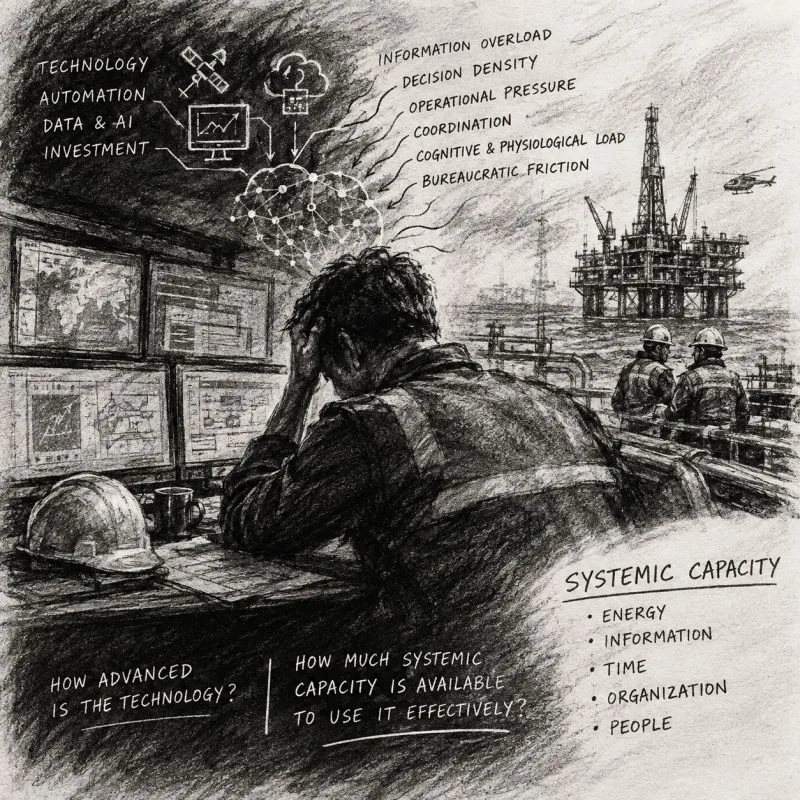
En Oil & Gas y otras operaciones complejas, más tecnología no garantiza mejores decisiones: esta pieza estudia la capacidad sistémica, lo que un sistema puede absorber y convertir en acción bajo presión.

NOTA-ECO-003 · Economía 5.0
Frankenstein y el petróleo: ¿por qué Venezuela vuelve a importar geopolíticamente?
Tercera entrega de la serie: tras el paso del capital a la IA y a la concentración financiera, llega el siguiente cuello de botella, el petróleo, y con él Venezuela vuelve al tablero geopolítico.