

Economía 5.0 · OSF-ECO-086
IEAbio: índice de energía biológica adaptativa
Por Carlos J. Pérez Pulido · ISHEA Institute ·
IEAbio mide cuánto pueden sostener personas, organizaciones y sociedades bajo la fricción acumulada del sistema: una lectura más allá del PIB de la capacidad real de actuar, innovar y adaptarse
Preprint — Manuscrito depositado en OSF. Sin revisión por pares.
Pieza original en inglés.
Project Description – IEAbio
The Adaptive Biological Energy Index (IEAbio) is a scientific framework designed to quantify the capacity of human systems—individuals, organizations, and societies—to sustain complex cognitive, social, and productive processes under environmental and systemic stress.
IEAbio integrates biological energy, knowledge, and investment against the accumulated friction in the system (social, bureaucratic, informational, and environmental). Unlike conventional economic indicators such as GDP, IEAbio measures the real capacity to act, innovate, and adapt, providing insights into systemic resilience, innovation potential, and risk of collapse.
Key features:
Interdisciplinary approach: Combines biology, thermodynamics, and systems theory.
Multi-level applicability: Individual, organizational, and national scales.
Reproducible metrics: Clear definitions of variables, data sources, and normalization methods.
Historical and contemporary validation: Demonstrates predictive capacity for both past civilizations and modern societies.
Open framework: Allows external researchers to reproduce calculations, test hypotheses, and contribute improvements.
Goal: To create a transparent, actionable, and scientifically grounded tool for understanding how energy availability and systemic friction shape human potential and societal outcomes.
IEAbio – Adaptive Biological Energy Index
Welcome to the IEAbio project on OSF.
This project aims to create a reproducible scientific framework for measuring the capacity of human systems to cope with external frictions, integrating biological, cognitive, and social variables.
📌 Purpose
- Provide a structured metric of adaptation and resilience.
- Allow comparisons across contexts (countries, cities, historical periods).
- Serve as an open research framework to validate hypotheses on energy, knowledge, investment, and external friction.
🗂 Project Structure
Model
- Conceptual explanation of all variables.
- Clear and visual IEAbio equation.
- Documentation of how to measure each variable.
Data
- Sample datasets (countries, cities).
- Sources and normalization notes.
- Reliable indicators (World Bank, WHO, V-Dem, etc.).
Validation
- Practical case studies: comparing different contexts.
- Historical evolution of IEAbio.
- Model limitations and assumptions.
Reproducibility
- Python and Excel scripts for automatic calculation.
- Templates ready to fill with real data.
References
- Studies, academic papers, and documentation cited.
⚙ How to Get Started
- Review the Model section to understand variables and equation.
- Check Data to see examples and indicator structure.
- Explore Validation to learn how to interpret IEAbio.
- Use Reproducibility to calculate your own indices.
- Add comments or suggestions in the wiki discussion page.
💡 Notes
- All variables are normalized to a 0–100 scale for comparability.
- IEAbio is presented as a reproducible framework, not a definitive judgment.
- Improvements, feedback, and external validations are welcome.
Project contact: ISHEAInstitute.org@gmail.com
IEAbio – Índice de Energía Adaptativa Biológica
Bienvenido al proyecto IEAbio en OSF.
Este proyecto tiene como objetivo crear un marco científico reproducible para medir la capacidad de sistemas humanos frente a fricciones externas, integrando variables biológicas, cognitivas y sociales.
📌 Propósito
- Proporcionar una métrica estructurada de adaptación y resiliencia.
- Permitir comparaciones entre contextos (países, ciudades, periodos históricos).
- Servir como marco de investigación abierta para validar hipótesis sobre energía, conocimiento, inversión y fricción externa.
🗂 Estructura del Proyecto
Modelo
- Explicación conceptual de variables.
- Ecuación IEAbio clara y visual.
- Documentación de cómo medir cada variable.
Datos
- Conjunto de datos de ejemplo (paises, ciudades).
- Fuentes y notas de normalización.
- Indicadores confiables (World Bank, OMS, V-Dem, etc.).
Validación
- Casos prácticos: comparación de contextos distintos.
- Evolución histórica de IEAbio.
- Límites y supuestos del modelo.
Reproducibilidad
- Scripts Python y Excel para cálculo automático.
- Plantillas listas para rellenar con datos reales.
Referencias
- Estudios, papers y documentación académica citada.
⚙ Cómo empezar
- Revisa la sección Modelo para entender variables y ecuación.
- Consulta Datos para ver ejemplos y estructura de indicadores.
- Explora Validación para aprender cómo interpretar IEAbio.
- Usa Reproducibilidad para calcular tus propios índices.
- Añade comentarios o sugerencias en la página de discusión del wiki.
💡 Notas
- Todas las variables están normalizadas a escala 0–100 para comparabilidad.
- IEAbio se presenta como un marco reproducible, no como un juicio definitivo.
- Las mejoras, comentarios y validaciones externas son bienvenidas.
Contacto del proyecto: ISHEAInstitute.org@gmail.com
IEAbio – Índice de Energía Adaptativa Biológica
Objetivo
Medir la capacidad de un sistema humano para sostener procesos complejos frente a fricción externa.
Variables
- Energía (E): biológica, cognitiva y metabólica disponible.
- Conocimiento (K): acumulación educativa y técnica.
- Inversión (I): recursos destinados a crecimiento productivo y social.
- ΔF (Fricción externa): barreras sociales, burocráticas, informacionales y ambientales.
- Suicidio: indicador estructural de colapso social extremo, usado como variable correctiva.
Ecuación
E × K × I
IEAbio = ------------ ΔF_total
Cómo usar
- Recolectar indicadores de E, K, I y ΔF.
- Normalizar variables a escala 0–100.
- Aplicar la ecuación.
- Comparar contextos (países, ciudades, periodos históricos).
IEAbio_OSF_Project/
│
├─ README.md
│ - Breve descripción del proyecto, objetivo de IEAbio, motivación.
│
├─ Modelo/
│ ├─ README_Modelo.md
│ │ - Explicación conceptual de cada variable (E, K, I, ΔF)
│ │ - Contexto y propósito del índice
│ ├─ IEAbio_equacion.png
│ │ - Visualización clara de la ecuación:
│ │
│ │ E × K × I
│ │ IEAbio = ------------
│ │ ΔF_total
│ └─ Documentacion_de_variables.md
│ - Cómo se mide cada variable con indicadores específicos
│
├─ Datos/
│ ├─ Datos_CoreSet_13_paises.csv
│ │ - Ejemplo de tabla:
│ │
│ │ Pais,E,K,I,DeltaF
│ │ A,80,75,90,50
│ │ B,60,70,85,65
│ ├─ Indicadores_fuentes.md
│ │ - Fuentes: World Bank, OECD, OMS, V-Dem, Edelman
│ └─ Notas_de_normalizacion.md
│ - Cómo se transforman variables a escala 0–100
│
├─ Validacion/
│ ├─ Caso_practico_paisA_vs_paisB.md
│ │ - Comparación paso a paso de dos contextos distintos
│ ├─ Evolucion_historica.md
│ │ - Ejemplo histórico de validación (ej. ciudades o países)
│ └─ Limitaciones_del_modelo.md
│ - Supuestos, sesgos y límites de IEAbio
│
├─ Reproducibilidad/
│ ├─ Script_calculo_IEAbio.ipynb
│ │ - Código Python para reproducir IEAbio a partir de datos
│ └─ Plantilla_excel_IEAbio.xlsx
│ - Hoja lista para insertar variables y calcular IEAbio automáticamente
│
└─ Referencias/
└─ Referencias_bibliograficas.md
- Estudios y papers citados
En la misma sala — Economía 5.0

NOTA-ECO-001 · Economía 5.0
¿Y si las variables con las que medimos el éxito de los países estuvieran al revés?
Durante décadas el progreso se ha medido con PIB, productividad, crecimiento y energía. Esta pieza plantea que esas variables podrían estar invertidas y pide repensar qué significa que un país prospere.
NOTA-ECO-002 · Economía 5.0
¿Por qué fallan los sistemas de alta ingeniería cuando la tecnología es más avanzada?
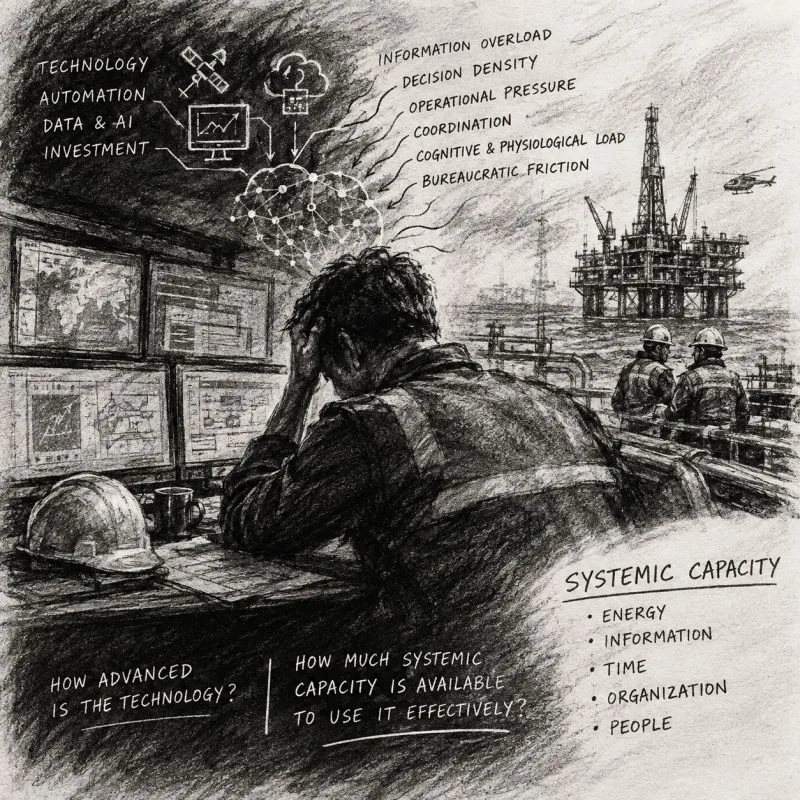
En Oil & Gas y otras operaciones complejas, más tecnología no garantiza mejores decisiones: esta pieza estudia la capacidad sistémica, lo que un sistema puede absorber y convertir en acción bajo presión.

NOTA-ECO-003 · Economía 5.0
Frankenstein y el petróleo: ¿por qué Venezuela vuelve a importar geopolíticamente?
Tercera entrega de la serie: tras el paso del capital a la IA y a la concentración financiera, llega el siguiente cuello de botella, el petróleo, y con él Venezuela vuelve al tablero geopolítico.