

Coherencia · OSF-COH-029
Índice de coherencia energética en los cristales de nieve
Por Carlos J. Pérez Pulido · ISHEA Institute ·
Un índice adimensional de coherencia (K) reúne cohesión reticular, energía superficial, términos térmicos y flujo de vapor para comprobar si placas, columnas y dendritas responden a regímenes energéticos distintos.
Preprint — Manuscrito depositado en OSF. Sin revisión por pares.
Pieza original en inglés.
Project Description
This project introduces a dimensionless energetic coherence index (K*) intended to organize measurable energy-density contributions governing snow crystal growth. The framework integrates lattice cohesion energy, surface free energy, thermal energy, dipolar interactions, environmental perturbations, and vapor flux.
The objective is to explore whether morphological transitions (plates, columns, dendrites) correlate with structured energetic regimes without modifying established crystallographic or surface-kinetic models.
The approach is quantitatively structured, dimensionally consistent, and experimentally testable. Laboratory replication protocols and statistical validation criteria are provided. Experimental confirmation remains pending.
Energetic Coherence Interpretation of Snow Crystal Morphology
The Energetic Coherence Interpretation of Snow Crystal Morphology is a conceptual framework proposed by C.J. Pérez Pulido (2026) within the ISHEA Institute research program. It presents an interpretive layer for understanding transitions in snow crystal morphology as mapped in the Nakaya diagram.
The framework does not replace established crystallographic or surface-kinetics models but proposes an integrative parameter intended to organize energetic contributions influencing crystal growth.
Background
Snow crystal morphology has been systematically studied since the work of Ukichiro Nakaya (1954), who mapped crystal habit as a function of temperature and water vapor supersaturation. Subsequent theoretical advances, particularly by Kenneth G. Libbrecht, explained morphological transitions using surface attachment kinetics and diffusion-limited growth theory.
Ice in its most common atmospheric form (Ice Ih) exhibits hexagonal symmetry due to the tetrahedral hydrogen-bond network of water molecules. Under varying thermodynamic conditions, crystals form plates, columns, needles, or dendritic structures.
Conceptual Framework
The coherence interpretation introduces a qualitative parameter K intended to integrate multiple energetic contributions:
Molecular cohesion energy of the hydrogen-bond lattice
Surface free energy
Thermal energy
Environmental perturbations
Dipolar interactions
Directional vapor flux associated with supersaturation
The parameter is dimensionless when normalized as energy densities and is proposed as an organizational index rather than an independent predictive model.
Interpretation of Morphological Transitions
Within this framework:
High K regimes correspond to stable dendritic growth
Intermediate K regimes correspond to plate or column formation
Low K regimes correspond to irregular or unstable growth
The persistence of sixfold symmetry is interpreted as reflecting a high-coherence configuration of the hydrogen-bond network in Ice Ih.
The model is presented as consistent with diffusion-limited aggregation theory and classical thermodynamics.
Relationship to Established Models
The coherence framework is explicitly described as complementary to:
Nakaya’s morphology diagram
Surface-kinetics models of crystal growth
Classical crystallography of ice Ih
Thermodynamic nucleation theory
It does not modify established physical laws but attempts to provide an integrative interpretive layer across scales.
Proposed Quantitative Development
The framework suggests that formalization would require:
Measurable lattice cohesion energy per unit volume
Surface free energy values for basal and prism faces
Boltzmann thermal energy scaling
Supersaturation gradient quantification
Environmental perturbation indexing
Experimental validation would involve controlled laboratory crystal growth with correlation between calculated coherence index values and observed morphology.
See Also
Snow crystal
Nakaya diagram
Ice Ih
Diffusion-limited aggregation
Fractal geometry
Surface kinetics
References
Nakaya, U. (1954). Snow Crystals: Natural and Artificial.
Libbrecht, K. G. (2005, 2017). Surface kinetics and snow crystal growth.
Petrenko & Whitworth (1999). Physics of Ice.
Debenedetti (1996). Metastable Liquids.
Mandelbrot (1983). The Fractal Geometry of Nature.
En la misma sala — Coherencia

NOTA-COH-001 · Coherencia
Narrativa no es confianza: sin confianza, la narrativa pierde fuerza
Una advertencia al mundo corporativo y político: el storytelling no compensa una arquitectura débil. Sin la confianza estructural que la sostenga, cualquier narrativa pierde fuerza.
NOTA-COH-002 · Coherencia
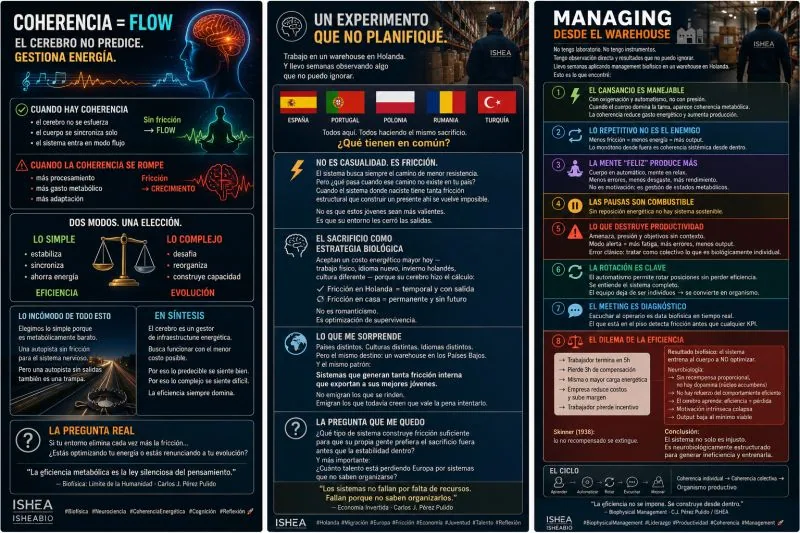
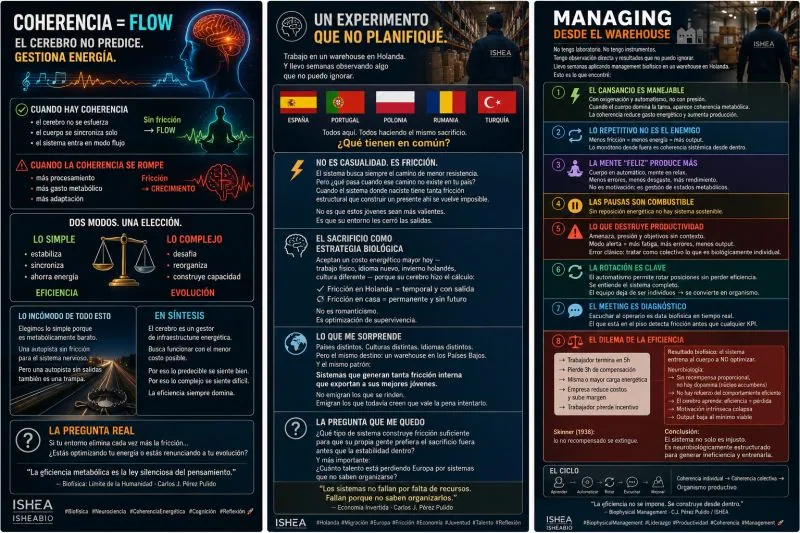
Managing desde el warehouse: management biofísico sin laboratorio (3/4)
Sin instrumentos ni laboratorio, solo observación directa: semanas aplicando management biofísico en una nave logística y unos resultados difíciles de ignorar.
NOTA-COH-003 · Coherencia
La respuesta no es cultural, es biológica (1/4)
El cuerpo sigue el ritmo antes de que la mente decida. Punto de partida de la serie: la respuesta al entorno no se explica por cultura, sino por biología.