

Economía 5.0 · NOTA-ECO-112
La Wreck-It Policy en la Estrategia de Seguridad Nacional de 2025
Por Carlos J. Pérez Pulido · ISHEA Institute ·
La Estrategia de Seguridad Nacional de Estados Unidos de 2025 valida por escrito el marco de la Wreck-It Policy. Ya no es una hipótesis de analista: es doctrina oficial documentada.
Nota de divulgación — Escrito breve publicado en abierto. Pensamiento en curso, no resultado.
Pieza original en inglés.
The "Wreck-It Policy": The 2025 NSS Confirms It
This is not speculation. The official U.S. National Security Strategy explicitly validates this framework.**
📄 [Official Document](https://lnkd.in/g7584bgw)
The United States is no longer trying to persuade, reform, or negotiate with certain regimes. It is **neutralizing them through induced systemic breakdown.**
The 2025 NSS proves it—in writing.
🔑 What the NSS explicitly confirms
1️⃣ The "Trump Corollary" to Monroe Doctrine
NSS, page 15:
> "We will assert and enforce a 'Trump Corollary' to the Monroe Doctrine... to deny non-Hemispheric competitors the ability to position forces or own strategically vital assets in our Hemisphere."*
**This is official doctrine.**
2️⃣ Targeting outlaw structures, not nations
NSS, page 16:
> *"Enlist regional champions to **neutralize cartels**, stop illegal migration, and **wind down adversarial outside influence** from control of military installations, ports, and key infrastructure."*
*Goal:*Eliminate criminal networks and foreign influence, not destroy countries.
3️⃣ Forcing strategic autonomy: "Burden-Shifting"**
NSS, page 12:
> Burden-Sharing and Burden-Shifting– The days of the United States propping up the entire world order are over. **Allies must assume primary responsibility for their regions.**"*
Examples:
- NATO: 5% GDP defense spending
- Hemisphere: Regional partners "neutralize cartels" (p.16)
- Asia: "Allies must step up and do much more" (p.24)
*Message:*"We provide capabilities, you assume responsibility."
4️⃣ Hemispheric security comes FIRST**
The NSS lists regional priorities in order (p.5, 15):
#1 Western Hemisphere – before Asia, Europe, Middle East
> *"The Western Hemisphere must remain **free of hostile foreign incursion**... This is a **condition of our security and prosperity.**"*
*Why?* Secure the backyard before global competition with China/Russia.
5️⃣ Authorization of lethal force
NSS, page 16:
> *"Targeted deployments **including where necessary the use of lethal force** to defeat cartels."
This moves beyond sanctions to **kinetic operations**.
6️⃣ The global pattern**
Burden-shifting applies worldwide:
- **Europe:** "Take primary responsibility for defense" (p.26)
- **Middle East:** "Days of dominating U.S. policy are over" (p.27)
- **Africa:** "Transition from aid to investment" (p.29)
📌 The grand strategy
**Core thesis (pp. 5, 12, 15):**
> *"Secure hemisphere from adversarial influence + force allied autonomy = resource concentration for China/Russia competition."*
Not elegant. Not humanitarian. *But now official U.S. policy.**
📄 **Key sections:** pp.15-18 (Hemisphere), p.12 (Burden-Shifting), pp.19-24 (Asia)
#VenezuelaPower #DonroePolicy
#NSS2025 #TrumpCorollary #MonroeDoctrine #USForeignPolicy #BurdenShifting #LatinAmerica #Venezuela #China #ishea #GreatPowerCompetition #NationalSecurity #Geopolitics
En la misma sala — Economía 5.0
SN-ECO-001 · Economía 5.0
La economía circular debe empezar en el diseño: una perspectiva ISHEA sobre Economy 5.0
El próximo paso de la economía circular no es recuperar más, sino diseñar para perder menos. Economy 5.0 une gemelos digitales, gestión biofísica, diseño circular y finanzas sostenibles para preservar el valor sistémico.
SN-ECO-002 · Economía 5.0
Economy 5.0: más allá de la energía y el carbono, hacia la coherencia sistémica
La propuesta de ISHEA para Economy 5.0: un marco económico centrado en las personas que, más allá de la energía y el carbono, examina la coherencia sistémica, las capacidades humanas y la resiliencia.
OSF-ECO-003 · Economía 5.0
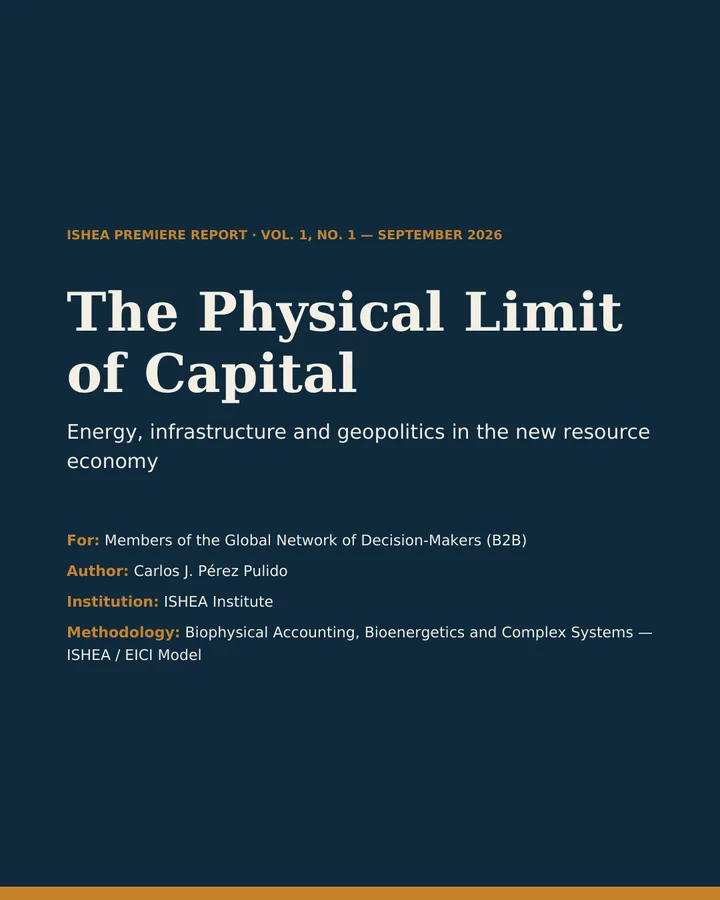
El límite físico del capital: energía, infraestructura y geopolítica
Primer informe del ISHEA Institute: analiza cómo la infraestructura de IA, las cadenas de energía y minerales y los corredores marítimos fijan cuánto capital financiero puede convertirse en economía real.