

Coherencia · NOTA-COH-009
Las raíces de la racionalidad: ¿qué hace posible decidir de forma adaptativa?
Por Carlos J. Pérez Pulido · ISHEA Institute ·
Lectura del preprint de Rahul Bhui y colegas (MIT, Brown, UCL, Columbia, NYU), que rastrea el origen de la decisión adaptativa y sus implicaciones para el estudio de la cognición.
Nota de divulgación — Escrito breve publicado en abierto. Pensamiento en curso, no resultado.
Pieza original en inglés.
What makes adaptive decision-making possible?
That is the central question explored by Rahul Bhui and colleagues (MIT, Brown, UCL, Columbia, NYU) in their 2026 preprint *The Roots of Rationality*.
The paper identifies six adaptive dynamics operating across timescales:
→ Thinking
→ Learning
→ Development
→ Market selection
→ Cultural evolution
→ Genetic evolution
What makes the work particularly important is that the authors openly recognize a core unresolved problem:
"without clear constraints, everything could be explained as optimal in some form."
That challenge is precisely where the ISHEA EICI framework enters the discussion.
Rather than treating adaptation purely as an optimization problem, EICI approaches it as a coherence problem under energetic, informational, and frictional constraints:
EICI = E × I / F
Where:
— E = available energy / resources
— I = informational coherence
— F = frictional resistance
The framework proposes three system regimes:
Δ+1 → coherence
Δ=0 → reorganization threshold
Δ−1 → collapse
Importantly, EICI does not attempt to define universal optimality.
Instead, it measures whether adaptive coherence itself can be maintained across environments and timescales — a distinction directly connected to the No Free Lunch limitations discussed by Bhui et al.
In this sense:
Bhui et al. provide the adaptive taxonomy.
EICI proposes a formal coherence calculus.
Not competing frameworks.
Potentially complementary ones.
Position paper: https://lnkd.in/dtXA9vWA
K-Model cluster: https://lnkd.in/dY8xZmGZ
DOI Trends paper: https://lnkd.in/dM78DxC2
#ComplexSystems #AdaptiveDecisionMaking #CognitiveScience #SystemsTheory #Coherence #ISHEA #OpenScience
---
En la misma sala — Coherencia
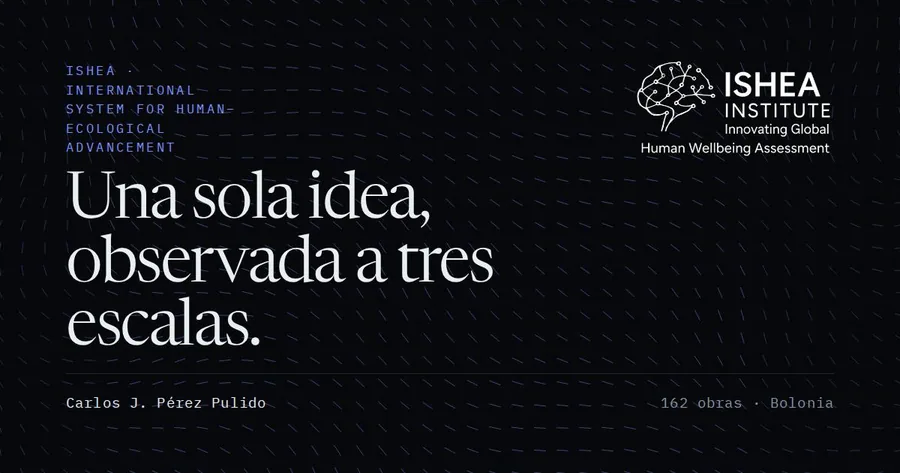
NOTA-COH-001 · Coherencia
Narrativa no es confianza: sin confianza, la narrativa pierde fuerza
Una advertencia al mundo corporativo y político: el storytelling no compensa una arquitectura débil. Sin la confianza estructural que la sostenga, cualquier narrativa pierde fuerza.
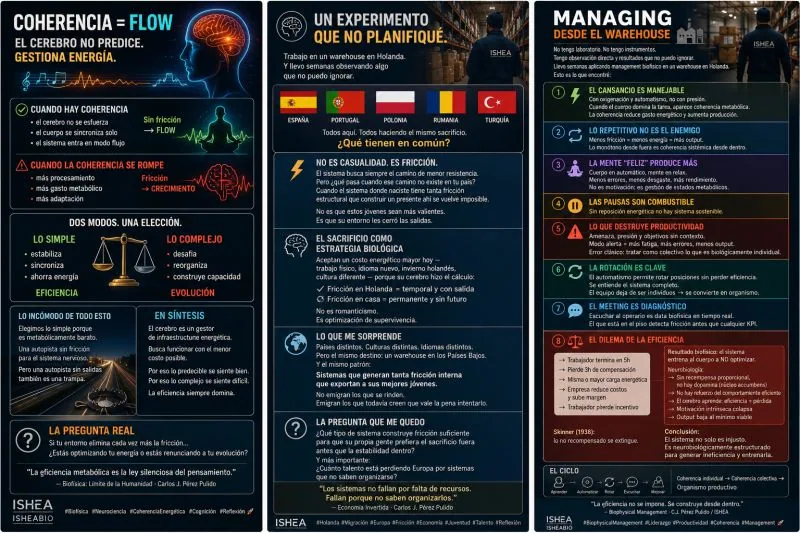
NOTA-COH-002 · Coherencia
Managing desde el warehouse: management biofísico sin laboratorio (3/4)
Sin instrumentos ni laboratorio, solo observación directa: semanas aplicando management biofísico en una nave logística y unos resultados difíciles de ignorar.
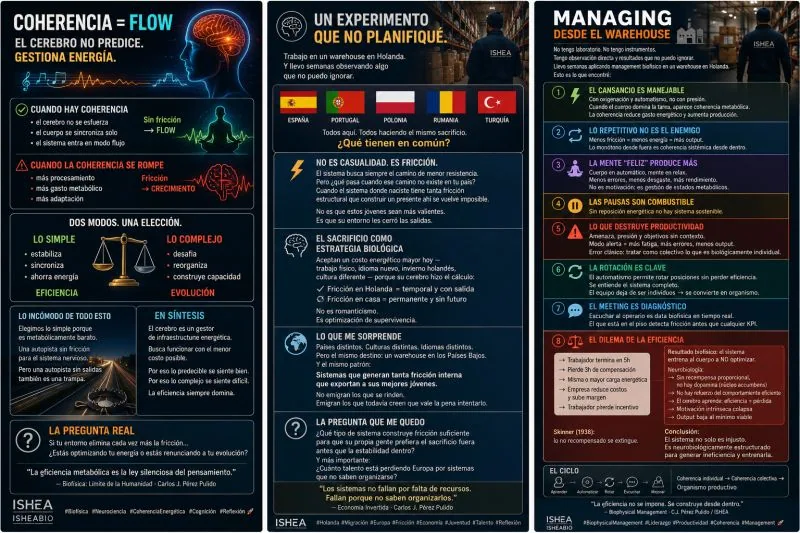
NOTA-COH-003 · Coherencia
La respuesta no es cultural, es biológica (1/4)
El cuerpo sigue el ritmo antes de que la mente decida. Punto de partida de la serie: la respuesta al entorno no se explica por cultura, sino por biología.