

Bioenergética · OSF-BIO-065
Restricción energética celular como principio unificador del envejecimiento: marco ISHEA Δ±1
Por Carlos J. Pérez Pulido · ISHEA Institute ·
Propone el envejecimiento como una transición entre tres regímenes de estabilidad —coherencia, transición y colapso entrópico— determinados por el equilibrio entre energía disponible y demanda de reparación.
Preprint — Manuscrito depositado en OSF. Sin revisión por pares.
Pieza original en inglés.
This manuscript proposes the ISHEA Δ±1 Coherence Framework as a theoretical perspective on aging, in which cellular biological state is approximated by a Coherence Index (CI = K / R+T), defined as the ratio between energetic availability (ATP production and NAD⁺ bioavailability) and repair–detoxification demand (oxidative stress burden, autophagic load, and proteostatic pressure). We propose that aging emerges as a phase transition across three stability regimes: a coherent state (Δ+1), a transitional regime (Δ0), and an entropic collapse state (Δ−1).
The CI is introduced as a latent systems-level variable, not a validated biomarker, approximating the balance between energy supply and maintenance demand. The framework generates 10 falsifiable predictions across cellular, neural, social, and intervention domains, and is positioned as complementary to established aging frameworks including the Hallmarks of Aging (López-Otín et al., 2023) and the Information Theory of Aging (Sinclair, 2019).
Empirical grounding is drawn from published biomarker data (Massudi 2012; Short 2005; Cawthon 2003; Wyss-Coray 2019) and from independent observations presented at the Brain Aging and Neurodegeneration Conference (Nature Korea, 2025), including astrocytic metabolic support (T variable), APOE4 as a constraint sensitivity modifier, and MAO-B/GABA as a predicted feedback brake in the Δ0→Δ−1 transition.
This work is a theoretical perspective intended for empirical testing. No clinical recommendations are made or implied.
Keywords:
bioenergetics; aging; NAD⁺; ATP; coherence; constraint; phase transition; ISHEA; falsifiable hypothesis; systems biology; neurodegeneration; telomeres; proteostasis
🧬 ISHEA Δ±1 Coherence Framework — OSF Project Wiki
Overview
The ISHEA Δ±1 Coherence Framework proposes a unifying systems-level model of aging based on cellular energetic constraints. Rather than treating aging as a collection of independent processes, this framework integrates metabolic, redox, and informational dynamics into a single measurable construct: the Coherence Index (CI).
The CI is defined as:
CI = K / (R + T)
Where:
K = Energetic supply and coherence (Level I: redox regulation; Level II: ATP execution)
R = Repair, detoxification, and systemic demand
T = Entropic and environmental stressors
This formulation captures aging as a balance between energetic capacity and biological demand, rather than a unidirectional decline.
Conceptual Framework
Two-Level Bioenergetic Hierarchy
Level I (K1): Redox and informational coherence (NAD⁺, ROS signaling, metabolic regulation)
Level II (K2): Energetic execution capacity (ATP production and mitochondrial output)
The model predicts that:
Aging is redox-limited, not ATP-limited
This prediction is supported by global sensitivity analysis showing Level I dominance over Level II (~154×).
Phase Dynamics (Δ±1 Model)
Aging is represented as a phase transition across three regimes:
Regime CI State Interpretation
Δ+1 CI > 0 High coherence, adaptive capacity
Δ0 CI ≈ 0 Transition point, maximum plasticity
Δ−1 CI < 0 Systemic decline, high demand burden
The model predicts a critical transition around ~40 years, where system variability peaks and intervention potential is maximized.
Empirical Cross-Validation
The framework has been evaluated using published data from the UK Biobank (n≈250,000 participants).
Key Findings
26/26 biomarkers (100%) correctly classified by hazard ratio direction
Pro-aging biomarkers (HR>1) → mapped to R (demand)
Anti-aging biomarkers (HR<1) → mapped to K (coherence)
GlycA (HR=1.25), the strongest mortality predictor, maps to R (r≈−0.957 with CI)
CI extended vs. original: r≈0.99 convergence
These results support the structural validity of the framework.
Computational Validation
Sensitivity Analysis (Sobol)
Level I / Level II ratio ≈ 154×
Indicates dominance of redox coherence over ATP capacity
Monte Carlo Simulation
Maximum uncertainty observed at Δ0 (~age 40)
Consistent with phase transition theory
Intervention Insights (In Silico)
Simulation scenarios suggest:
NAD⁺ restoration (Level I) → strongest impact near Δ0
ATP enhancement alone (Level II) → limited effect
Chronic stress → accelerates transition to Δ−1
This supports a hierarchical intervention strategy, prioritizing coherence restoration over isolated energy boosting.
Scope and Limitations
The CI is currently a theoretical composite variable
No prospective cohort has yet measured CI directly
Validation is structural and predictive, not causal
Biomarker classification, while pre-defined, may require independent external validation
Future Work
Planned validation pathway includes:
-
Cross-sectional calibration of CI components in a single cohort
-
Longitudinal validation of CI vs. aging outcomes
-
Intervention trials targeting Level I vs. Level II mechanisms
-
External blinded classification of biomarkers
Reproducibility and Data
All computational analyses are available in this repository, including:
CI calculation scripts (Python)
Sobol sensitivity analysis
Monte Carlo simulations
UK Biobank cross-validation tables
Citation
Pérez Pulido, C.J. (2025).
ISHEA Δ±1 Coherence Framework: A Systems-Level Model of Cellular Energetic Constraint in Aging.
DOI: https://doi.org/10.17605/OSF.IO/RMAFU
Contact
Carlos J. Pérez Pulido
ISHEA Institute
En la misma sala — Bioenergética
NOTA-BIO-001 · Bioenergética
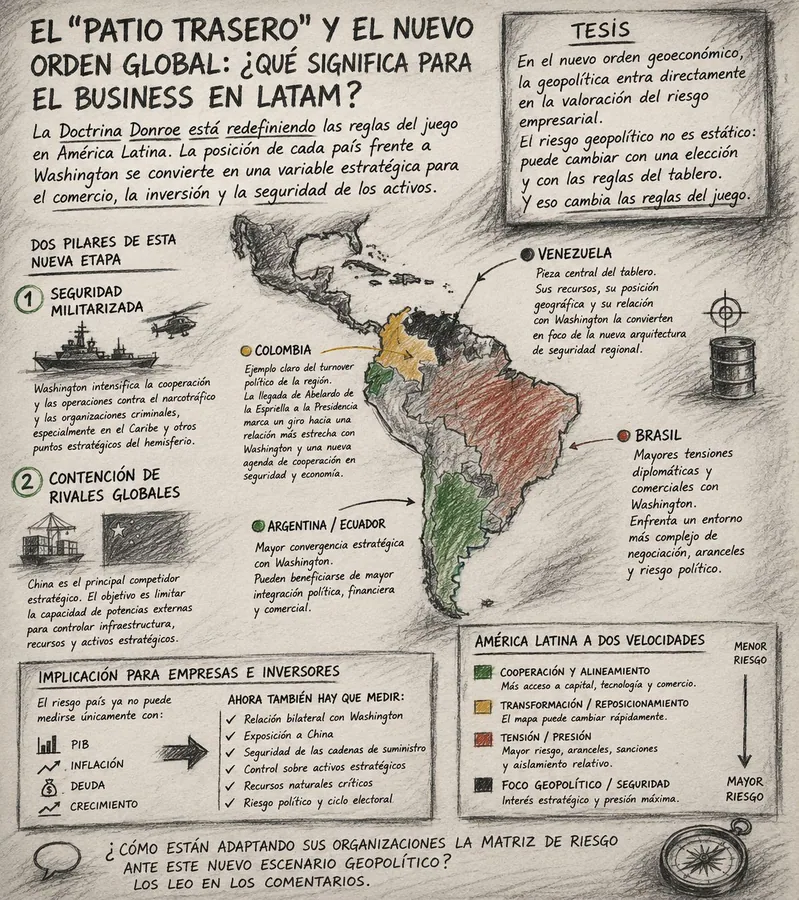
El «patio trasero» y el nuevo orden global: ¿qué significa para el business plan en Latam?
Un análisis de cómo la llamada Doctrina Donroe ha convertido en política explícita la metáfora del «patio trasero» y de lo que ese giro supone para cualquier plan de negocio en América Latina.

NOTA-BIO-002 · Bioenergética
¿Por qué los trabajadores más eficientes se vuelven más lentos a mitad de la jornada?
Para directores de operaciones y gerentes de logística: una lectura bioenergética de por qué los mejores trabajadores pierden productividad a mitad de jornada, un patrón que muchos ven y pocos explican.

NOTA-BIO-003 · Bioenergética
¿Amenaza u oportunidad? La inteligencia artificial y nuestra capacidad creativa
Frente al llamamiento de León XIV a «desarmar la IA», esta pieza sostiene que el riesgo no está en la tecnología, sino en el sistema humano que la usa: bien diseñada, puede liberar capacidad creativa.