

Coerenza · OSF-COH-024
Coerenza energetico-informazionale: criterio termodinamico per la scelta di esopianeti
Di Carlos J. Pérez Pulido · ISHEA Institute ·
Ordina i mondi candidati per il telescopio spaziale Nancy Grace Roman tramite l'indice EICI, che pesa energia stellare, integrità planetaria e attrito entropico invece della sola distanza orbitale.
Preprint — Manoscritto depositato su OSF. Senza revisione paritaria.
Opera originale in inglese.
Project Description
This project introduces the Energetic–Informational Coherence framework as a thermodynamic approach to exoplanet prioritization. The model defines planetary viability as an emergent balance between three measurable dimensions: available stellar energy (E), planetary structural integrity (I), and environmental variability or entropic friction (F).
The framework formalizes this relationship through the Energy–Integrity Coherence Index (EICI), which provides a dimensionless metric for ranking planetary systems according to their capacity to sustain organized complexity. Unlike the classical habitable zone (HZ), which is based primarily on orbital distance and liquid water constraints, EICI incorporates stability, energy distribution, and environmental dynamics into a unified criterion.
The approach is designed to be compatible with large-scale observational datasets, particularly those expected from the Nancy Grace Roman Space Telescope. Using photometric, orbital, and population-level data obtained through the Wide Field Instrument (WFI), key components of the EICI can be estimated, enabling statistical prioritization of exoplanet targets.
Preliminary cross-domain analysis suggests that systems capable of sustaining organized complexity occupy a regime of high energetic–informational coherence, while low-coherence regimes are associated with instability. When applied to planetary systems, this implies that exoplanets with higher inferred EICI values may exhibit greater atmospheric stability and a higher likelihood of retaining conditions compatible with biosignature detection.
This project provides a thermodynamic complement to existing habitability frameworks and proposes a scalable methodology for target selection in next-generation exoplanet surveys. All conceptual models, parameter definitions, and computational approaches are designed to support reproducibility and future empirical validation.
Title
Energetic–Informational Coherence as a Thermodynamic Criterion for Exoplanet Target Prioritization with the Nancy Grace Roman Space Telescope
Author
Pérez Pulido, C.J.
ISHEA — Institute for Systems Health and Emergent Architecture
Abstract
The classical habitable zone (HZ) defines orbital regions where liquid water may exist, but it does not fully capture the thermodynamic conditions required for the emergence and persistence of organized complexity.
We propose an Energetic–Informational Coherence framework as a complementary criterion for exoplanet prioritization. The framework introduces the Energy–Integrity Coherence Index (EICI), which integrates three measurable dimensions: available stellar energy, planetary structural integrity (including atmospheric retention), and environmental variability.
Preliminary cross-domain analysis suggests that systems capable of sustaining organized complexity occupy a regime of high energetic–informational coherence, while low-coherence regimes are associated with instability or collapse. Applying this formulation to planetary systems enables a physically grounded ranking of targets beyond classical orbital habitability.
The Nancy Grace Roman Space Telescope, particularly through its Wide Field Instrument (WFI), will provide large-scale photometric and microlensing datasets capable of constraining key EICI components, including stellar irradiation, orbital stability, and population-level exoplanet demographics.
We hypothesize that, within Roman-detected exoplanet populations, targets exhibiting higher inferred coherence values will show an increased probability of retaining stable atmospheres and, in follow-up observations, a higher likelihood of detectable biosignature candidates.
This framework provides a thermodynamic complement to existing habitability metrics and offers a scalable approach for prioritizing targets in next-generation exoplanet surveys.
Keywords
exoplanets · habitability · biosignatures · thermodynamics · Roman Space Telescope · exoplanet demographics · target prioritization
Conference tracks
Exoplanet demographics and atmospheric characterization
New results and emerging questions enabled by Roman
Presentation preference
Oral or Poster
Nella stessa sala — Coerenza
NOTA-COH-001 · Coerenza
La narrativa non è fiducia: senza fiducia, la narrativa perde forza
Un monito al mondo aziendale e politico: lo storytelling non può compensare un'architettura debole. Senza una fiducia strutturale che la sostenga, qualsiasi narrativa perde forza.
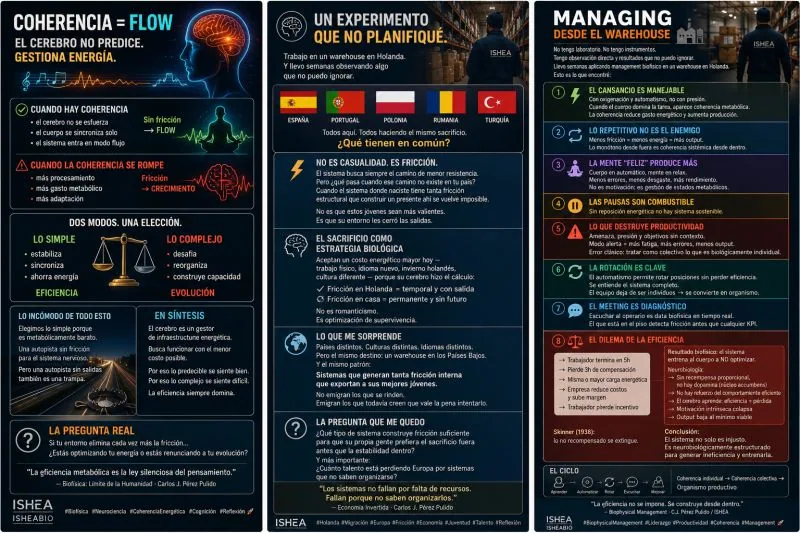
NOTA-COH-002 · Coerenza
Managing dal magazzino: management biofisico senza laboratorio (3/4)
Senza strumenti né laboratorio, solo osservazione diretta: settimane di management biofisico applicato in un magazzino logistico, con risultati difficili da ignorare.
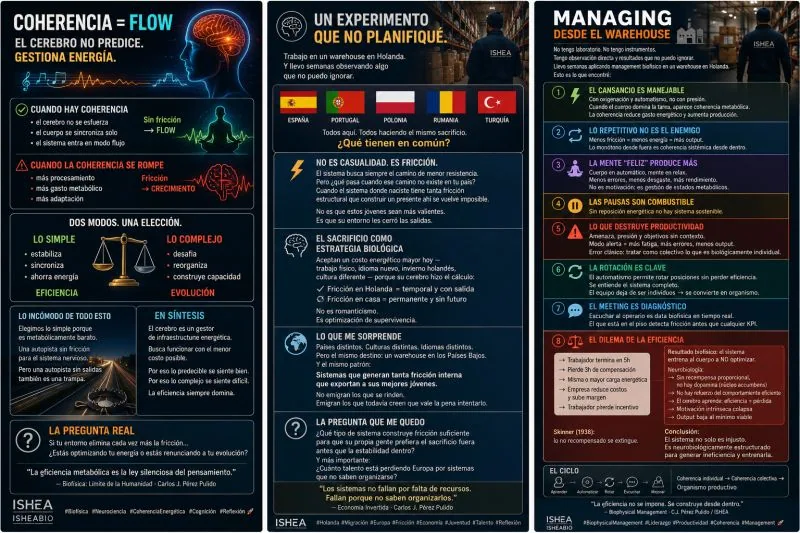
NOTA-COH-003 · Coerenza
La risposta non è culturale, è biologica (1/4)
Il corpo segue il ritmo prima che la mente decida. Punto di partenza della serie: la risposta all'ambiente non si spiega con la cultura, ma con la biologia.