

Sistemi planetari · SN-PLA-003
Integrazione dei flussi energetici planetari, cicli solari e dinamiche dei biosistemi
Di Carlos J. Pérez Pulido · ISHEA Institute ·
L'indice di flusso energetico planetario collega cicli solari, chimica stratosferica e bioenergetica nel quadro HALO, offrendo un ponte riproducibile tra scienza planetaria e biologica
Comunità scientifica — Pubblicato su Springer Nature Communities: divulgazione tra pari, senza revisione formale.
Opera originale in inglese.
Integrating Planetary Energy Flows, Solar Cycles, and Biosystem Dynamics
Perez Pulido, C.J. · ISHEA Institute · Nature Communities Post · February 2026
DOI: 10.17605/OSF.IO/GY83R
ISHEA Institute – Universal Coherence Division
The Question
How do solar energetic cycles propagate through the planetary system — from the magnetosphere through the stratosphere to biological energy systems — and can a unified index track this cascade?
The Gleissberg Solar Cycle (~80–100 year periodicity) is currently in an elevated phase. Solar Cycle 25 shows higher-than-predicted activity. This sustained energetic perturbation affects the planetary system at all scales, from magnetospheric particle flux to stratospheric chemistry.
The Halo Zone framework bridges these scales using the Planetary Energy Flow Index (PEFI) as an integrative metric.
The Halo Zone Framework
The Halo Zone is the analytical layer connecting planetary-scale energy monitoring to biosystem-level dynamics. It integrates four classes of publicly available satellite data:
| Layer | Variables | Sources |
|---|---|---|
| Space weather | Proton flux (>35, >70, >140 MeV), Electron flux (>30, >100, >300 keV) | NOAA-POES, GOES, CSES |
| Stratospheric chemistry | O3, NOx, HOx concentrations by altitude | Aura/MLS, OMPS |
| Atmospheric dynamics | Stratospheric temperature, jet stream velocity | ERA5 Reanalysis |
| Biosystem response | Mitochondrial ATP flux, O2 consumption, proton gradient | MIT OpenCell, Human Protein Atlas, NCBI |
The total energetic perturbation is expressed as:
\Delta E_\text{total} = \Delta E_\text{part} + \Delta E_\text{thermal} + \Delta E_\text{chem} + \Delta E_\text{kin}
Transparency: PEFI applies internal weights to these components. Weights are proprietary, but all input variables, formulas, and raw datasets are fully public and replicable up to the weighting stage.
What the Data Shows
- Proton flux dominates — consistently
Sensitivity analysis (+-10% to +-20%) places proton flux as the dominant driver of PEFI at 48% sensitivity. Electron flux is second at 28%.
| Variable | Sensitivity (% ΔPEFI per % change) |
|---|---|
| Proton Flux (>35 MeV) | 48% |
| Electron Flux | 28% |
| O3 Concentration | 15% |
| Jet Stream Velocity | 9% |
- The South Atlantic Anomaly (SAA) is contracting
- 2019: 7.25 × 10⁶ km²
- 2024: 6.80 × 10⁶ km²
-
Δ: -0.45 × 10⁶ km² over 5 years
This is consistent with ongoing geomagnetic evolution during Solar Cycle 25.
2. Stratospheric chemistry responds to particle flux -
Electron flux >300 keV correlates with Δ−1 events: stratospheric warmings, jet stream undulations, Arctic air descents.
- O3 depletion: −15%; NOx increase: +10%
-
Supports literature on energetic particle precipitation effects (Sinnhuber et al., 2012).
3. Exploratory bioenergetic correlation -
BioFlow_index integrates normalized mitochondrial ATP flux, O2 consumption, and proton gradient.
- Shows co-variation with PEFI across 2019–2024.
- Hypothesis-generating; causal direction not established.
Why This Matters
- Atmospheric science: PEFI could complement dynamical models for extreme event detection.
- Biology & medicine: Planetary energetic cycles might modulate cellular energy efficiency; timing interventions with high-coherence periods is testable.
- Planetary management: Interventions should work with natural energy flows, not against them.
The Gleissberg Cycle elevated phase provides a ~50-year window of increased solar energy. The question: restoration or suppression?
Open Questions for the Community
- Which observational proxies best capture energetic particle precipitation effects on stratospheric ozone?
- Can the BioFlow-PEFI correlation be replicated using alternative normalization protocols?
- How does the Halo Zone framework compare to planetary boundary frameworks?
- What prospective validation design is most convincing for the biosystem correlation?
Next Steps
- Prospective validation of PEFI during Solar Cycle 25 peak (2025–2027)
- Independent replication of BioFlow-PEFI correlation using public datasets
- Integration with Vortex prediction framework (DOI)
- Extension to ecosystem respiration data (FLUXNET) for planetary-scale bioenergetic analysis
Resources
- Main paper: DOI 10.17605/OSF.IO/GY83R
- Parent project (Gleissberg Cycle): DOI 10.17605/OSF.IO/7YAV2
- Related – Polar Vortex framework: DOI 10.17605/OSF.IO/NV8ZW
- ISHEA program overview: DOI 10.17605/OSF.IO/JBNGT
Perez Pulido, C.J. · ISHEA Institute · February 2026
DOI: 10.17605/OSF.IO/GY83R
isheainstitute.org@gmail.com
Nella stessa sala — Sistemi planetari
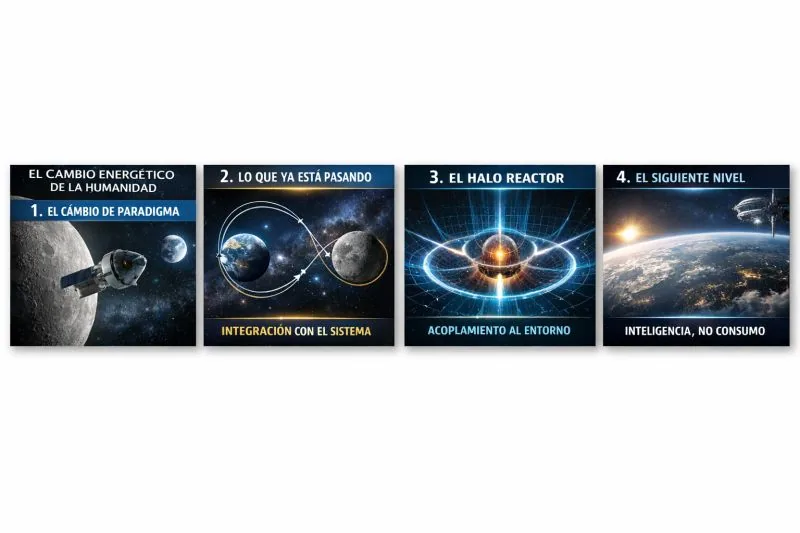
NOTA-PLA-001 · Sistemi planetari
3/4. L'HALO Reactor non è un reattore
Terza parte della serie: l'HALO Reactor non brucia né consuma combustibile. Il testo smonta l'idea classica di reattore per descrivere un sistema che organizza l'energia invece di consumarla.
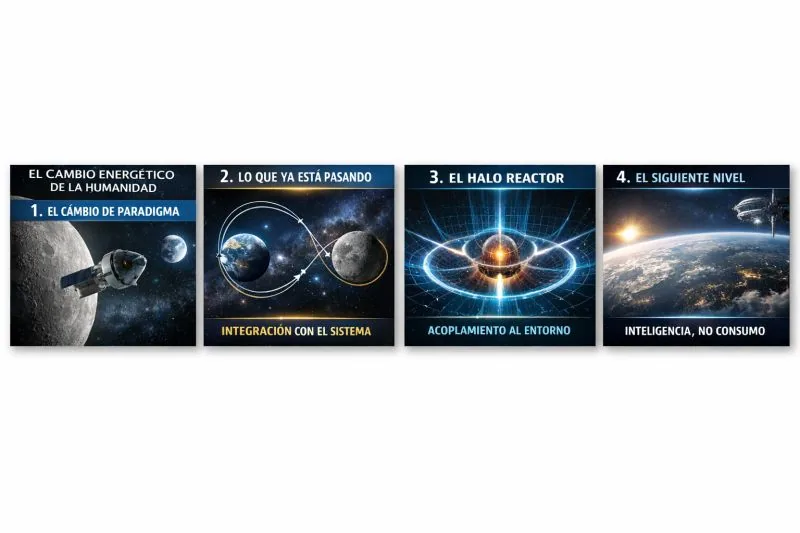
NOTA-PLA-002 · Sistemi planetari
Energia coerente: da Artemis a HALO
Non è una storia sui razzi, ma sul principio invisibile che la natura usa per sostenere i sistemi complessi e che oggi ridefinisce la progettazione di missioni e macchine.

SN-PLA-004 · Sistemi planetari
Evidenza empirica della formazione di peptidi guidata dall'energia
L'energia diretta induce la formazione di peptidi dalla glicina in condizioni interplanetarie, un sostegno empirico all'accoppiamento energetico universale e all'auto-organizzazione molecolare (quadro ECU).