

Economia 5.0 · SN-ECO-001
L'economia circolare deve partire dalla progettazione: una prospettiva ISHEA sull'Economy 5.0
Di Carlos J. Pérez Pulido · ISHEA Institute ·
L'economia circolare non deve solo recuperare di più, ma progettare per perdere meno. L'Economy 5.0 unisce gemelli digitali, gestione biofisica, design circolare e finanza sostenibile per tutelare il valore sistemico.
Comunità scientifica — Pubblicato su Springer Nature Communities: divulgazione tra pari, senza revisione formale.
Opera originale in inglese.
Circular Economy Must Begin at the Design Stage: An ISHEA Perspective on Economy 5.0
Subtitle: Digital Twins, Biophysical Management and the Challenge of Preserving Systemic Value
Author: Carlos J. Pérez Pulido
Affiliation: ISHEA Institute — International System for Human–Ecological Advancement
The next step in circular economy is not simply recovering more. It is designing to lose less.
Circular economy has changed the way industries think about resources, waste and production. Yet a fundamental question remains: why do we continue to treat the recovery of lost value as the central objective, rather than preventing avoidable losses at the design stage?
A product that cannot be repaired, a component that cannot be separated, or an industrial process that consumes unnecessary energy creates constraints long before waste management begins. Recycling can recover part of the material value, but it cannot always restore the energy, functionality and resources already invested.
This suggests a shift in perspective: circularity should not begin when a product becomes waste. It should begin when the product and the system around it are designed.
Within the Economy 5.0 framework proposed by ISHEA Institute, this question connects three dimensions that are often examined separately: material and energy flows, human functional capacity, and the information systems used to make economic decisions.
Designing for lower avoidable losses
Thermodynamics establishes physical limits on the transformation and recovery of materials and energy. Circular systems cannot eliminate these limits. Nor can they reverse every form of material degradation.
However, design decisions can influence how much value is preserved throughout a product's life cycle.
Durability, repairability, modularity, disassembly and reuse can reduce the need for unnecessary transformation. In some applications, retaining a component's original function may preserve more value than processing it into a secondary material.
Research on digital twinning and circularity has explored how digital representations can help quantify material, energy and exergy flows, while work on design-led reuse highlights the potential of preserving existing value before resorting to recycling.
This leads to a concept proposed here by ISHEA:
Entropy-Informed Circular Design.
It describes a design-oriented approach that uses information about material and energy flows to reduce avoidable losses, material dispersion and functional degradation.
The expression must be used carefully. It is not a claim that economic systems can eliminate thermodynamic entropy. It is a proposed design principle that requires operational definitions and measurable indicators.
The practical question is straightforward: can we design products and industrial systems that preserve more functionality, require fewer transformations and make high-quality recovery easier?
Digital Twins: from monitoring to anticipation
Digital Twins offer an important technological opportunity.
By representing physical assets, products and processes through digital models connected to operational information, they can help decision-makers compare alternative configurations before implementing them.
In circular applications, this may include evaluating:
- Product durability and maintenance requirements.
- Component replacement and disassembly.
- Material composition and recovery potential.
- Energy consumption across the life cycle.
- Reuse and remanufacturing scenarios.
- Logistics and resource allocation.
The value of a Digital Twin is not simply that it makes a system visible. Its potential lies in helping organizations anticipate the consequences of decisions.
Nevertheless, digitalisation is not automatically sustainable. Sensors, computing infrastructure, data centres, software maintenance and cybersecurity all have costs and environmental implications. The complete life cycle must be considered.
The human dimension: Biophysical Management
There is another limitation in conventional approaches to efficiency: productive systems depend on human capacities that cannot be treated as unlimited.
Work intensity, fatigue, recovery, ergonomics, environmental conditions and task organisation can influence operational continuity and safety.
The ISHEA concept of Biophysical Management (BPM) examines how these human and biological constraints interact with productive environments.
Its central proposition is that efficiency should not be evaluated exclusively through output, speed or unit cost. It should also consider the conditions that allow people to sustain work safely and effectively.
Automation may reduce certain physical demands, but it can also introduce new risks involving supervision, coordination, system failures and human-machine interaction.
The relevant question is therefore not simply how much work can be automated, but how technology and organisational design can improve the relationship between productivity, safety and human functional capacity.
This is particularly important when circular strategies introduce additional sorting, handling, disassembly or recovery activities. A process may reduce material waste while increasing physical or cognitive demands on workers. A systemic evaluation should make that trade-off visible.
From ESG indicators to systemic sustainability
Environmental, Social and Governance (ESG) criteria have expanded the information available to investors and organisations. They provide an important structure for assessing environmental and social performance and governance practices.
However, indicators do not automatically reveal how decisions interact across an entire system.
A local environmental improvement may shift costs to suppliers, workers, communities or other stages of a supply chain.
To examine these interdependencies, ISHEA proposes ESS — Systemic Sustainability Strategies as a complementary conceptual framework.
ESS is not presented as a replacement for ESG, a certification or an established reporting standard. It is a proposal to examine whether economic, human and ecological outcomes remain coherent across the system being evaluated.
The distinction matters: sustainability is not only about improving individual indicators. It is also about understanding whether improvements in one area create new constraints elsewhere.
Connecting circularity with economic viability
Circular initiatives must also demonstrate how their environmental and operational benefits relate to financial performance.
For this purpose, ISHEA proposes a preliminary model called the Triple Vector of Liquidity.
It distinguishes three potential sources of economic value:
- Operational savings: reduced energy consumption, material losses, maintenance costs and production interruptions.
- Net material recovery: the value of recovered materials and components after accounting for collection, separation, transport and processing costs.
- Eligible environmental revenues: revenues associated with environmental outcomes that meet the requirements of applicable verification and market mechanisms.
These vectors should not be treated as guaranteed revenues. Their contribution depends on project economics, market conditions, regulatory eligibility and reliable measurement.
The model is intended as a framework for evaluation, not as a validated financial instrument.
A research agenda, not a finished solution
The integration of circular design, Digital Twins and Biophysical Management raises a broader research question:
Can productive systems preserve more material, energetic, functional and human value when circularity is incorporated into their original design?
Answering this requires comparative studies, life-cycle assessments, operational data and financial evaluation. It also requires transparent indicators and independent verification.
The ISHEA Economy 5.0 framework brings these questions together. Its concepts, including ESS and the Triple Vector of Liquidity, remain proposals requiring further methodological development and empirical testing.
The ambition is not to replace established sustainability frameworks, but to connect their different dimensions through a more integrated view of economic systems.
Circular economy should not be judged only by how much waste a system can recover.
Its deeper potential lies in designing systems that need to destroy less value in order to maintain their economic, human and ecological functions.
Sustainability does not begin when a system learns to recover what it has lost. It begins when the system is designed not to lose it unnecessarily.
Selected references
- Reuter, Worrell & Meskers (2024). The fundamental limits of circularity quantified by digital twinning. Handbook of Recycling, 2nd edition. https://doi.org/10.1016/B978-0-323-85514-3.00013-0
- Mügge et al. (2024). Digital Twins within the Circular Economy: Literature Review and Concept Presentation. Sustainability, 16(7), 2748. https://doi.org/10.3390/su16072748
- Keulemans & Adams (2024). Emergent digital possibilities for design-led reuse within circular economy. npj Urban Sustainability, 4, Article 31.
- Formentini et al. (2025). A review of Disassembly Systems for Circular Product Design. Journal of Cleaner Production, 506, 145459. https://doi.org/10.1016/j.jclepro.2025.145459
- Pérez Pulido, C. J. (2026). Biophysical Management: Structural Constraints on Efficiency in Physical Labor Environments. ISHEA Institute. OSF. https://doi.org/10.17605/OSF.IO/N7GY6
AI-use declaration
Generative AI tools, including ChatGPT, were used to assist with the organisation and drafting of this contribution. The author is responsible for reviewing, verifying, revising and approving the final text, its interpretations and all references before publication.
CircularEconomy, #DigitalTwins, #Sustainability, #SystemsEngineering #Macroeconomics.
Nella stessa sala — Economia 5.0
SN-ECO-002 · Economia 5.0
Economy 5.0: oltre l'energia e il carbonio, verso la coerenza sistemica
La proposta di ISHEA per Economy 5.0: un quadro economico incentrato sulla persona che, oltre a energia, carbonio ed efficienza, esamina la coerenza sistemica, le capacità umane e la resilienza dei sistemi.
OSF-ECO-003 · Economia 5.0
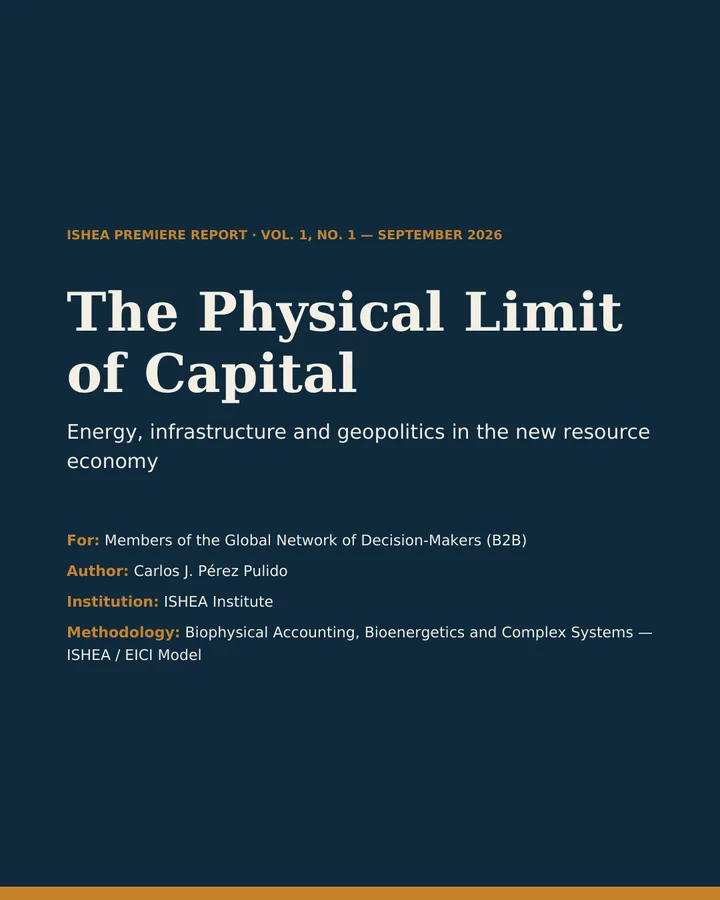
Il limite fisico del capitale: energia, infrastrutture e geopolitica
Il primo rapporto dell'ISHEA Institute esamina come l'infrastruttura dell'IA, le filiere di energia e minerali e i corridoi marittimi stabiliscano quanto capitale finanziario possa tradursi in economia reale.

NOTA-ECO-004 · Economia 5.0
Due facce della stessa medaglia: LATAM e Medio Oriente
Quarto capitolo della serie: dopo aver percorso lo scacchiere latinoamericano, Carlos J. Pérez Pulido mette a confronto LATAM e Medio Oriente, due geografie in apparenza lontane che sono facce della stessa medaglia.