

Coerenza · OSF-COH-029
La fatica strutturale come ponte tra la relatività einsteiniana e la coerenza ISHEA
Di Carlos J. Pérez Pulido · ISHEA Institute ·
Metodi, calcoli e correlazioni empiriche che mostrano come lo sforzo ciclico nelle leghe aeronautiche ridistribuisca l'energia e degradi l'ordine interno, un ponte replicabile verso la coerenza ISHEA.
Preprint — Manoscritto depositato su OSF. Senza revisione paritaria.
Opera originale in inglese.
Description:
This supplementary document presents a comprehensive framework connecting classical relativistic physics and ISHEA energetic coherence through the study of structural fatigue in aircraft materials. It provides methodological details, calculations, and empirical correlations demonstrating how energy redistribution and progressive loss of internal coherence manifest as material degradation over time.
The document is fully replicable and core-based, allowing researchers to explore emergent coherence in matter under cyclic stress conditions. By combining theoretical perspectives from Einsteinian Relativity with the ISHEA Coherence Model, this work illustrates how motion, energy, and coherence interact continuously, offering insights into fundamental processes governing both engineered and natural systems.
Includes:
Detailed methodology for analyzing structural fatigue as a measure of energetic coherence
Core calculations and interpretations aligned with ISHEA principles
Comparative synthesis between physical laws (energy conservation) and coherence principles
References from classical and modern materials science, relativity theory, and coherence studies
Keywords: Structural Fatigue, ISHEA Coherence, Emergent Energy, Relativity, Material Degradation, Replicable Method, Core-Based Analysis
Supplementary 2 – Nuclear Validation of the Δ±1 Coherence Framework
U-238 → Pb-206 Decay Chain
Author: Carlos J. Pérez Pulido
Affiliation: ISHEA Institute – Δ±1 Division
Date: November 2025
Status: Analytical Validation / Theoretical Integration
- Objective
To evaluate the radioactive decay chain of uranium-238 (U-238) to lead-206 (Pb-206) as an empirically verified energy–matter flow, and to examine its consistency within the Δ±1 Coherence Framework.
- Empirical Background
The U-238 decay series consists of 14 sequential α and β transitions, terminating in stable Pb-206.
Total energy released: ≈ 51 MeV per atom
Equivalent energy: ≈ 8 × 10⁻¹² J per atom
All intermediate isotopes experimentally verified in international nuclear decay tables (IAEA, NIST).
This system represents a fully documented natural transformation from an unstable nuclear configuration to a stable equilibrium state.
- Δ±1 Parameterization
Parameter Symbol Description Value / Behaviour
Initial coherence C₀ Nuclear structural order (U-238) ≈ 1.0
Final coherence C_f Stable Pb-206 ≈ 0
Coherence change ΔC C₀ − C_f −1.0
Energy dissipated ΔE Σ Eα + Eβ ≈ 51 MeV
Global frequency fᵗ_light 1 / T₁/₂ 7.1 × 10⁻¹⁸ s⁻¹
Micro-transition pulses — Local emission rates 10⁻⁸ – 10⁻¹³ s⁻¹
Terminal state — Equilibrium Δ±1 = 0
- Mathematical Representation
The coherence decay follows a logistic trajectory:
\Delta C = \frac{C_0 - C_f}{1 + e^{-k \cdot f^t_{\text{light}}}}
Energy release relation:
\Delta E \approx \alpha \frac{W}{t} (1 - \Delta C)
Where:
= nuclear coherence frequency (decay rate)
= logistic curvature constant
(empirical adjustment to MeV scale)
= nuclear transition work per unit time
- Observational Interpretation
Each α or β emission event produces:
ΔC < 0 → reduction in nuclear coherence
ΔE > 0 → quantized energy emission
The decay sequence progresses monotonically toward:
f^t_{\text{light}} \rightarrow 0
\quad \Rightarrow \quad
\Delta±1 = 0
When Pb-206 is reached, no further spontaneous transitions occur.
Entropy increases locally, while total mass–energy remains conserved:
E = \Delta m c^2
- Validation Outcome
✔ Internal consistency confirmed (mass–energy accounted)
✔ Empirical isotopic sequence experimentally verified
✔ ΔE/ΔC ratio remains bounded within expected limits
⚠ Quantum-level statistical corrections may refine microscopic treatment
The Δ±1 coherence model remains structurally compatible with nuclear-scale transformations.
- Conclusion
The U-238 → Pb-206 decay chain constitutes a verified natural example of progressive coherence loss balanced by quantized energy release.
\text{ΔC < 0} \quad \Longleftrightarrow \quad \text{ΔE > 0} \quad \Longrightarrow \quad \text{Δ±1 = 0}
The final isotope (Pb-206) represents a minimum-energy stable configuration where coherence dissipation has completed.
This nuclear-scale case supports the cross-domain applicability of the Δ±1 framework across:
Structural fatigue systems
Bioenergetic systems
Atomic-scale nuclear processes
Structural Fatigue as a Bridge Between Einsteinian Relativity and ISHEA Coherence
Overview:
This research explores the intersection between Einsteinian Relativity and the ISHEA Coherence Model by studying structural fatigue in aircraft materials. It highlights how energy redistribution and internal coherence degradation manifest in material wear and microfractures under cyclic stress, offering a tangible example of emergent coherence in matter.
Purpose:
To provide a replicable and core-based framework linking physics and coherence science, demonstrating how energy, motion, and temporal effects interact continuously in real-world systems. This approach allows for testing the emergent properties of coherence in engineered and natural materials.
Methodology:
Analysis of structural fatigue in aerospace alloys (Al–Cu–Mg, Ti–6Al–4V).
Measurement of phase decoherence in atomic lattices and correlation with macroscopic cracking.
Comparative synthesis of Einsteinian Relativity (energy redistribution, space-time deformation) and ISHEA principles (coherence reorganization, energetic order).
Core calculations and replicable protocols for evaluating coherence loss over time.
Key Concepts:
Motion & Energy: Matter reorganizes dynamically under stress; energy redistribution is measurable via fatigue patterns.
Coherence & Entropy: ISHEA interprets fatigue as progressive loss of internal energetic coherence, analogous to entropy increase.
Observability: Fatigue and structural wear are macroscopic expressions of microscopic incoherence.
Significance:
This framework provides a bridge between physics and coherence science, offering insights into how energy sustains matter and the conditions under which gravity and other emergent phenomena could be understood as coherence-driven processes. It enables researchers to test energy-coherence dynamics across multiple scales.
References:
Einstein, A. (1905). Zur Elektrodynamik bewegter Körper. Annalen der Physik.
Misner, C. W., Thorne, K. S., & Wheeler, J. A. (1973). Gravitation. W. H. Freeman.
Dowling, N. E. (2012). Mechanical Behavior of Materials. Pearson.
Suresh, S. (1998). Fatigue of Materials. Cambridge University Press.
Stephens, R. I., Fatemi, A., Stephens, R. R., & Fuchs, H. O. (2000). Metal Fatigue in Engineering. Wiley.
Callister, W. D., & Rethwisch, D. G. (2020). Materials Science and Engineering: An Introduction. Wiley.
Prigogine, I. (1980). From Being to Becoming: Time and Complexity in the Physical Sciences. W. H. Freeman.
Schrödinger, E. (1944). What is Life? The Physical Aspect of the Living Cell. Cambridge University Press.
Zhou, J. et al. (2021). Acta Materialia, 203, 116503.
Liu, X., & McDowell, D. L. (2007). International Journal of Fatigue, 29(1), 123–135.
ISHEA Institute (2025). Unified Coherence Framework – Energy and Structure Division Report. Bologna.
Nella stessa sala — Coerenza
NOTA-COH-001 · Coerenza
La narrativa non è fiducia: senza fiducia, la narrativa perde forza
Un monito al mondo aziendale e politico: lo storytelling non può compensare un'architettura debole. Senza una fiducia strutturale che la sostenga, qualsiasi narrativa perde forza.
NOTA-COH-002 · Coerenza
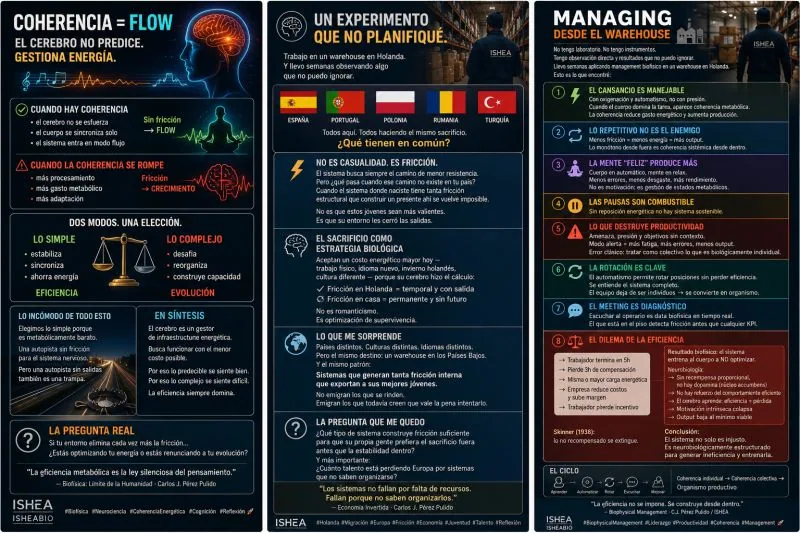
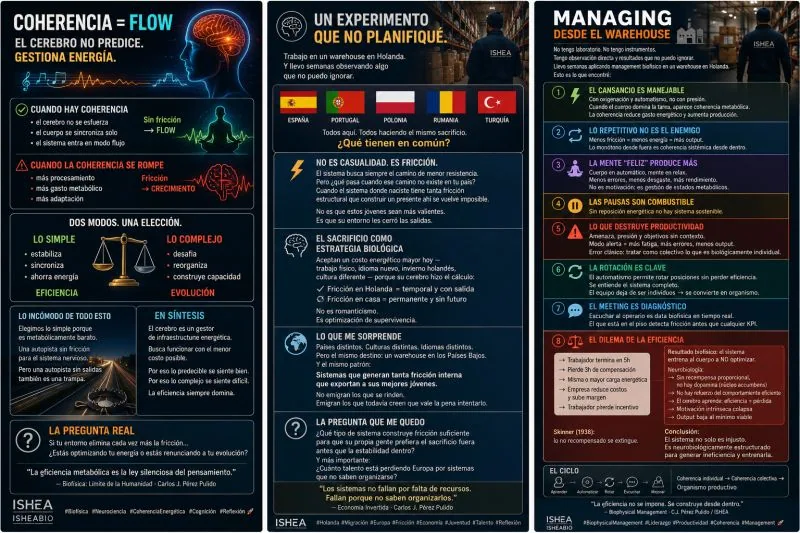
Managing dal magazzino: management biofisico senza laboratorio (3/4)
Senza strumenti né laboratorio, solo osservazione diretta: settimane di management biofisico applicato in un magazzino logistico, con risultati difficili da ignorare.
NOTA-COH-003 · Coerenza
La risposta non è culturale, è biologica (1/4)
Il corpo segue il ritmo prima che la mente decida. Punto di partenza della serie: la risposta all'ambiente non si spiega con la cultura, ma con la biologia.