

Cognición colectiva · OSF-COG-012
El TDAH como configuración cognitiva sensible al contexto: un marco de coherencia
Por Carlos J. Pérez Pulido · ISHEA Institute ·
Un marco conceptual que lee el TDAH no como déficit sino como una configuración cuyo rendimiento depende del contexto: la coherencia surge de la energía y la información disponibles menos la fricción.
Preprint — Manuscrito depositado en OSF. Sin revisión por pares.
Pieza original en inglés.
🧠 ISHEA Cognitive Coherence Model
Description
The ISHEA Cognitive Coherence Model is a conceptual framework proposed by Carlos J. Pérez Pulido that describes cognitive performance as an emergent property of the interaction between cognitive resources, structured information, and systemic interference (friction).
The model is expressed through the functional relationship:
C ≈ (E × I) − F
Where:
C (Cognitive Coherence) refers to the degree of alignment between attention, cognition, and task execution
E (Energy) represents available cognitive resources, including attentional capacity and mental stamina
I (Information) refers to the structure and clarity of task-relevant input
F (Friction) represents interference factors such as interruptions, ambiguity, stress, and task switching
The framework integrates insights from flow theory, cognitive load theory, and task-switching research into a unified systems-level interpretation of cognition.
Theoretical Foundations
The model builds upon established research domains:
Flow theory, introduced by Mihaly Csikszentmihalyi, which describes optimal states of deep focus and intrinsic motivation
Cognitive load theory, which emphasizes the limited capacity of working memory
Task-switching research, which demonstrates the performance costs of multitasking and attentional shifts
The ISHEA model attempts to integrate these domains by proposing that cognitive efficiency depends on the alignment between resources (E), structured information (I), and minimal interference (F).
Information Decomposition
A central contribution of the model is the decomposition of the information variable (I) into three operational components:
I₁: Goal clarity — the degree to which task objectives are explicit and unambiguous
I₂: Feedback immediacy — the speed and relevance of performance feedback
I₃: Task structure — the organization and sequencing of task components
This decomposition allows for experimental manipulation and measurement in applied settings.
System States
The model describes three primary cognitive states:
Δ+1 (High coherence / flow): High E × I and low F, associated with sustained attention and high performance
Δ0 (Transitional state): Balance between E × I and F, associated with unstable or fluctuating performance
Δ−1 (Low coherence / breakdown): Low E × I or high F, associated with cognitive fatigue, distraction, and error accumulation
Application to ADHD
Within this framework, Trastorno por Déficit de Atención e Hiperactividad is interpreted not solely as a deficit of cognitive resources, but as a context-sensitive cognitive configuration characterized by:
Increased sensitivity to friction (F)
Narrower thresholds between cognitive states
Greater variability between high-coherence (hyperfocus) and low-coherence states
The model suggests that individuals with ADHD may achieve high levels of coherence under conditions of:
High information structure (I)
Low environmental friction (F)
This perspective aligns with neurodiversity approaches while remaining compatible with established clinical frameworks.
Implications
Education
Emphasizes structured tasks, clear goals, and immediate feedback
Reduces environmental distractions and cognitive friction
Organizational Design
Highlights the negative impact of interruptions and multitasking
Supports workflow designs that protect focus and reduce friction
Cognitive Performance
Suggests that flow can be facilitated by optimizing environmental and informational conditions rather than relying solely on motivation
Limitations
The model is conceptual and requires empirical validation
Variables (E, I, F) require further operationalization
The relationship is heuristic, not a physical law
Bioenergetic interpretations of E remain hypothetical
Research Status
The ISHEA Cognitive Coherence Model is currently under development as part of the broader ISHEA framework. Ongoing work includes:
Experimental validation of friction and information effects
Exploration of bioenergetic correlates of cognitive performance
Application across educational, organizational, and clinical domains
Summary
The ISHEA Cognitive Coherence Model proposes that cognitive performance is not determined solely by ability or effort, but by the alignment between:
Available resources
Structured information
Environmental conditions
By framing flow, attention, and cognitive breakdown within a single system, the model offers a unified perspective for understanding human cognition across contexts.
En la misma sala — Cognición colectiva
NOTA-COG-001 · Cognición colectiva
PISA 2025: ¿qué ocurre cuando aprender demasiado rápido deja de ser aprender?
Una lectura de los resultados de PISA 2025 y de la señal que dejan en el rendimiento de los países de la OCDE: la sospecha de que acelerar el aprendizaje puede terminar vaciándolo de contenido.
NOTA-COG-002 · Cognición colectiva
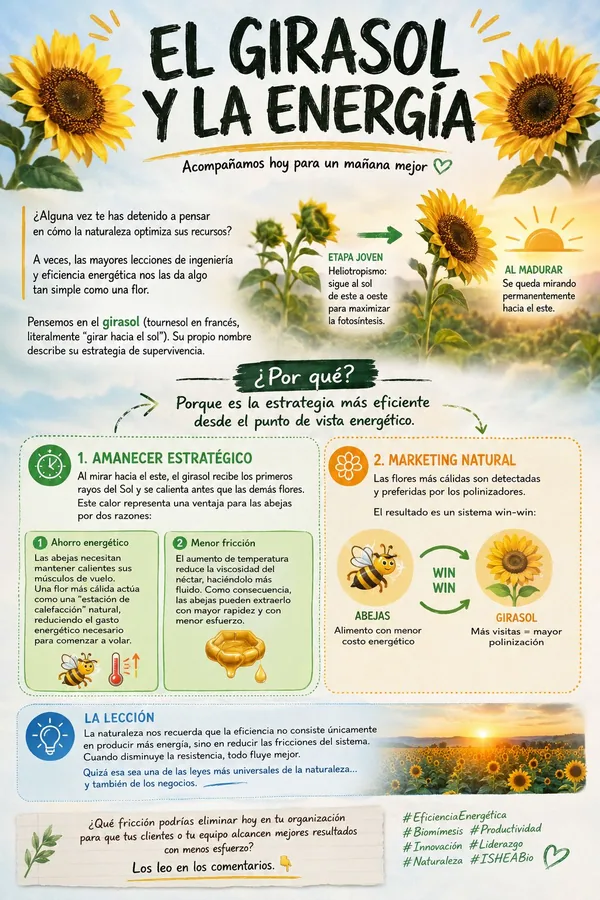
El girasol y la energía
Cómo la naturaleza optimiza sus recursos: el girasol convierte su geometría en una lección de ingeniería y eficiencia energética que la tecnología humana todavía intenta igualar.
OSF-COG-003 · Cognición colectiva
ICSD: dinámica de estados cognitivos (en preparación)
Repositorio en preparación del ICSD, el modelo de dinámica de estados cognitivos; abre el espacio donde se depositarán los materiales del marco EICI + TACC conforme avance la investigación.