

Economía 5.0 · OSF-ECO-132
La economía hueca y la economía autofágica positiva: la madriguera invertida
Por Carlos J. Pérez Pulido · ISHEA Institute ·
Dentro de ISHEA–Economía 5.0, da nombre al crecimiento hueco: PIB, crédito y consumo que se expanden mientras cae la densidad estructural. Japón, China y Estados Unidos como casos de estudio
Preprint — Manuscrito depositado en OSF. Sin revisión por pares.
Pieza original en inglés.
The Hollow Economy and Positive Autophagic Economy – The Inverted Rabbit Hole explores the paradox of modern growth within the ISHEA–Economy 5.0 framework. The paper defines Hollow Growth as a condition in which quantitative expansion (GDP, consumption, credit) occurs alongside a loss of structural density—declining real production, unstable employment, speculative innovation, and social weakening.
Through comparative analysis of Japan (1990–2000), China (2020–2025), and the United States (2023–2025), the study reveals that economies can appear prosperous while their internal mechanisms deteriorate. This “Rabbit Hole Economy” becomes a self-referential loop where debt, digital replication, and artificial intelligence generate simulated rather than real progress.
The concept of the Autophagic Economy reinterprets this apparent decay as a regenerative process: systems digest obsolete structures—industries, labor models, and consumption patterns—to reconfigure toward cognitive, circular, and sustainable value. Rather than collapse, economic autofagy can signify evolutionary digestion, transforming crisis into renewal.
The study concludes that Positive Economic Autophagy, integrated with the Hollow Economy, anticipates the emergence of Economy 5.0—a post-material system where human well-being expands through knowledge, experience, and emotional capital rather than extractive growth.
🧭 The Hollow Economy & Positive Autophagic Economy – The Inverted Rabbit Hole
Author: C. J. Pérez Pulido – ISHEA Institute
DOI: 10.17605/OSF.IO/WST24
🔹 Overview
This study introduces the concepts of Hollow Growth and Positive Economic Autophagy within the framework of the ISHEA–Economy 5.0 model, redefining how modern societies experience expansion, contraction, and regeneration.
The term “Hollow Economy” refers to a paradoxical phase of economic growth where quantitative indicators (GDP, credit, consumption) continue to rise while the real structure of production, employment, and innovation becomes increasingly fragile.
The Autophagic Economy, by contrast, represents a transformational response—a process through which an economy digests its obsolete components (industries, models, and institutions) to re-emerge with higher efficiency, reduced material dependence, and greater cognitive and emotional value creation.
🔹 Theoretical Context
The research expands the ISHEA (Index of Expanded Human Satisfaction) model by connecting economic metabolism with human well-being, ecological sustainability, and institutional adaptation.
It argues that in post-industrial societies, value is progressively transferred from material production to symbolic, emotional, and informational systems.
The paper situates this transition within a broader historical arc:
Japan (1990–2000): early signs of structural rigidity and deflationary autophagy.
China (2020–2025): rapid growth masking internal hollowing driven by debt and construction.
United States (2023–2025): technological autophagy—AI generating AI, finance detached from real productivity.
🔹 Key Concepts
Concept Definition ISHEA Interpretation
Hollow Growth Expansion without density; GDP rises but social well-being stagnates. Asymmetry between nominal and adjusted progress.
Rabbit Hole Economy Simulated growth loop based on self-referential data, debt, and digital speculation. Collapse of productive–social correspondence.
Economic Autophagy The economy consumes obsolete structures to evolve. Negative delta of progress during reconfiguration.
Positive Autophagy (+1) Regenerative digestion leading to new balance between cognitive, ecological, and social dimensions. Structural renewal and transition toward Economy 5.0.
🔹 Implications
The study proposes that the collapse of traditional indicators (GDP, inflation, productivity) is not a sign of failure but of metabolic transformation.
Autophagic processes can lead to a new economic architecture that is:
Less material, more cognitive
Less extractive, more regenerative
Less linear, more circular
This theoretical framework offers a bridge between economic complexity, social psychology, and ecological systems, suggesting that the next evolution of capitalism will be autophagic rather than expansionist.
🔹 Citation
Pérez Pulido, C. J. (2025). The Hollow Economy and Positive Autophagic Economy – The Inverted Rabbit Hole. ISHEA Institute. DOI: 10.17605/OSF.IO/WST24.
En la misma sala — Economía 5.0

NOTA-ECO-001 · Economía 5.0
¿Y si las variables con las que medimos el éxito de los países estuvieran al revés?
Durante décadas el progreso se ha medido con PIB, productividad, crecimiento y energía. Esta pieza plantea que esas variables podrían estar invertidas y pide repensar qué significa que un país prospere.
NOTA-ECO-002 · Economía 5.0
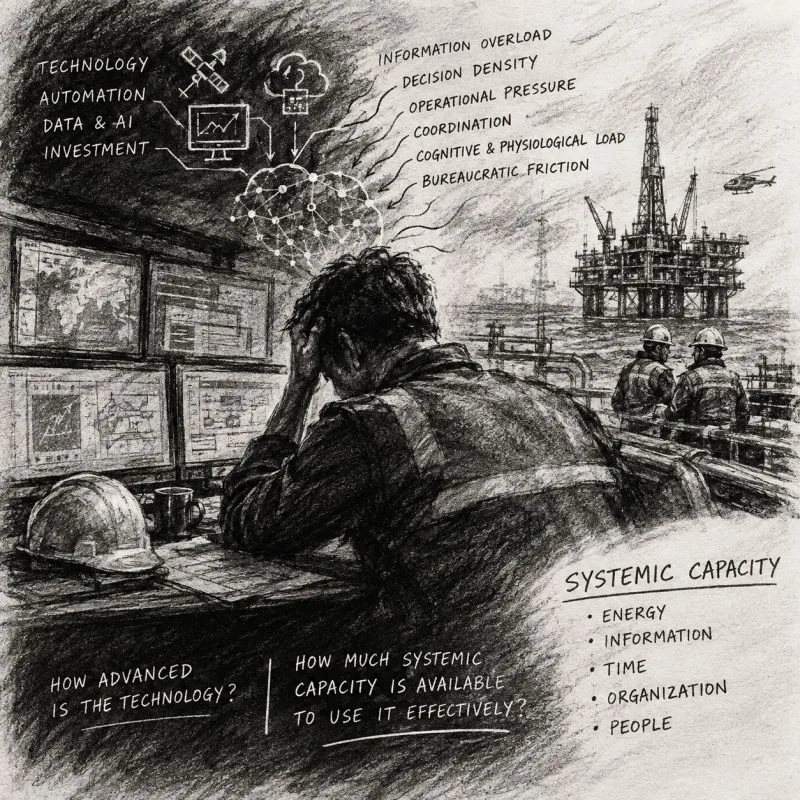
¿Por qué fallan los sistemas de alta ingeniería cuando la tecnología es más avanzada?
En Oil & Gas y otras operaciones complejas, más tecnología no garantiza mejores decisiones: esta pieza estudia la capacidad sistémica, lo que un sistema puede absorber y convertir en acción bajo presión.

NOTA-ECO-003 · Economía 5.0
Frankenstein y el petróleo: ¿por qué Venezuela vuelve a importar geopolíticamente?
Tercera entrega de la serie: tras el paso del capital a la IA y a la concentración financiera, llega el siguiente cuello de botella, el petróleo, y con él Venezuela vuelve al tablero geopolítico.