

Economia 5.0 · OSF-ECO-132
L'economia vuota e l'economia autofagica positiva: la tana del coniglio invertita
Di Carlos J. Pérez Pulido · ISHEA Institute ·
Dentro ISHEA–Economia 5.0, dà un nome alla crescita vuota: PIL, credito e consumi che si espandono mentre la densità strutturale si perde. Giappone, Cina e Stati Uniti come casi di studio
Preprint — Manoscritto depositato su OSF. Senza revisione paritaria.
Opera originale in inglese.
The Hollow Economy and Positive Autophagic Economy – The Inverted Rabbit Hole explores the paradox of modern growth within the ISHEA–Economy 5.0 framework. The paper defines Hollow Growth as a condition in which quantitative expansion (GDP, consumption, credit) occurs alongside a loss of structural density—declining real production, unstable employment, speculative innovation, and social weakening.
Through comparative analysis of Japan (1990–2000), China (2020–2025), and the United States (2023–2025), the study reveals that economies can appear prosperous while their internal mechanisms deteriorate. This “Rabbit Hole Economy” becomes a self-referential loop where debt, digital replication, and artificial intelligence generate simulated rather than real progress.
The concept of the Autophagic Economy reinterprets this apparent decay as a regenerative process: systems digest obsolete structures—industries, labor models, and consumption patterns—to reconfigure toward cognitive, circular, and sustainable value. Rather than collapse, economic autofagy can signify evolutionary digestion, transforming crisis into renewal.
The study concludes that Positive Economic Autophagy, integrated with the Hollow Economy, anticipates the emergence of Economy 5.0—a post-material system where human well-being expands through knowledge, experience, and emotional capital rather than extractive growth.
🧭 The Hollow Economy & Positive Autophagic Economy – The Inverted Rabbit Hole
Author: C. J. Pérez Pulido – ISHEA Institute
DOI: 10.17605/OSF.IO/WST24
🔹 Overview
This study introduces the concepts of Hollow Growth and Positive Economic Autophagy within the framework of the ISHEA–Economy 5.0 model, redefining how modern societies experience expansion, contraction, and regeneration.
The term “Hollow Economy” refers to a paradoxical phase of economic growth where quantitative indicators (GDP, credit, consumption) continue to rise while the real structure of production, employment, and innovation becomes increasingly fragile.
The Autophagic Economy, by contrast, represents a transformational response—a process through which an economy digests its obsolete components (industries, models, and institutions) to re-emerge with higher efficiency, reduced material dependence, and greater cognitive and emotional value creation.
🔹 Theoretical Context
The research expands the ISHEA (Index of Expanded Human Satisfaction) model by connecting economic metabolism with human well-being, ecological sustainability, and institutional adaptation.
It argues that in post-industrial societies, value is progressively transferred from material production to symbolic, emotional, and informational systems.
The paper situates this transition within a broader historical arc:
Japan (1990–2000): early signs of structural rigidity and deflationary autophagy.
China (2020–2025): rapid growth masking internal hollowing driven by debt and construction.
United States (2023–2025): technological autophagy—AI generating AI, finance detached from real productivity.
🔹 Key Concepts
Concept Definition ISHEA Interpretation
Hollow Growth Expansion without density; GDP rises but social well-being stagnates. Asymmetry between nominal and adjusted progress.
Rabbit Hole Economy Simulated growth loop based on self-referential data, debt, and digital speculation. Collapse of productive–social correspondence.
Economic Autophagy The economy consumes obsolete structures to evolve. Negative delta of progress during reconfiguration.
Positive Autophagy (+1) Regenerative digestion leading to new balance between cognitive, ecological, and social dimensions. Structural renewal and transition toward Economy 5.0.
🔹 Implications
The study proposes that the collapse of traditional indicators (GDP, inflation, productivity) is not a sign of failure but of metabolic transformation.
Autophagic processes can lead to a new economic architecture that is:
Less material, more cognitive
Less extractive, more regenerative
Less linear, more circular
This theoretical framework offers a bridge between economic complexity, social psychology, and ecological systems, suggesting that the next evolution of capitalism will be autophagic rather than expansionist.
🔹 Citation
Pérez Pulido, C. J. (2025). The Hollow Economy and Positive Autophagic Economy – The Inverted Rabbit Hole. ISHEA Institute. DOI: 10.17605/OSF.IO/WST24.
Nella stessa sala — Economia 5.0

NOTA-ECO-001 · Economia 5.0
E se le variabili con cui misuriamo il successo dei Paesi fossero del tutto capovolte?
Da decenni il progresso si misura con PIL, produttività, crescita ed energia. Questo testo sostiene che quelle variabili potrebbero essere capovolte e invita a ripensare che cosa significhi, per un Paese, prosperare.
NOTA-ECO-002 · Economia 5.0
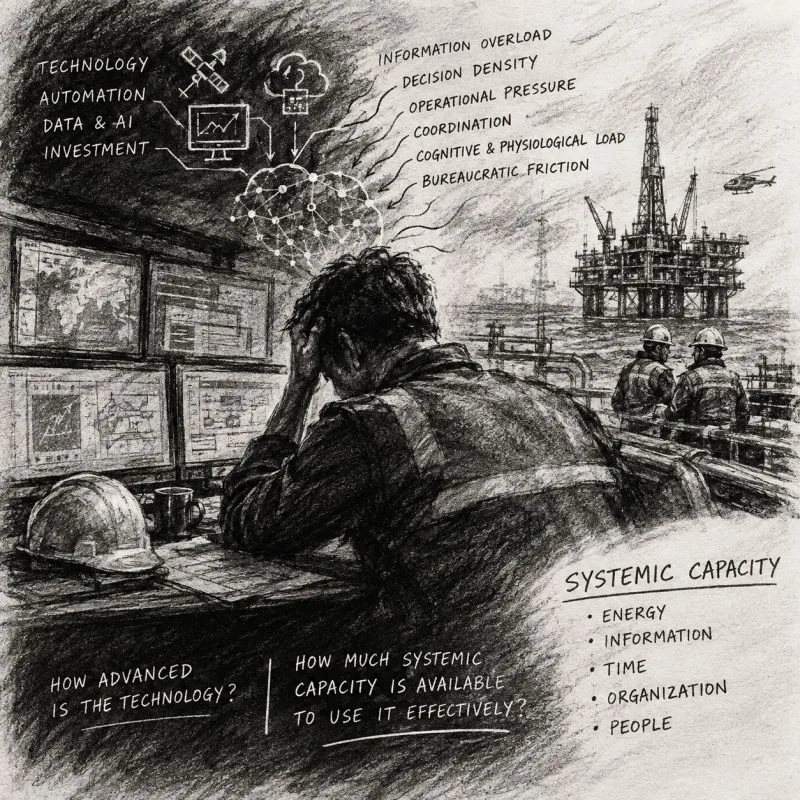
Perché l’alta ingegneria sbaglia proprio quando la tecnologia è più avanzata?
Nell’Oil & Gas e in altre operazioni complesse, più tecnologia non garantisce decisioni migliori: questo testo indaga la capacità sistemica, quanto un sistema sa assorbire e tradurre in azione sotto pressione.

NOTA-ECO-003 · Economia 5.0
Frankenstein e il petrolio: perché il Venezuela torna a contare nella geopolitica?
Terza puntata della serie: dopo il passaggio dal capitale all'IA e alla concentrazione finanziaria, emerge il nuovo collo di bottiglia, il petrolio, e con esso il Venezuela torna sullo scacchiere geopolitico.