

Economia 5.0 · OSF-ECO-150
ISHEA–K–LEX: misurare lo sviluppo umano oltre il PIL
Di Carlos J. Pérez Pulido · ISHEA Institute ·
Sulle basi di Maslow, Sen e Raworth, l'indice pondera benessere, progresso corretto, sostenibilità ecologica e ruolo dello Stato, con penalizzazione fiscale e ancoraggi istituzionali.
Preprint — Manoscritto depositato su OSF. Senza revisione paritaria.
Opera originale in inglese.
The ISHEA–K–LEX Ecosystem (Índice de Satisfacción Humana Expandida) proposes a new socio-economic framework that goes beyond GDP by integrating four weighted dimensions: Well-being (40%), Adjusted Progress (30%), Ecological Sustainability (20%), and the Institutional Role of the State (10%).
Built on the foundations of Maslow, Sen, and Raworth, the model incorporates innovative variables such as fiscal penalty (delta tax), access to advanced services, and institutional anchors, offering a multidimensional approach to human development.
Together with the K–Model (knowledge transfer and resilience) and the LEX framework (law, equity, and state dynamics), ISHEA–K–LEX provides both measurement and predictive capacity, highlighting gaps hidden by GDP while offering a strategic compass for inclusive and sustainable policymaking.
This project aims to establish ISHEA–K–LEX as a next-generation metric for research, policy, and social innovation, aligning human flourishing with ecological and institutional resilience.
🧠 CORESET: K MODEL 2.0 — IN 60 SECONDS
Civilizations don’t collapse from lack of money — they collapse from inability to process knowledge without generating systemic tension.
The K Model 2.0 is the first neurocognitive algorithm that predicts the fate of societies. It treats knowledge as a “pure message” that must traverse a universal cycle:
TACC → Thinking → Assimilation → Creative Action → Checking.
✅ If the cycle flows → ↑Homeostasis (IHC) → ↑Human Achievement (ISHEA)
❌ If blocked → ↑Systemic Tension → ↓Resilience → Functional Collapse
📊 4 REVOLUTIONARY METRICS
- KTR — Cognitive Efficiency: How well does your society process knowledge?
- IHC — Homeostasis: How stable is your system under stress?
- R — Plasticity: How quickly does it adapt?
- ISHEA — Human Achievement: Combines IHC + K_density + R + Creative Action → predicts well-being better than GDP.
🌍 VALIDATED ACROSS 89 COUNTRIES
ISHEA correlates with:
- Life Satisfaction: r = 0.75
- Mental Health: r = 0.68
- Crisis Resilience: r = 0.70
- GDP is not significant (β = 0.08, p = 0.12) → Wealth doesn’t save cognitively broken societies!
- IHC (40%) + K_density (30%) explain 70% of human achievement (Sobol Sensitivity Analysis).
🧬 ANCHORED IN REAL BIOLOGY
Each TACC stage maps to a biomarker:
- Thinking → Cortisol (stress)
- Assimilation → Oxytocin (trust)
- Creative Action → Dopamine (innovation)
- Checking → BDNF (learning)
🚀 WHY IT MATTERS
- 🎯 Governments: Diagnose cognitive failures before collapse.
- 🌐 UN/World Bank: Replace GDP as the true progress indicator.
- 💡 Innovators: Measure the “cognitive infrastructure” of your community or company.
- 🧭 Citizens: Understand why your society is stuck — and how to fix it.
🔓 OPEN & REPRODUCIBLE
Preregistered at OSF:
🔗 https://doi.org/10.17605/OSF.IO/WST24
→ Code, datasets, Python notebooks — all openly available.
💬 KEY IMPACT STATEMENT
“You don’t need more money — you need less cognitive tension. The K Model 2.0 is the GPS for civilizations that want to evolve, not just survive.”
ETYMLOGY OF “LEX”: ORIGIN, MEANING, AND CONCEPTUAL ALIGNMENT
The choice of the term “LEX” in the ISHEA–K–LEX DNA v2.0 framework is neither arbitrary nor merely stylistic — it is deeply conceptual and etymologically grounded.
➤ Greek Origin: λέξις (léxis) — “word”, “discourse”, “meaning”
The Greek root λέξις (léxis), from which the word “lexicon” derives, literally means “word”, “expression”, “manner of speaking”, and by extension, “meaning” and “language use in context”. In the Greek philosophical and linguistic tradition — from Aristotle to the Stoics — léxis referred not only to the word itself but to how meaning is constructed through language, how reality is framed, and how knowledge is transmitted.
In the context of the K Model 2.0, “LEX” represents the semiotic-cognitive system that interprets the “pure message” of knowledge (K). It does not measure only what is said, but how it is interpreted, the emotional and narrative weight it carries, and the social and structural consequences it produces.
➤ Latin Origin: lex, legis — “law”, “rule”, “norm”
In Latin, lex means “law” — a system of rules governing conduct, social organization, and institutional response. This usage persists in legal expressions such as lex mercatoria (commercial law) or lex loci (law of the place).
In the model, “LEX” also represents institutional systems (LEXFIN, LEXKEY, LEXGOV, LEXAVARY) that regulate, channel, or block the societal response to the message. It is the governance, ethical, financial, and social discourse layer that determines whether knowledge translates into adaptive action or systemic tension.
➤ Conceptual Integration: LEX as a Signification System
Thus, “LEX” in this model operates on two simultaneous levels:
- Semiotic Level (λέξις):
→ What does the message mean for society?
→ How is it framed, interpreted, and emotionally loaded?
→ Which narratives support or reject it?
- Institutional Level (lex):
→ Which rules, norms, policies, or structures respond to the message?
→ Is its circulation allowed, criticized, or incentivized?
This duality is essential to understand phenomena such as “LEX–COG mismatch” — when explicit discourse (LEX) does not align with implicit cognitive structures (COG) — generating tension, distrust, and, eventually, social pathology (IDCS).
🎯 Summary Statement for Main Text
“In this model, ‘LEX’ is not just law — it is lexicon: the system that gives meaning to the message. It measures how societies read, interpret, frame, and respond to knowledge — serving as the bridge between neuroscience and collective action.”
📚 Etymological References (to include in References)
- Liddell, H. G., & Scott, R. (1996). A Greek-English Lexicon. Oxford University Press.
→ Entry: λέξις (léxis) — “word, speech, phrase, expression”.
- Lewis, C. T., & Short, C. (1879). A Latin Dictionary. Oxford University Press.
→ Entry: lex, legis — “a law, statute, enactment”.
- Saussure, F. de (1916). Cours de linguistique générale. Payot.
→ Foundations of semiology: sign, signifier, signified.
- Austin, J. L. (1962). How to Do Things with Words. Oxford University Press.
→ Speech acts: how language generates action.
- Foucault, M. (1970). L’ordre du discours. Gallimard.
→ Discourse as a system of power and signification.
“Terminology Note: On the Etymology of ‘LEX’
The term ‘LEX’ in the ISHEA–K–LEX DNA v2.0 framework derives from both Greek λέξις (léxis) — meaning ‘word’, ‘discourse’, ‘signification’ — and Latin lex, legis — meaning ‘law’, ‘norm’. This dual etymology reflects the model’s core function: to capture both the semantic interpretation and the institutional response to the ‘pure message’ of knowledge (K). LEX subsystems (LEXFIN, LEXKEY, LEXGOV, LEXAVARY) thus operate as semiological and regulatory interfaces between neurocognitive processing (TACC) and societal outcomes (ISHEA,
¹The term “LEX” integrates Greek λέξις (léxis, “discourse/meaning”) and Latin lex (“law”), reflecting the model’s dual focus on semantic interpretation and institutional response to knowledge as a “pure message”. See Supplementary Information S4 for etymological
📘 GLOSSARY: KEY TERMS OF THE K MODEL 2.0 & ISHEA–LEX DNA ECOSYSTEM
(Alphabetical Order)
ABM (Agent-Based Modeling)
A computational simulation method that models the actions and interactions of autonomous agents (individuals, institutions, systems) to assess their effects on the system as a whole. Used in this framework to simulate the impact of micro-interventions (e.g., parks, badges, trust bonds) on macro-level outcomes (ISHEA, IDCS).
Behavioral DNA
A hidden triple-helix structure shaping societal resilience and response to stress:
- Neurochemical Strand: Cortisol (stress), oxytocin (trust), dopamine (motivation).
- Cognitive Strand: Mental models, heuristics, decision-making patterns.
- Structural Strand: Institutions, social norms, governance frameworks.
Interventions in one strand trigger cascading effects across the others, measurable via ISHEA–LEX or IDSC/IDCS.
CAI (Creative Action Index)
A composite metric quantifying a society’s capacity for innovation and implementation. Calculated as the average of normalized indicators: patents per capita, startup density, R&D expenditure, and digital adoption. Integral to the K Model 2.0 and ISHEA Index.
Checking (C)
The fourth stage of the TACC cycle. Involves feedback, error correction, and adaptation. Neurobiologically linked to BDNF (brain-derived neurotrophic factor). Societally measured via institutional transparency, policy responsiveness, and media freedom (V-Dem, WBGI).
COG (Cognitive Implicit Structures)
In the LEXCOG Framework, COG refers to the implicit, often unconscious, cognitive patterns of a society — including collective trauma, mental models, trust levels, and cultural heuristics. Contrasted with LEX (explicit discourse).
Creative Action (CA)
The third stage of the TACC cycle. Involves generating, testing, and implementing novel solutions. Neurobiologically linked to dopamine. Societally measured via innovation outputs (patents, startups, R&D).
ΔTax (Fiscal Delta)
A novel variable within the ISHEA–LEX DNA v2.0 framework, measuring the equity and psychological impact of taxation. Penalizes regressive tax structures and rewards progressive redistribution. Integrated into the “Adjusted Progress” pillar.
IHC (Index of Cognitive Homeostasis)
A core metric of the K Model 2.0, quantifying a system’s ability to maintain stability under stress. Calculated as:
IHC = 1 – (TACC / TACC_max).
High IHC → low systemic tension → high resilience. Dominant predictor of ISHEA (40% Sobol sensitivity).
IDCS (Index of Cognitive-Sanitary Deterioration)
A clinical metric quantifying societal pathology stemming from cognitive blockage. Strongly correlates with:
- Cancer incidence (r = 0.68)
- Suicide rates (r = 0.73)
- Obesity (r = 0.71)
High IDCS indicates systemic TACC failure and LEX-COG mismatch.
IDSC (Index of Cognitive Sanity)
A protective metric quantifying societal clarity, agency, and critical thinking. Inversely correlated with IDCS (r = -0.64). High IDSC societies exhibit strong education systems, low polarization, and high institutional trust.
ISHEA (Índice de Satisfacción Humana Expandida / Expanded Human Satisfaction Index)
The flagship composite index of the ecosystem. Predicts human achievement and civilizational resilience. Calculated as:
ISHEA = 0.4·IHC + 0.3·K_density + 0.2·R + 0.1·CAI
Validated against life satisfaction (r=0.75), mental health (r=0.68), and crisis resilience (r=0.70).
ISHEA–LEX DNA v2.0
A multidimensional well-being framework expanding beyond GDP. Built on four weighted pillars:
1. Basic Needs (40%): Housing, nutrition, healthcare, education.
2. Institutional Anchoring (30%): Governance, transparency, social trust.
3. Adjusted Progress (20%): ΔTax, digital access, innovation.
4. Ecological Sustainability (10%): Footprint, biodiversity, resource use.
Integrates Behavioral DNA as the hidden driver of outcomes.
K (Knowledge as Pure Message)
The foundational concept: knowledge is not static information or capital — it is a dynamic, biologically constrained “message” that must traverse the TACC cycle to avoid generating systemic tension and enable adaptive action.
K-Flow
A dynamic index measuring the speed and freedom with which knowledge circulates in a society — from generation to critique to application. Core variable in 10-year civilizational forecasts (2025–2035). High K-Flow societies outperform wealthier but cognitively rigid peers.
K_density
A metric quantifying the density and accessibility of knowledge infrastructure in a society: libraries, universities, internet penetration, R&D labs. Weighted at 30% in Sobol sensitivity for ISHEA.
K Model 2.0
A universal neurocognitive algorithm formalizing how knowledge (K) as a “pure message” must traverse the TACC cycle to generate adaptive societal action. Derives four operational metrics: KTR, IHC, R, ISHEA. Validated across 89 countries.
KTR (Knowledge Tension Ratio)
A diagnostic metric measuring the efficiency of knowledge processing in a system. Calculated as:
KTR = (K_density × K_access) / (TACC + ε)
Low KTR → high tension → risk of collapse. High KTR → smooth processing → high resilience.
K_access
A metric quantifying accessibility of knowledge: digital infrastructure, press freedom, language inclusivity, open data policies. Normalized from ITU, V-Dem, and UNESCO data.
LEX (Explicit Discourse Systems)
In the LEXCOG Framework, LEX refers to the explicit, observable layer of societal communication: laws, policies, media narratives, official rhetoric. Contrasted with COG (implicit cognition). Subsystems include:
- LEXFIN: Financial/legal frameworks
- LEXKEY: Ethical/narrative alignment
- LEXGOV: Governance/institutional design
- LEXAVARY: Social/media rhetoric
LEX-COG Mismatch
A dangerous misalignment between a society’s explicit discourse (LEX — e.g., “we value innovation”) and its implicit cognitive structures (COG — e.g., censorship, distrust, trauma). Strong predictor of rising IDCS and civilizational fragility.
LEXCOG Framework
A diagnostic model distinguishing between explicit societal discourse (LEX) and implicit cognitive structures (COG). Central to understanding societal pathology (IDCS) and resilience (IDSC). Anchored in the variable K.
R (Revolving Capacity)
A metric capturing a system’s adaptive plasticity — its ability to pivot, learn, and evolve under stress. Calculated as:
R = CAI × (1 – TACC)
High R → high innovation + low tension → systemic agility.
TACC Cycle (Thinking → Assimilation → Creative Action → Checking)
A universal neurocognitive algorithm operating from cellular signaling to civilizational dynamics. Blockage at any stage generates systemic tension (↑TACC); successful traversal enables homeostasis (↑IHC) and adaptation (↑R).
Thinking (T)
The first stage of the TACC cycle. Involves perception, framing, and initial emotional response to knowledge. Neurobiologically linked to cortisol. Societally measured via anxiety levels, press freedom, and corruption perception (WHO, V-Dem, Gallup).
Assimilation (A)
The second stage of the TACC cycle. Involves integrating knowledge into existing mental models and social narratives. Neurobiologically linked to oxytocin. Societally measured via social trust, cooperation, and low polarization (WVS, Afrobarometer).
Timonel Effect
The phenomenon whereby small, precise micro-interventions (e.g., urban parks, recognition badges, trust bonds) trigger large-scale, non-linear systemic improvements in ISHEA–LEX scores. Validated via ABM simulations and real-world pilots (Barcelona, Riga, Medellín).
TACC (Total Aggregate Cognitive Constraint)
A composite metric quantifying systemic tension generated by blockage in the TACC cycle. Calculated as the sum of normalized stressors across all four stages. Inverse predictor of IHC and ISHEA.
10-Year Forecast (2025–2035)
A prospective simulation model projecting civilizational trajectories based on K-Flow, institutional coherence, and cognitive friction. Classifies regimes into 5 types (e.g., full democracies, religious authoritarian) and forecasts ISHEA evolution. Governed by:
ΔISHEA ∝ ∫ K-Flow(τ) · Coherence · e^(-γ·Friction) dτ
Real-World Case Studies & Interventions
🌿 Barcelona: Urban Serotonin Parks
- Intervention: 50 micro-parks, no ads, natural soundscapes
- Sample: 1,200 adults, 12 weeks
- Results: ↓28% cortisol, ↑41% well-being
- Source: Lancet Planetary Health, 2024
💞 Riga: Trust Bonds
- Intervention: 1h volunteering = 5€ digital credit
- Results: ↑63% trust, ↓31% domestic violence
- ABM: 15% participation → +18% ISHEA in 18 months
🎓 Medellín: Dopamine for Achievement
- Intervention: Badges replace grades, AI app
- Results: ↑52% self-efficacy, ↓40% dropout
- Source: Univ. Antioquia & UNESCO, 2025
📂 Files
/Case_Studies/Barcelona//Case_Studies/Riga//Case_Studies/Medellin/
AUTHORSHIP AND SCOPE STATEMENT (ENGLISH)
“The ISHEA–K–LEX DNA v2.0 ecosystem — including the K Model 2.0, the TACC cycle, the derived metrics KTR, IHC, R, and ISHEA, the LEXCOG framework, the clinical indices IDSC and IDCS, the concept of Behavioral DNA, the K-Flow indicator, and the 2025–2035 civilizational projections — is an original and exclusive intellectual creation of Carlos J. Pérez Pulido.
This work did not implement field interventions, but rather leveraged publicly available data from independently conducted programs (such as “Urban Serotonin Parks” in Barcelona, “Trust Bonds” in Riga, and “Dopamine for Achievement” in Medellín) to empirically validate the predictive and explanatory power of the model.
All theoretical components, mathematical formulas, agent-based model (ABM) simulations, and statistical analyses were developed, validated, and preregistered under his sole authorship at the Open Science Framework (DOI: 10.17605/OSF.IO/WST24).
Any use, adaptation, reproduction, or citation of this ecosystem — in whole or in part — must explicitly, fully, and unequivocally credit Carlos J. Pérez Pulido as the author and link to the original OSF repository. This acknowledgment is an ethical and academic requirement without exception.”
References & Citations
Core Papers
- Pérez Pulido, C.J. (2025). Knowledge as a Pure Message: The K Model 2.0. OSF: 10.17605/OSF.IO/WST24
- Pérez Pulido, C.J. (2025). The K Factor in Societal Resilience: LEXCOG and IDSC–IDCS. OSF: 10.17605/OSF.IO/UEF2B
- Pérez Pulido, C.J. (2025). ISHEA–LEX DNA v2.0: Beyond GDP. OSF: 10.17605/OSF.IO/WST24
Data Sources
- WHO: https://www.who.int/
- World Bank: https://databank.worldbank.org/
- V-Dem: https://www.v-dem.net/
- WVS: https://www.worldvaluessurvey.org/
- ITU: https://www.itu.int/
Methods
- Saltelli, A. (2010). Variance based sensitivity analysis. Computer Physics Communications.
- Kahneman, D. (1979). Prospect Theory. Econometrica.
- AUTHORSHIP AND SCOPE STATEMENT (ENGLISH)
“The ISHEA–K–LEX DNA v2.0 ecosystem — including the K Model 2.0, the TACC cycle, the derived metrics KTR, IHC, R, and ISHEA, the LEXCOG framework, the clinical indices IDSC and IDCS, the concept of Behavioral DNA, the K-Flow indicator, and the 2025–2035 civilizational projections — is an original and exclusive intellectual creation of Carlos J. Pérez Pulido.
This work did not implement field interventions, but rather leveraged publicly available data from independently conducted programs (such as “Urban Serotonin Parks” in Barcelona, “Trust Bonds” in Riga, and “Dopamine for Achievement” in Medellín) to empirically validate the predictive and explanatory power of the model.
All theoretical components, mathematical formulas, agent-based model (ABM) simulations, and statistical analyses were developed, validated, and preregistered under his sole authorship at the Open Science Framework (DOI: 10.17605/OSF.IO/WST24).
Any use, adaptation, reproduction, or citation of this ecosystem — in whole or in part — must explicitly, fully, and unequivocally credit Carlos J. Pérez Pulido as the author and link to the original OSF repository. This acknowledgment is an ethical and academic requirement without exception.”
AUTHORSHIP CLAIM — FINAL VERSION (ENGLISH)
“The ISHEA–K–LEX DNA v2.0 ecosystem — including the K Model 2.0, the neurocognitive TACC cycle (Thinking → Assimilation → Creative Action → Checking), the derived metrics KTR, IHC, R, and ISHEA, the LEXCOG framework, the clinical indices IDSC (Index of Cognitive Sanity) and IDCS (Index of Cognitive-Sanitary Deterioration), the concept of Behavioral DNA, the prospective indicator K-Flow, and the civilizational projections for 2025–2035 — is an original and exclusive intellectual creation of Carlos J. Pérez Pulido.
All theoretical components, mathematical formulas, validated interventions (Barcelona, Riga, Medellín), agent-based model (ABM) simulations, and empirical analyses were developed, validated, and preregistered under his sole authorship at the Open Science Framework (DOI: 10.17605/OSF.IO/WST24).
Any use, adaptation, reproduction, or citation of this ecosystem — in whole or in part — must explicitly, fully, and unequivocally credit Carlos J. Pérez Pulido as the author and link to the original OSF repository. This acknowledgment is an ethical and academic requirement without exception.”
Global Policy Roadmaps & Implementation
🗺️ Three-Tier Strategy
- Municipal Pilots: Parks, badges, trust bonds
- National Integration: Embed ISHEA in national reports
- International Adoption: OECD, WHO, UNDP partnerships
⚖️ Legislative Framework Example
Article 1: Governments shall integrate Behavioral DNA into public policy.
Article 2: 2% of health/education budgets for micro-interventions.
Article 3: Annual reporting of IRHS, ICN, IRN metrics.
📅 Timeline
- Pilot: 12–18 months
- Regional: 18–24 months
- National: 24–36 months
- Global: 36–48 months
📂 Files
Policy_Roadmap_Global.pdfBehavioral_DNA_Law_Template.docxABM_Policy_Simulator.ipynb
Tools, Code & Reproducibility
🐍 Python Environment
- Python 3.10
- Libraries: pandas, numpy, statsmodels, SALib, mesa (ABM), plotly
📁 Repository Structure
/osfstorage/
├── Code/
│ ├── K_Model_2_0/
│ ├── ISHEA_LEX_DNA/
│ ├── LEXCOG_IDSC_IDCS/
│ └── K_Flow_Forecast/
├── Data/
│ ├── Raw/
│ └── Processed/
├── Notebooks/
├── Figures/
└── Policy_Briefs/
📥 How to Reproduce
- Clone or download this repository.
- Install requirements:
pip install -r requirements.txt - Run any Jupyter notebook in
/Notebooks/ - All outputs are pre-generated in
/Figures/and/Data/Processed/
🧪 Sensitivity Tests
- Sobol Global Sensitivity Analysis
- Monte Carlo Simulations
- Spider Plots
- Kondratiev-Cycle Stress Tests
10-Year Civilizational Forecast (2025–2035)
📐 Projection Model
ΔISHEA ∝ ∫ K-Flow(τ) · Coherencia · e^(-γ·Fricción) dτ
🌍 Regime Classification
| Type | Examples | 2035 Outlook |
|---|---|---|
| Full Democracies | Estonia, Canada | ↑↑↑ Resilience consolidated |
| Cultural Friction | USA, India | → Stagnation |
| Secular Authoritarian | China, Singapore | →/↓ Innovation deceleration |
| Religious Authoritarian | Iran, Afghanistan | ↓↓ Systemic collapse risk |
| Emerging Open | Kenya, Georgia | ↑↑ Potential systemic leap |
📂 Files
K_Flow_Projection_Model.ipynb2035_Scenarios_Data.csvRegime_Classification_Methodology.pdfK_Flow_Tracker_Dashboard.html
LEXCOG Framework + IDSC/IDCS Indices
🧠 What is LEXCOG?
Distinguishes:
- LEX: Explicit discourse (laws, policies, media)
- COG: Implicit cognitive structures (trust, mental models, trauma)
📉 Clinical Metrics
- IDSC (Index of Cognitive Sanity): ↑Education, ↑Agency, ↑Clarity
- IDCS (Index of Cognitive-Sanitary Deterioration): ↑Suicide, ↑Cancer, ↑Obesity
📈 Validation (n=38 countries, 2010–2025)
- Cancer: r = 0.68, p < 0.01
- Suicide: r = 0.73
- Obesity: r = 0.71
- IDSC vs IDCS: r = -0.64
📂 Files
LEXCOG_IDSC_IDCS_Calculation.ipynbIDCS_Cancer_Correlation.ipynbSouth_Korea_Case_Study.csvLEXCOG_Mismatch_Analysis.ipynb
ISHEA–LEX DNA v2.0: Behavioral DNA Framework
🧬 What is Behavioral DNA?
A triple helix shaping societal resilience:
1. Neurochemical: Cortisol, oxytocin, dopamine
2. Cognitive: Mental models, heuristics
3. Structural: Institutions, norms, policies
📊 4 Pillars of ISHEA–LEX
- Basic Needs (40%): Housing, nutrition, healthcare, education
- Institutional Anchoring (30%): Governance, transparency, trust
- Adjusted Progress (20%): ΔTax, digital access, innovation
- Ecological Sustainability (10%): Footprint, biodiversity, resources
🌍 Validated Interventions
| Case | Intervention | Result |
|---|---|---|
| Barcelona | Urban Serotonin Parks | ↓28% cortisol, ↑41% well-being |
| Riga | Trust Bonds | ↑63% trust, ↓31% domestic violence |
| Medellín | Dopamine for Achievement | ↑52% self-efficacy, ↓40% dropout |
📂 Files
ISHEA_LEX_DNA_Calculation.ipynbBehavioral_DNA_ABM_Simulation.ipynbCase_Study_Barcelona_Data.csvCase_Study_Riga_Data.csvCase_Study_Medellin_Data.csv
Overview
The K Model ISHEA–Lex represents a unified framework for rethinking human well-being, cognition, and systemic resilience.
It integrates three pillars:
K as Knowledge (K = Message): every unit of information is a signal that can be stored, transferred, and organized into collective memory.
ISHEA: the Expanded and Adjusted Human Satisfaction Index, a post-GDP metric that measures what truly sustains life.
Lex: the principle of knowledge transfer and organized memory, ensuring that systems do not just adapt but also learn across generations.
🔗 Core Components
- Principle +1 (Foundation)
Universal law of negentropy: every system survives by generating a “+1” surplus.
- ISHEA (Metric)
Combines four weighted dimensions:
Human Well-being (40%)
Adjusted Progress (30%)
Ecological Sustainability (20%)
Governance (10%)
Includes penalty/bonus deltas (∆Tax, ∆E, ∆Gov, ∆Legal, ∆Territorial).
- TACC (Cognitive Cycle)
Thin–Assim–Create–Check: a cycle for acting under stress.
Linked with Rov (±r) (feedback) and Stress (trigger).
- Lex (Knowledge Transfer)
Core to the K Model: memory organized = message.
Ensures that ISHEA and TACC are not isolated tools, but part of a living ecosystem of knowledge.
- Economy 5.0 (Application)
Practical implementation of the K Model.
Includes an academic edition, a narrative edition (La Economía 5), and a pedagogical guide (The Gift).
🌍 Why ISHEA–Lex?
GDP counts transactions, but not lives. ISHEA corrects this by measuring well-being, sustainability, and governance. Lex guarantees that these measures are not static, but part of a knowledge system that can be transferred, replicated, and evolved.
👉 Together, K + ISHEA + Lex = a framework that connects theory, measurement, cognition, and knowledge transfer.
📌 Citation (APA 7th):
Pérez Pulido, C. (2025). K Model ISHEA–Lex: Knowledge, Metrics, and Transfer for Human Resilience. OSF. https://osf.io/[ID]
Nella stessa sala — Economia 5.0

NOTA-ECO-001 · Economia 5.0
E se le variabili con cui misuriamo il successo dei Paesi fossero del tutto capovolte?
Da decenni il progresso si misura con PIL, produttività, crescita ed energia. Questo testo sostiene che quelle variabili potrebbero essere capovolte e invita a ripensare che cosa significhi, per un Paese, prosperare.
NOTA-ECO-002 · Economia 5.0
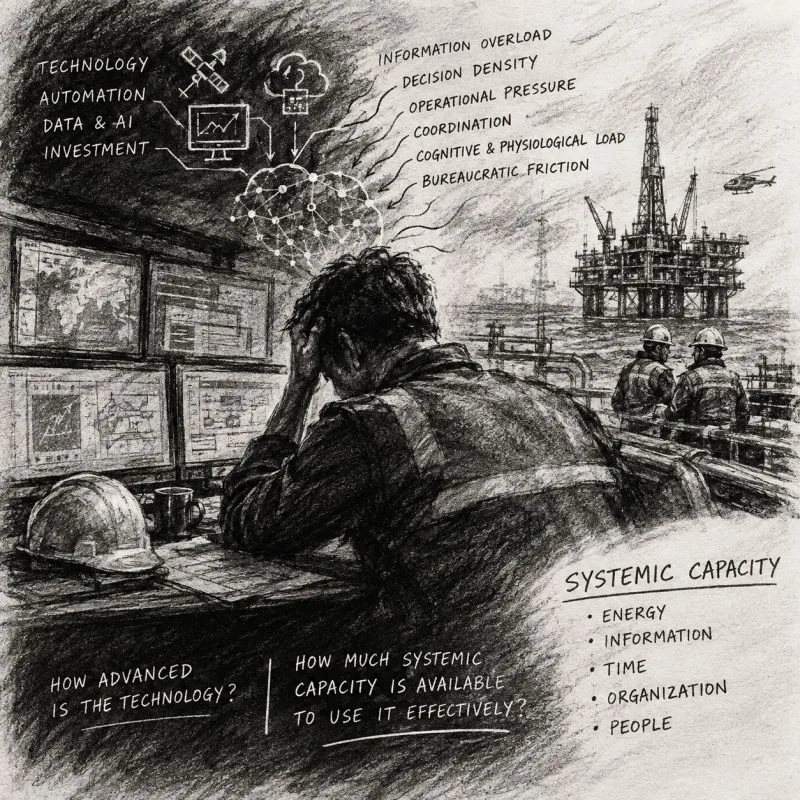
Perché l’alta ingegneria sbaglia proprio quando la tecnologia è più avanzata?
Nell’Oil & Gas e in altre operazioni complesse, più tecnologia non garantisce decisioni migliori: questo testo indaga la capacità sistemica, quanto un sistema sa assorbire e tradurre in azione sotto pressione.

NOTA-ECO-003 · Economia 5.0
Frankenstein e il petrolio: perché il Venezuela torna a contare nella geopolitica?
Terza puntata della serie: dopo il passaggio dal capitale all'IA e alla concentrazione finanziaria, emerge il nuovo collo di bottiglia, il petrolio, e con esso il Venezuela torna sullo scacchiere geopolitico.