

Planetary systems · NOTA-PLA-001
3/4. The HALO Reactor Is Not a Reactor
By Carlos J. Pérez Pulido · ISHEA Institute ·
Third instalment of the series: the HALO Reactor neither burns nor consumes fuel. The piece dismantles the classic idea of a reactor to describe a system that organises energy rather than spending it.
Note — Short piece published openly. Thinking in progress, not a result.
Original piece in Spanish.
🌀 3/4. EL HALO REACTOR NO ES UN REACTOR
Ese es el primer error.
Cuando escuchamos “reactor”, pensamos en:
Combustible.
Consumo.
Generación de energía.
Pero el concepto de Halo Reactor rompe eso.
No genera energía.
No la almacena.
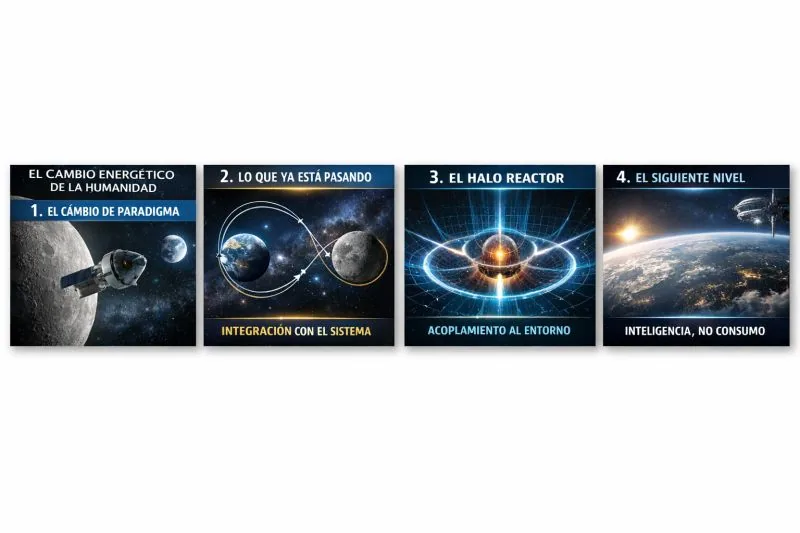
👉 Se acopla al sistema energético existente.
Imagina esto:
En lugar de remar contra el océano…
usas las corrientes.
En lugar de quemar combustible…
usas la geometría del espacio-tiempo.
Eso ya ocurre parcialmente en misiones como Artemis II.
Pero el Halo Reactor lleva ese principio al límite.
«No moverse en el espacio…
sino moverse con el espacio.»
Esto redefine todo:
• Energía
• Propulsión
• Sistemas tecnológicos
No es una tecnología más.
👉 Es un cambio de lenguaje.
#HaloReactor #Physics #Spacetime #FutureOfEnergy
#DeepTech #Innovation #ISHEA #NextFrontier #carlosjperezpulido
In the same room — Planetary systems
NOTA-PLA-002 · Planetary systems
Coherent Energy: From Artemis to HALO
Not a story about rockets, but about the invisible principle nature uses to sustain complex systems, and which is now redefining how missions and machines are designed.

SN-PLA-003 · Planetary systems
Integrating planetary energy flows, solar cycles and biosystem dynamics
The Planetary Energy Flow Index links solar cycles, stratospheric chemistry and bioenergetics inside the HALO framework, offering a reproducible bridge between planetary and biological science

SN-PLA-004 · Planetary systems
Empirical evidence of energy-driven peptide formation
Directed energy drives glycine to form peptides under interplanetary-like conditions, empirical support for universal energy coupling and molecular self-organization within the ECU framework.