

Coherence · OSF-COH-006
Coherence before optimality: the ISHEA EICI across micro, meso and macro scales
By Carlos J. Pérez Pulido · ISHEA Institute ·
An opinion paper arguing that EICI = E × I / F is not a domain-specific tool but a universal index, tested from cellular bioenergetics to national development and planetary biosignatures.
Preprint — Manuscript deposited on OSF. Not peer-reviewed.
Opinion paper submitted for consideration to Trends in Cognitive Sciences. Presents the ISHEA Energetic–Informational Coherence Index (EICI = E×I/F) as a universal coherence index — not a domain-specific tool — applicable from cellular bioenergetics (NAD⁺/ROS/ATP; K-Model) to individual cognition (TACC cycle), organizational dynamics, national development (13-nation CoreSet; r=0.87 vs. Happiness Index), civilizational history, and planetary biosignature detection (Roman Space Telescope protocol). Responds to Bhui et al. (2026, PsyArXiv) by providing the formal constraint their taxonomy identifies as absent. Three measurable states: Δ+1 (coherence), Δ=0 (reorganization threshold), Δ−1 (collapse). Developed and publicly documented prior to Bhui et al. preprint. Parent project: 10.17605/OSF.IO/WST24.
This paper positions the ISHEA EICI framework as a universal coherence index in formal dialogue with Bhui et al. (2026) — "The Roots of Rationality" (MIT, NYU, Columbia, UCL, Brown). While Bhui et al. identify six adaptive dynamics across timescales but leave the constraints problem open, this paper provides the formal resolution at three scales simultaneously: (1) Micro — TACC cycle (Thinking→Assimilation→Creation→Checking) as bioenergetic decomposition of individual cognition; (2) Meso — EICI as organizational coherence instrument (ζ=0.68, panel OLS); (3) Macro — ICC (Collective Cognition Index) as population-level predictor of market, cultural, and genetic adaptive outcomes. Eight empirical cases documented. EICI operates below the No Free Lunch theorem: it measures whether adaptive machinery functions prior to any optimality judgment. Author: C.J. Pérez Pulido, ISHEA Institute, Bologna. Part of K-Model cluster: 10.17605/OSF.IO/WST24.
In the same room — Coherence
NOTA-COH-001 · Coherence
Narrative Is Not Trust: Without Trust, Narrative Loses Its Power
A warning to the corporate and political world: storytelling cannot make up for a weak architecture. Without the structural trust that sustains it, any narrative loses its power.
NOTA-COH-002 · Coherence
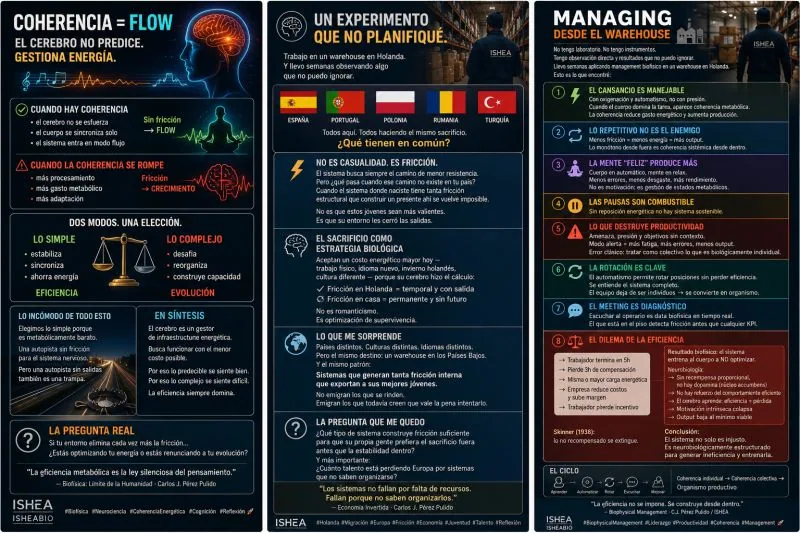
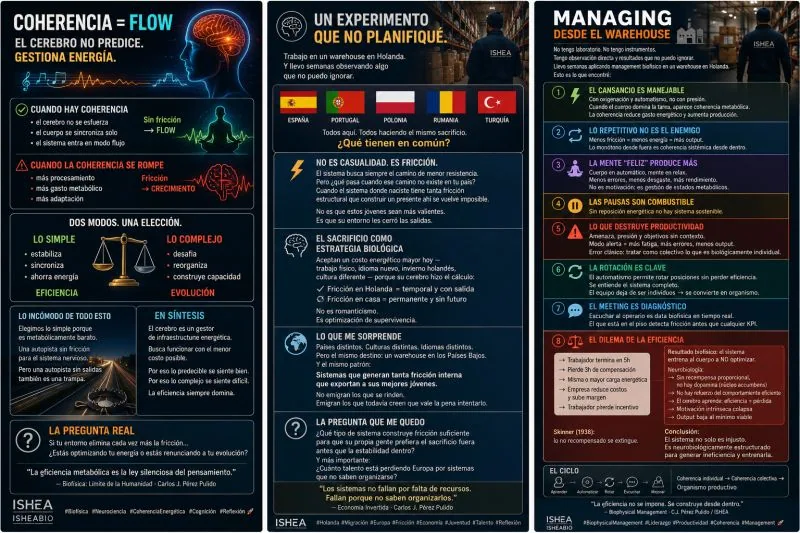
Managing from the Warehouse: Biophysical Management Without a Lab (3/4)
No instruments, no laboratory, only direct observation: weeks of applying biophysical management on a logistics floor, with results too consistent to ignore.
NOTA-COH-003 · Coherence
The Response Is Not Cultural, It Is Biological (1/4)
The body follows the rhythm before the mind decides. The starting point of the series: our response to the environment is explained by biology, not by culture.