

Coherence · OSF-COH-014
ISHEA → EICI → Δ±1: evolution toward an energetic-informational coherence framework
By Carlos J. Pérez Pulido · ISHEA Institute ·
A traceable record of how the ISHEA programme narrowed from a multidimensional human index to the EICI criterion and then to the Δ±1 structural model: the working memory of the framework.
Preprint — Manuscript deposited on OSF. Not peer-reviewed.
This project documents the conceptual and methodological evolution of the ISHEA research program, from its initial formulation as a multidimensional human-centered index (ISHEA) toward a bio-physical and system-level framework based on energetic–informational coherence (EICI), and its subsequent abstraction into the Δ±1 structural model.
The objective of this repository is to provide a transparent and traceable record of the progressive refinement of the framework, highlighting the transition from descriptive, high-dimensional indicators to simplified and potentially transferable representations of system organization.
The project integrates:
conceptual synthesis (including posts published in Nature Communities)
intermediate theoretical formulations and preprints
supporting analyses and domain-specific applications
links to ongoing peer-reviewed submissions
Rather than presenting a finalized theory, this repository reflects an active research program exploring whether coherence concentration — defined as the distribution of organized structures within dissipative environments — may represent a recurring structural motif across complex systems.
Current work focuses on:
operational definitions of coherence (Δ)
cross-domain parameterization strategies
validation through biological, physical, and computational systems
This project is intended to support transparency, reproducibility, and constructive scientific dialogue.
PHASE 1
┌──────────────────────────────────────────┐
│ ISHEA │
│ Expanded Human Satisfaction Index │
│ │
│ - Multidimensional │
│ - Socio-economic focus │
│ - High complexity │
└──────────────────────────────────────────┘
↓
Conceptual refinement
PHASE 2
┌──────────────────────────────────────────┐
│ Energetic Transition │
│ │
│ - Energy as core constraint │
│ - Reduction of variables │
│ - Emergence of coherence │
└──────────────────────────────────────────┘
↓
Structural simplification
PHASE 3
┌──────────────────────────────────────────┐
│ EICI │
│ Energetic–Informational Coherence Index │
│ │
│ - Coherence vs Dissipation │
│ - Bio-physical grounding │
│ - System-level efficiency │
└──────────────────────────────────────────┘
↓
Abstraction
PHASE 4
┌──────────────────────────────────────────┐
│ Δ±1 Framework │
│ │
│ Δ+1 → Coherent Nodes │
│ Δ−1 → Dissipative Background │
│ │
│ - Cross-domain structure │
│ - Reduced complexity │
└──────────────────────────────────────────┘
↓
Scientific validation
PHASE 5
┌──────────────────────────────────────────┐
│ Validation Pipeline │
│ │
│ Nature Communities → Conceptual Layer │
│ OSF → Traceability & Preprints │
│ Journals → Peer Review │
│ │
│ (e.g. Scientific Reports / npj Aging) │
└──────────────────────────────────────────┘
🧠 **ISHEA → EICI → Δ±1
Energetic–Informational Coherence Research Program**
Overview
This project documents the evolution of the ISHEA research framework, from its initial formulation as a multidimensional human-centered index toward a bio-physical and structural approach based on energetic–informational coherence.
The research progresses through three main stages:
ISHEA — descriptive, multidimensional index
EICI — bio-physical coherence framework
Δ±1 — structural abstraction across domains
The goal is to explore whether coherence concentration within dissipative environments represents a recurring organizational pattern in complex systems.
Research Motivation
Many complex systems — biological, physical, and computational — exhibit a common feature:
A limited subset of organized structures disproportionately influences system behavior.
This observation motivates the central question:
Is this pattern domain-specific, or does it reflect a deeper structural constraint?
Framework Evolution
Phase I — ISHEA (Expanded Human Satisfaction Index)
Multidimensional socio-economic model
Integrates needs, opportunity, progress, and institutions
High descriptive power, but limited physical grounding
Phase II — Energetic Transition
Identification of energy as a fundamental constraint
Shift from indicators → underlying system drivers
Emergence of coherence as a central concept
Phase III — EICI (Energetic–Informational Coherence Index)
Focus on:
energetic flow
coherence
dissipation
Reframes system performance as a balance between:
organized behavior
entropy and energy loss
Phase IV — Δ±1 Structural Framework
Abstract representation of system organization
Conceptual definition:
Δ+1: localized coherence (organized, high influence)
Δ−1: dissipative background (noise, entropy)
This formulation aims to provide a common descriptive language across domains.
Core Hypothesis
Across diverse systems:
Coherent structures concentrate influence, while surrounding regions remain dissipative.
The research explores whether this reflects:
a structural invariance, or
a convergent but domain-specific phenomenon
Domains of Application
The framework is being explored across:
Fluid dynamics (turbulence, vortices)
Neural systems (synchronization hubs)
Dynamical systems (attractors)
Cellular bioenergetics (PMF, redox balance)
Plasma physics (filaments, flux tubes)
Research Structure
This project is part of a broader research pipeline:
Conceptual layer
Posts published in Nature Communities
Intermediate layer
OSF preprints and working documents
Validation layer
Manuscripts currently under peer review
Current Status
Ongoing work includes:
operational definition of Δ (coherence measure)
domain-specific parameterization
sensitivity and comparative analyses
preparation of peer-reviewed publications
Methodological Direction
The research combines:
conceptual modeling
system-level analysis
bioenergetic interpretation
cross-domain comparison
Future work aims to include:
mathematical formalization
computational modeling
empirical validation
Key Research Questions
Can coherence be defined in a domain-independent way?
Is Δ measurable across different systems?
Do coherence transitions precede system instability?
Can this framework improve prediction or control of complex systems?
Repository Structure
This OSF project includes:
conceptual documents
framework evolution records
domain-specific analyses
preprints and working papers
links to external publications
Epistemological Position
This work does not claim a universal physical law.
Instead, it proposes:
a recurring structural pattern that may reflect constraints in energetic organization.
The framework is exploratory and intended for progressive validation.
Contribution and Feedback
This is an open and evolving research program.
Constructive feedback, domain-specific critique, and collaborative exploration are welcome.
Author
Carlos Pérez Pulido
ISHEA Institute — Universal Coherence Division
In the same room — Coherence
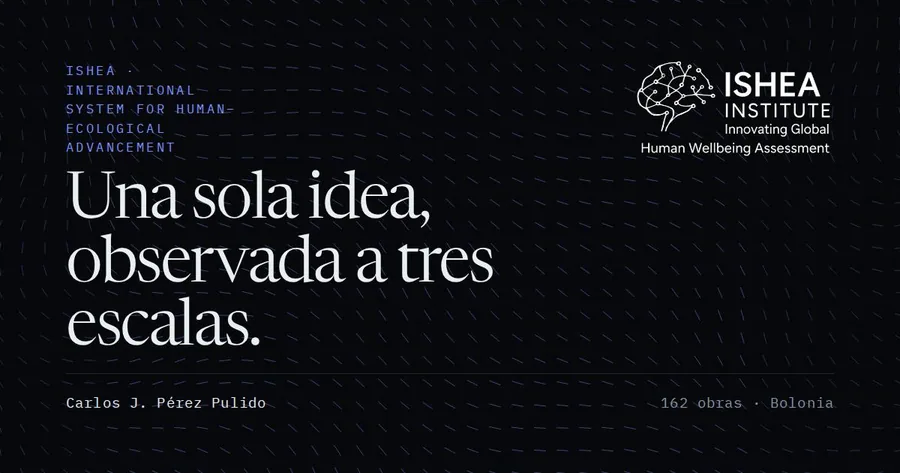
NOTA-COH-001 · Coherence
Narrative Is Not Trust: Without Trust, Narrative Loses Its Power
A warning to the corporate and political world: storytelling cannot make up for a weak architecture. Without the structural trust that sustains it, any narrative loses its power.
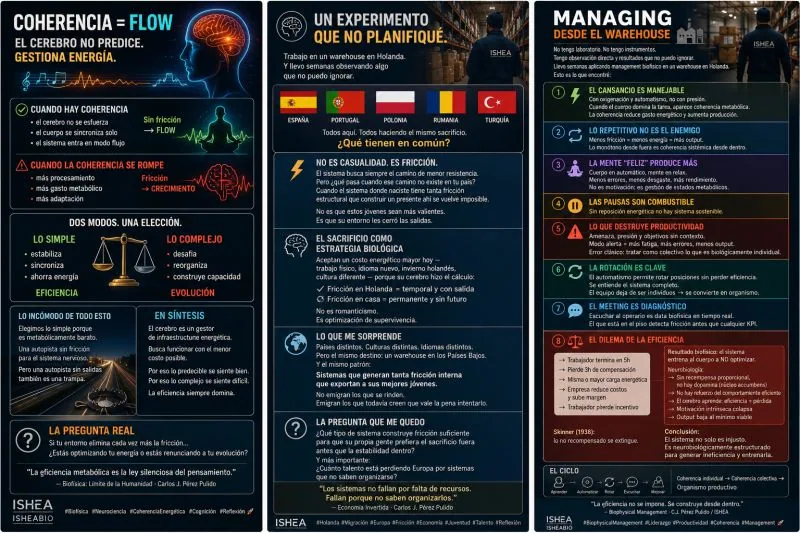
NOTA-COH-002 · Coherence
Managing from the Warehouse: Biophysical Management Without a Lab (3/4)
No instruments, no laboratory, only direct observation: weeks of applying biophysical management on a logistics floor, with results too consistent to ignore.
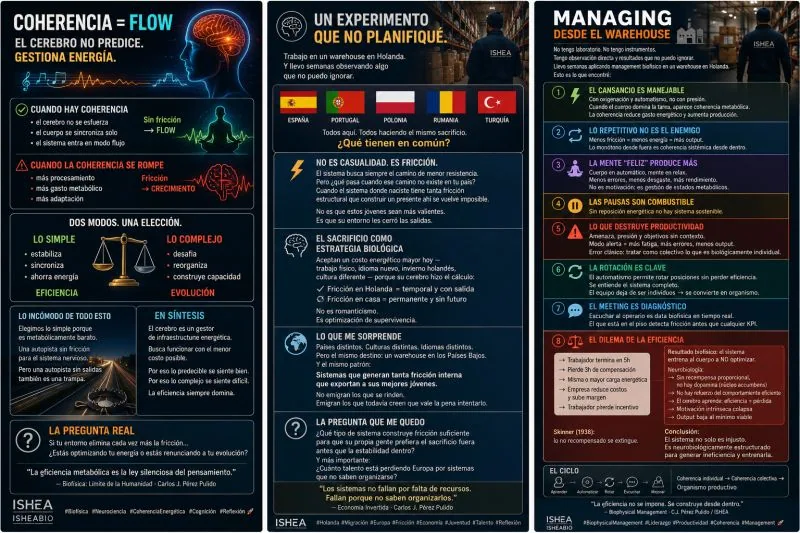
NOTA-COH-003 · Coherence
The Response Is Not Cultural, It Is Biological (1/4)
The body follows the rhythm before the mind decides. The starting point of the series: our response to the environment is explained by biology, not by culture.