

Bioenergética · OSF-BIO-138
De la sincronía bioenergética a la colmena narrativa
Por Carlos J. Pérez Pulido · ISHEA Institute ·
Modelo integrador en el que los factores FOXP actúan como compuertas de fidelidad bioenergética: traducen la instrucción genética en conducta dentro de los límites que fijan el cortisol y la mitocondria
Preprint — Manuscrito depositado en OSF. Sin revisión por pares.

Pieza original en inglés.
This project presents the ISHEA framework — an integrative systems model that bridges genetic regulation, bioenergetic dynamics, and digital phenotyping to understand and enhance human resilience and brain health. Central to the model are Forkhead Box (FOX) transcription factors, which act as "bioenergetic fidelity gates" that translate genetic instructions into neural and behavioral outputs under the energetic constraints imposed by cortisol and mitochondrial function.
The framework is structured around the TACC cycle (Knowledge–Transfer–Assimilation–Creative Action–Resilience), which maps how molecular signals propagate across biological scales to shape adaptive capacity. Disruptions in this flow—due to chronic stress, nutrient imbalance, or circadian misalignment—manifest as measurable changes in digital biomarkers such as heart rate variability (HRV), vocal prosody, and sleep architecture.
This OSF project documents the theoretical foundations, key hypotheses, and proposed validation pathways for non-pharmacological neuroprotection strategies grounded in real-time biofeedback and personalized lifestyle interventions.
Bioenergetic Fidelity Gates: Genetic-to-Neural Translation in the ISHEA Framework
Overview
The ISHEA Bio Collective proposes a unified systems model for understanding how genetic potential is translated into neural resilience through bioenergetic fidelity. At the core of this model are FOX transcription factors, which serve as context-sensitive interpreters of DNA instructions, gated by energy availability and cortisol signaling.
Core Components
1. Genetic Axis
- FOX proteins (e.g., FOXP1, FOXP2, FOXO1/3, FOXP3) regulate immune tolerance, neural plasticity, longevity, and stress response.
- They function as fidelity gates: only when cellular energy (ATP) and redox balance are sufficient do they permit coherent gene expression.
2. Bioenergetic Axis
- Cortisol modulates mitochondrial efficiency and resource allocation.
- Chronic elevation diverts ATP, impairs protein synthesis, and disrupts FOX-mediated transcription → loss of systemic coherence.
3. TACC Framework
A five-phase cycle describing adaptive information flow:
- Knowledge: Genetic and nutritional substrate
- Transfer: FOX-mediated transcription under cortisol modulation
- Assimilation: Mitochondrial ATP production enabling protein/neurotransmitter synthesis
- Creative Action: Integration into behavior (speech, emotion, decision-making)
- Resilience: Systemic stability under perturbation, reflected in digital biomarkers
4. Digital Biomarkers
Non-invasive, real-time indicators of bioenergetic-genetic coherence:
- Heart Rate Variability (HRV)
- Vocal prosody and speech dynamics
- Sleep architecture (REM/NREM cycling, fragmentation)
5. Interventions
Non-pharmacological “bioenergetic microhabits” to restore coherence:
- Controlled breathing
- Morning light exposure
- Nutrient timing (e.g., amino acid availability)
- Rhythmic movement
Research Goals
- Validate TACC phase transitions using multi-omics + digital phenotyping
- Develop predictive models linking cortisol rhythms, FOX expression, and HRV/vocal biomarkers
- Create personalized feedback algorithms for resilience optimization (“digital twins”)
Keywords
Forkhead Box, cortisol, mitochondrial bioenergetics, digital phenotyping, human resilience, ISHEA, TACC model, non-pharmacological neuroprotection, systems physiology
References
- Picard & McEwen (2018). Psychosomatic Medicine
- Wang et al. (2018). Nature Reviews Immunology
- Firth, Torous & Yung (2019). The Lancet Psychiatry
- Pérez Pulido (2025). ISHEA Systems Paper Series
En la misma sala — Bioenergética
NOTA-BIO-001 · Bioenergética
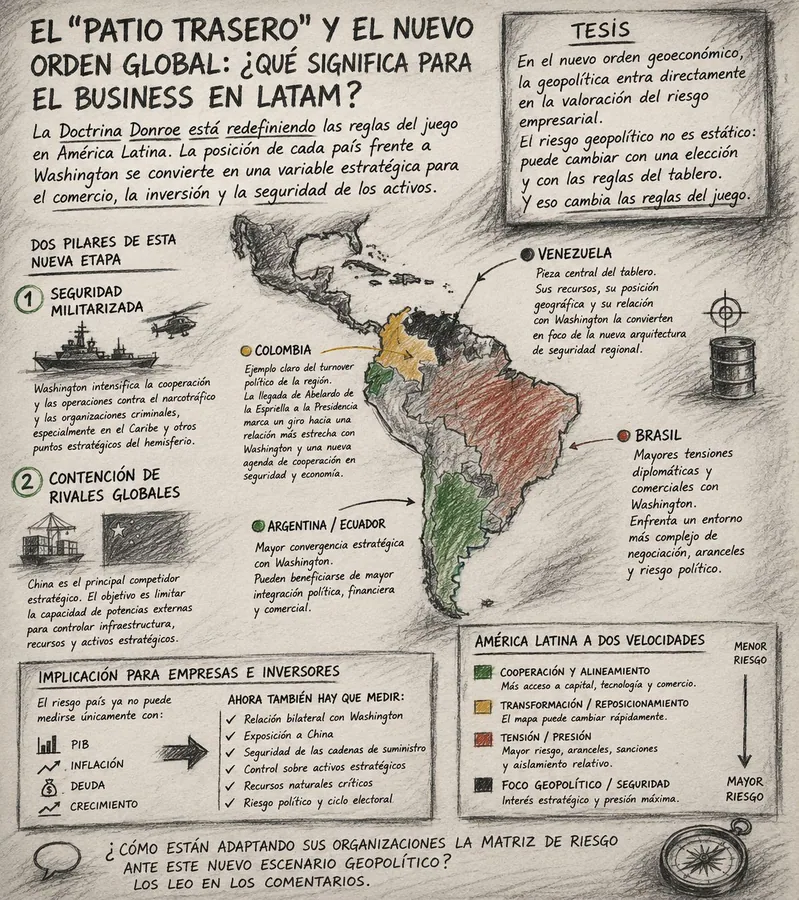
El «patio trasero» y el nuevo orden global: ¿qué significa para el business plan en Latam?
Un análisis de cómo la llamada Doctrina Donroe ha convertido en política explícita la metáfora del «patio trasero» y de lo que ese giro supone para cualquier plan de negocio en América Latina.

NOTA-BIO-002 · Bioenergética
¿Por qué los trabajadores más eficientes se vuelven más lentos a mitad de la jornada?
Para directores de operaciones y gerentes de logística: una lectura bioenergética de por qué los mejores trabajadores pierden productividad a mitad de jornada, un patrón que muchos ven y pocos explican.

NOTA-BIO-003 · Bioenergética
¿Amenaza u oportunidad? La inteligencia artificial y nuestra capacidad creativa
Frente al llamamiento de León XIV a «desarmar la IA», esta pieza sostiene que el riesgo no está en la tecnología, sino en el sistema humano que la usa: bien diseñada, puede liberar capacidad creativa.