

Bioenergetica · OSF-BIO-138
Dalla sincronia bioenergetica all'alveare narrativo
Di Carlos J. Pérez Pulido · ISHEA Institute ·
Modello integrativo in cui i fattori FOXP agiscono come porte di fedeltà bioenergetica: traducono l'istruzione genetica in comportamento entro i limiti fissati dal cortisolo e dai mitocondri
Preprint — Manoscritto depositato su OSF. Senza revisione paritaria.

Opera originale in inglese.
This project presents the ISHEA framework — an integrative systems model that bridges genetic regulation, bioenergetic dynamics, and digital phenotyping to understand and enhance human resilience and brain health. Central to the model are Forkhead Box (FOX) transcription factors, which act as "bioenergetic fidelity gates" that translate genetic instructions into neural and behavioral outputs under the energetic constraints imposed by cortisol and mitochondrial function.
The framework is structured around the TACC cycle (Knowledge–Transfer–Assimilation–Creative Action–Resilience), which maps how molecular signals propagate across biological scales to shape adaptive capacity. Disruptions in this flow—due to chronic stress, nutrient imbalance, or circadian misalignment—manifest as measurable changes in digital biomarkers such as heart rate variability (HRV), vocal prosody, and sleep architecture.
This OSF project documents the theoretical foundations, key hypotheses, and proposed validation pathways for non-pharmacological neuroprotection strategies grounded in real-time biofeedback and personalized lifestyle interventions.
Bioenergetic Fidelity Gates: Genetic-to-Neural Translation in the ISHEA Framework
Overview
The ISHEA Bio Collective proposes a unified systems model for understanding how genetic potential is translated into neural resilience through bioenergetic fidelity. At the core of this model are FOX transcription factors, which serve as context-sensitive interpreters of DNA instructions, gated by energy availability and cortisol signaling.
Core Components
1. Genetic Axis
- FOX proteins (e.g., FOXP1, FOXP2, FOXO1/3, FOXP3) regulate immune tolerance, neural plasticity, longevity, and stress response.
- They function as fidelity gates: only when cellular energy (ATP) and redox balance are sufficient do they permit coherent gene expression.
2. Bioenergetic Axis
- Cortisol modulates mitochondrial efficiency and resource allocation.
- Chronic elevation diverts ATP, impairs protein synthesis, and disrupts FOX-mediated transcription → loss of systemic coherence.
3. TACC Framework
A five-phase cycle describing adaptive information flow:
- Knowledge: Genetic and nutritional substrate
- Transfer: FOX-mediated transcription under cortisol modulation
- Assimilation: Mitochondrial ATP production enabling protein/neurotransmitter synthesis
- Creative Action: Integration into behavior (speech, emotion, decision-making)
- Resilience: Systemic stability under perturbation, reflected in digital biomarkers
4. Digital Biomarkers
Non-invasive, real-time indicators of bioenergetic-genetic coherence:
- Heart Rate Variability (HRV)
- Vocal prosody and speech dynamics
- Sleep architecture (REM/NREM cycling, fragmentation)
5. Interventions
Non-pharmacological “bioenergetic microhabits” to restore coherence:
- Controlled breathing
- Morning light exposure
- Nutrient timing (e.g., amino acid availability)
- Rhythmic movement
Research Goals
- Validate TACC phase transitions using multi-omics + digital phenotyping
- Develop predictive models linking cortisol rhythms, FOX expression, and HRV/vocal biomarkers
- Create personalized feedback algorithms for resilience optimization (“digital twins”)
Keywords
Forkhead Box, cortisol, mitochondrial bioenergetics, digital phenotyping, human resilience, ISHEA, TACC model, non-pharmacological neuroprotection, systems physiology
References
- Picard & McEwen (2018). Psychosomatic Medicine
- Wang et al. (2018). Nature Reviews Immunology
- Firth, Torous & Yung (2019). The Lancet Psychiatry
- Pérez Pulido (2025). ISHEA Systems Paper Series
Nella stessa sala — Bioenergetica
NOTA-BIO-001 · Bioenergetica
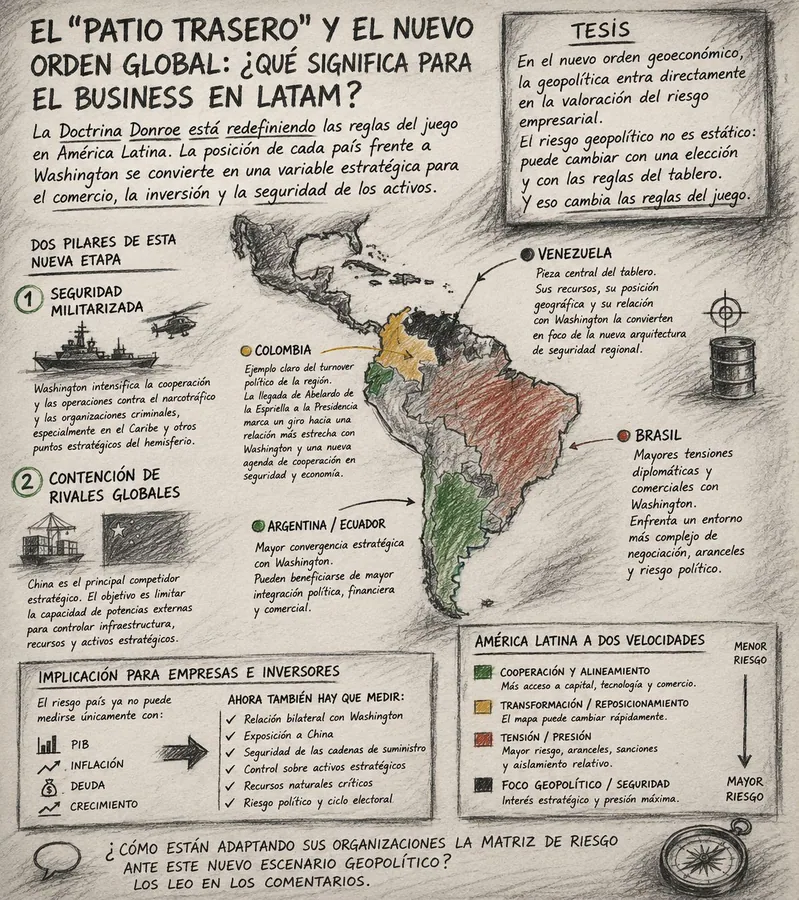
Il «cortile di casa» e il nuovo ordine globale: cosa significa per il business plan in LatAm?
Un'analisi di come la cosiddetta Dottrina Donroe abbia trasformato in politica esplicita la metafora del «cortile di casa» e di ciò che questa svolta comporta per ogni business plan in America Latina.

NOTA-BIO-002 · Bioenergetica
Perché i lavoratori più efficienti rallentano a metà giornata?
Per direttori operativi e responsabili della logistica: una lettura bioenergetica del perché i lavoratori migliori perdono produttività a metà giornata, un fenomeno che molti notano e pochi spiegano.

NOTA-BIO-003 · Bioenergetica
Minaccia o opportunità? L’intelligenza artificiale e la nostra capacità creativa
Di fronte all’appello di Leone XIV a «disarmare l’IA», questo testo sostiene che il rischio non sta nella tecnologia ma nel sistema umano che la usa: ben progettata, può liberare capacità creativa.