

Bioenergetics · OSF-BIO-138
From bioenergetic synchrony to the narrative hive
By Carlos J. Pérez Pulido · ISHEA Institute ·
An integrative model in which FOXP transcription factors act as bioenergetic fidelity gates, translating genetic instruction into behavior within the limits set by cortisol and mitochondrial output
Preprint — Manuscript deposited on OSF. Not peer-reviewed.

This project presents the ISHEA framework — an integrative systems model that bridges genetic regulation, bioenergetic dynamics, and digital phenotyping to understand and enhance human resilience and brain health. Central to the model are Forkhead Box (FOX) transcription factors, which act as "bioenergetic fidelity gates" that translate genetic instructions into neural and behavioral outputs under the energetic constraints imposed by cortisol and mitochondrial function.
The framework is structured around the TACC cycle (Knowledge–Transfer–Assimilation–Creative Action–Resilience), which maps how molecular signals propagate across biological scales to shape adaptive capacity. Disruptions in this flow—due to chronic stress, nutrient imbalance, or circadian misalignment—manifest as measurable changes in digital biomarkers such as heart rate variability (HRV), vocal prosody, and sleep architecture.
This OSF project documents the theoretical foundations, key hypotheses, and proposed validation pathways for non-pharmacological neuroprotection strategies grounded in real-time biofeedback and personalized lifestyle interventions.
Bioenergetic Fidelity Gates: Genetic-to-Neural Translation in the ISHEA Framework
Overview
The ISHEA Bio Collective proposes a unified systems model for understanding how genetic potential is translated into neural resilience through bioenergetic fidelity. At the core of this model are FOX transcription factors, which serve as context-sensitive interpreters of DNA instructions, gated by energy availability and cortisol signaling.
Core Components
1. Genetic Axis
- FOX proteins (e.g., FOXP1, FOXP2, FOXO1/3, FOXP3) regulate immune tolerance, neural plasticity, longevity, and stress response.
- They function as fidelity gates: only when cellular energy (ATP) and redox balance are sufficient do they permit coherent gene expression.
2. Bioenergetic Axis
- Cortisol modulates mitochondrial efficiency and resource allocation.
- Chronic elevation diverts ATP, impairs protein synthesis, and disrupts FOX-mediated transcription → loss of systemic coherence.
3. TACC Framework
A five-phase cycle describing adaptive information flow:
- Knowledge: Genetic and nutritional substrate
- Transfer: FOX-mediated transcription under cortisol modulation
- Assimilation: Mitochondrial ATP production enabling protein/neurotransmitter synthesis
- Creative Action: Integration into behavior (speech, emotion, decision-making)
- Resilience: Systemic stability under perturbation, reflected in digital biomarkers
4. Digital Biomarkers
Non-invasive, real-time indicators of bioenergetic-genetic coherence:
- Heart Rate Variability (HRV)
- Vocal prosody and speech dynamics
- Sleep architecture (REM/NREM cycling, fragmentation)
5. Interventions
Non-pharmacological “bioenergetic microhabits” to restore coherence:
- Controlled breathing
- Morning light exposure
- Nutrient timing (e.g., amino acid availability)
- Rhythmic movement
Research Goals
- Validate TACC phase transitions using multi-omics + digital phenotyping
- Develop predictive models linking cortisol rhythms, FOX expression, and HRV/vocal biomarkers
- Create personalized feedback algorithms for resilience optimization (“digital twins”)
Keywords
Forkhead Box, cortisol, mitochondrial bioenergetics, digital phenotyping, human resilience, ISHEA, TACC model, non-pharmacological neuroprotection, systems physiology
References
- Picard & McEwen (2018). Psychosomatic Medicine
- Wang et al. (2018). Nature Reviews Immunology
- Firth, Torous & Yung (2019). The Lancet Psychiatry
- Pérez Pulido (2025). ISHEA Systems Paper Series
In the same room — Bioenergetics
NOTA-BIO-001 · Bioenergetics
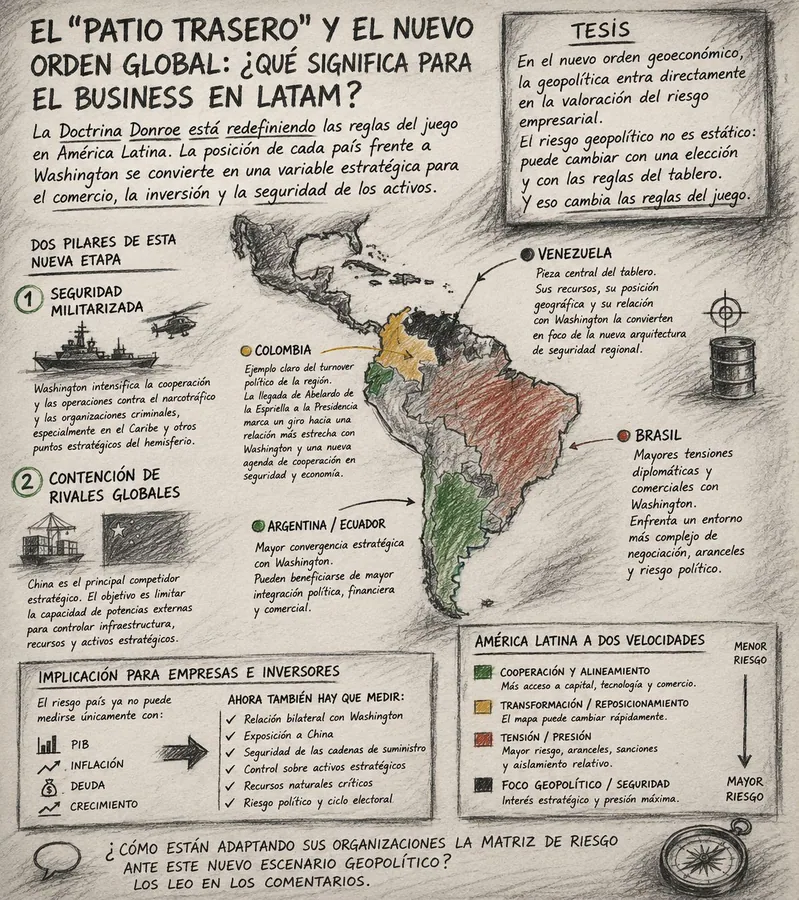
The “Backyard” and the New Global Order: What Does It Mean for the Business Plan in LatAm?
An analysis of how the so-called Donroe Doctrine has turned the “backyard” metaphor into explicit policy, and what that shift means for any business plan built for Latin America.

NOTA-BIO-002 · Bioenergetics
Why do the most efficient workers slow down midway through the workday?
For operations directors and logistics managers: a bioenergetic reading of why top performers lose productivity midway through the workday, a pattern many see and few explain.

NOTA-BIO-003 · Bioenergetics
Threat or opportunity? Artificial intelligence and our creative capacity
Responding to Pope Leo XIV’s call to “disarm AI”, this piece argues that the risk lies not in the technology but in the human system using it: well designed, AI can free up creative capacity.