

Economía 5.0 · NOTA-ECO-051
El café de tu mesa ya no es el mismo
Por Carlos J. Pérez Pulido · ISHEA Institute ·
Como ya ocurrió con la señal de precios de los huevos, las materias primas esenciales dejan de comportarse de forma aislada. El desayuno como indicador de una transformación estructural.
Nota de divulgación — Escrito breve publicado en abierto. Pensamiento en curso, no resultado.
Pieza original en inglés.
☕ Coffee on your table is not the same anymore
> Your breakfast will not feel the same again.
As previously observed in the eggs pricing signal, essential commodities are no longer behaving as isolated markets.
Coffee confirms the same structural pattern.
A bag that cost around US$4.30 in 2020 now approaches US$10 in some markets, without any proportional change in the product itself.
But this is not a coffee story.
It is a systems story.
What we are seeing in coffee is a compressed model of the new global economy:
→ Climate volatility disrupting harvests in Brazil and Vietnam 🌦️
→ Geopolitical fragmentation reshaping trade routes 🌍
→ Tariff divergence and regulatory complexity 🚢
→ Rising logistics, energy, and labor costs 📦
→ Persistent global demand growth 📈
No single factor explains the movement.
Together, they reveal a structural shift:
Prices are no longer formed only at production level — they emerge from interacting global systems.
This is why even when commodity markets stabilize, retail prices often remain elevated.
Because value is no longer localized.
In parallel, coffee chains are no longer selling coffee alone.
They are selling:
📱 Digital interaction systems
⚙️ Operational efficiency networks
🎯 Behavioral personalization
⏱️ Convenience and time compression
A latte is no longer a beverage.
It is a managed experience inside a service architecture.
From an ISHEA perspective, coffee is not an isolated case.
It is a measurable micro-model of systemic economic transformation.
The bean is the input.
The system is the cause.
---
🧭 ISHEA Insight
What we are observing is not inflation in the traditional sense.
It is emergent pricing, where value is distributed across energy, climate, logistics, technology, behavior, and governance systems simultaneously.
The physical product remains simple.
The pricing reality has become systemic.
---
PD:
As Maza Zabala used to say, the economy is like dry leather — press one side and another rises.
Today, that pressure is global and systemic.
Liquidity and supply-demand alone are no longer enough to explain prices. We are in a multi-system economic structure.
---
#Coffee #Inflation #GlobalEconomy #SupplyChains #Geopolitics #SystemThinking #MacroEconomics #FoodSecurity #Logistics #ISHEA #Economy #FutureOfEconomy
En la misma sala — Economía 5.0

NOTA-ECO-001 · Economía 5.0
¿Y si las variables con las que medimos el éxito de los países estuvieran al revés?
Durante décadas el progreso se ha medido con PIB, productividad, crecimiento y energía. Esta pieza plantea que esas variables podrían estar invertidas y pide repensar qué significa que un país prospere.
NOTA-ECO-002 · Economía 5.0
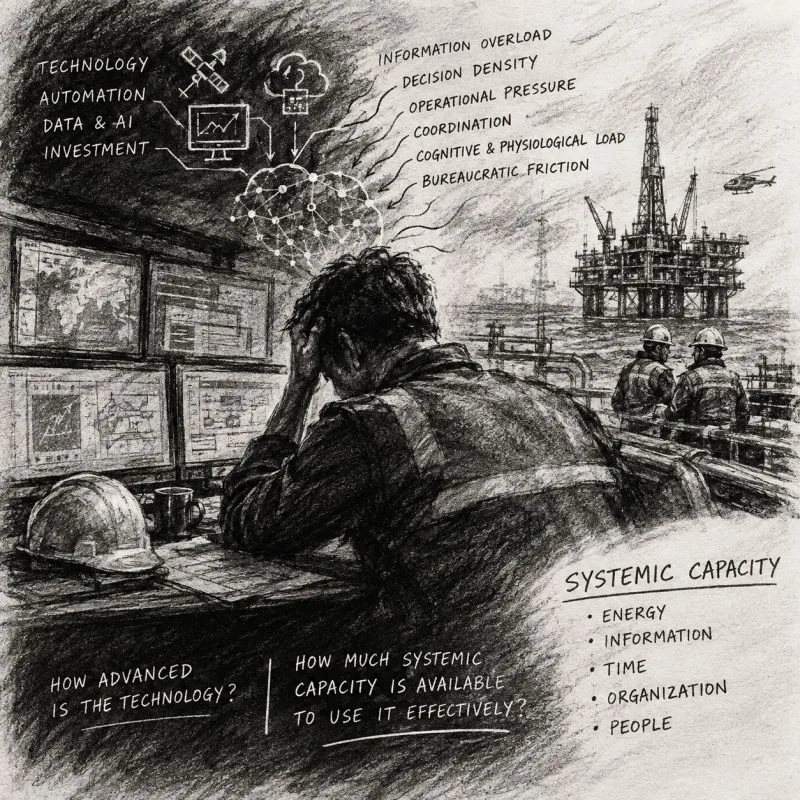
¿Por qué fallan los sistemas de alta ingeniería cuando la tecnología es más avanzada?
En Oil & Gas y otras operaciones complejas, más tecnología no garantiza mejores decisiones: esta pieza estudia la capacidad sistémica, lo que un sistema puede absorber y convertir en acción bajo presión.

NOTA-ECO-003 · Economía 5.0
Frankenstein y el petróleo: ¿por qué Venezuela vuelve a importar geopolíticamente?
Tercera entrega de la serie: tras el paso del capital a la IA y a la concentración financiera, llega el siguiente cuello de botella, el petróleo, y con él Venezuela vuelve al tablero geopolítico.