

Economy 5.0 · NOTA-ECO-051
The coffee on your table is not the same anymore
By Carlos J. Pérez Pulido · ISHEA Institute ·
As already observed in the eggs pricing signal, essential commodities no longer behave in isolation. Breakfast becomes a readable indicator of a deeper structural transformation.
Note — Short piece published openly. Thinking in progress, not a result.
☕ Coffee on your table is not the same anymore
> Your breakfast will not feel the same again.
As previously observed in the eggs pricing signal, essential commodities are no longer behaving as isolated markets.
Coffee confirms the same structural pattern.
A bag that cost around US$4.30 in 2020 now approaches US$10 in some markets, without any proportional change in the product itself.
But this is not a coffee story.
It is a systems story.
What we are seeing in coffee is a compressed model of the new global economy:
→ Climate volatility disrupting harvests in Brazil and Vietnam 🌦️
→ Geopolitical fragmentation reshaping trade routes 🌍
→ Tariff divergence and regulatory complexity 🚢
→ Rising logistics, energy, and labor costs 📦
→ Persistent global demand growth 📈
No single factor explains the movement.
Together, they reveal a structural shift:
Prices are no longer formed only at production level — they emerge from interacting global systems.
This is why even when commodity markets stabilize, retail prices often remain elevated.
Because value is no longer localized.
In parallel, coffee chains are no longer selling coffee alone.
They are selling:
📱 Digital interaction systems
⚙️ Operational efficiency networks
🎯 Behavioral personalization
⏱️ Convenience and time compression
A latte is no longer a beverage.
It is a managed experience inside a service architecture.
From an ISHEA perspective, coffee is not an isolated case.
It is a measurable micro-model of systemic economic transformation.
The bean is the input.
The system is the cause.
---
🧭 ISHEA Insight
What we are observing is not inflation in the traditional sense.
It is emergent pricing, where value is distributed across energy, climate, logistics, technology, behavior, and governance systems simultaneously.
The physical product remains simple.
The pricing reality has become systemic.
---
PD:
As Maza Zabala used to say, the economy is like dry leather — press one side and another rises.
Today, that pressure is global and systemic.
Liquidity and supply-demand alone are no longer enough to explain prices. We are in a multi-system economic structure.
---
#Coffee #Inflation #GlobalEconomy #SupplyChains #Geopolitics #SystemThinking #MacroEconomics #FoodSecurity #Logistics #ISHEA #Economy #FutureOfEconomy
In the same room — Economy 5.0

NOTA-ECO-001 · Economy 5.0
What if the variables we use to measure national success were completely backwards?
For decades, progress has been measured through GDP, productivity, growth and energy use. This piece argues those variables may be inverted and asks us to rethink what it means for a country to thrive.
NOTA-ECO-002 · Economy 5.0
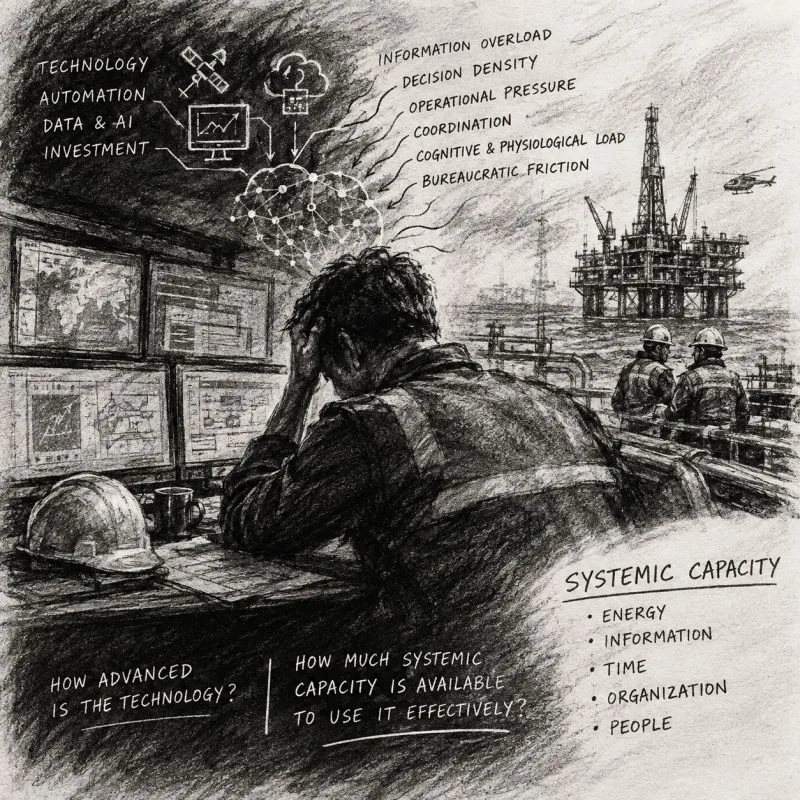
Why do highly engineered systems fail just when technology is most advanced?
In Oil & Gas and other complex operations, more technology does not guarantee better decisions: this piece examines systemic capacity, how much a system can absorb and turn into action under pressure.

NOTA-ECO-003 · Economy 5.0
Frankenstein and Oil: Why Does Venezuela Matter Geopolitically Again?
Third installment of the series: after tracing capital into AI and financial concentration, the next bottleneck comes into view, oil, and with it Venezuela returns to the geopolitical board.