

Economía 5.0 · OSF-ECO-145
El legado de KEY: cómo el conocimiento se transmite a través del tiempo
Por Carlos J. Pérez Pulido · ISHEA Institute ·
Relato transdisciplinar que sigue el conocimiento como proceso vivo, desde la primera molécula autorreplicante hasta la inteligencia artificial, según el ciclo fractal TRAM, TED, ROV y TACC.
Preprint — Manuscrito depositado en OSF. Sin revisión por pares.
Pieza original en inglés.
The Legacy of KEY is a transdisciplinary narrative that traces the evolution of knowledge as a living process—from the first self-replicating molecule to the rise of human consciousness and the emergence of artificial intelligence.
It proposes a universal model—KEY—that unites biology, cognition, and civilization under a single principle:
> All life exists to remember.
Through the archetypes TRAM (transmission), TED (tension), ROV (resolution), and TACC (Theodore–Assim–Crea–Check), the book reveals how every leap in communication—from DNA to writing, from printing to the internet—follows a fractal cycle of replication, crisis, and regeneration.
The text blends scientific precision with poetic clarity. It explores how humanity now faces its greatest evolutionary tension: the gap between technological acceleration (TRAM) and biological cognition (TACC).
Its central question is both philosophical and practical:
> Will artificial intelligence replace human thought—or regenerate it?
The answer, the book suggests, depends on how consciously we transmit what we know.
The Legacy of KEY (2025) by Carlos Pérez Pulido is a philosophical-scientific essay that redefines knowledge as a regenerative process rather than a static possession.
It presents a unified theory of information flow across time, describing how every system—biological, cognitive, or social—passes through four fundamental stages:
Cycle Element Function Evolutionary Expression
KEY The living message DNA, memory, idea
TRAM Transmission mechanism Language, writing, media, AI
TED Entropic tension Crisis, overload, mutation
ROV Revolving resolution Adaptation, regeneration, creation
Later, the TACC model (Theodore, Assim, Crea, Check) formalizes how humans process and regenerate knowledge through curiosity, integration, creativity, and validation.
The book culminates in an ethical and educational manifesto:
Human survival depends not on accumulating data but on cultivating minds capable of questioning, connecting, creating, and verifying.
“Every mind that awakens the TACC cycle in another keeps the universe remembering itself.”
🪶 File Mention (in Spanish)
Archivo original: El_Legado_de_KEY_Carlos_Perez_Pulido.pdf
Versión: Final corregida 2025
Idioma original: Español
Descripción: Manuscrito completo con seis capítulos, epílogo y apéndices (A–C).
Incluye índice, nota del autor, referencias y guía práctica del modelo TACC.
Licencia: Creative Commons Attribution–ShareAlike (CC BY-SA 4.0).
En la misma sala — Economía 5.0

NOTA-ECO-001 · Economía 5.0
¿Y si las variables con las que medimos el éxito de los países estuvieran al revés?
Durante décadas el progreso se ha medido con PIB, productividad, crecimiento y energía. Esta pieza plantea que esas variables podrían estar invertidas y pide repensar qué significa que un país prospere.
NOTA-ECO-002 · Economía 5.0
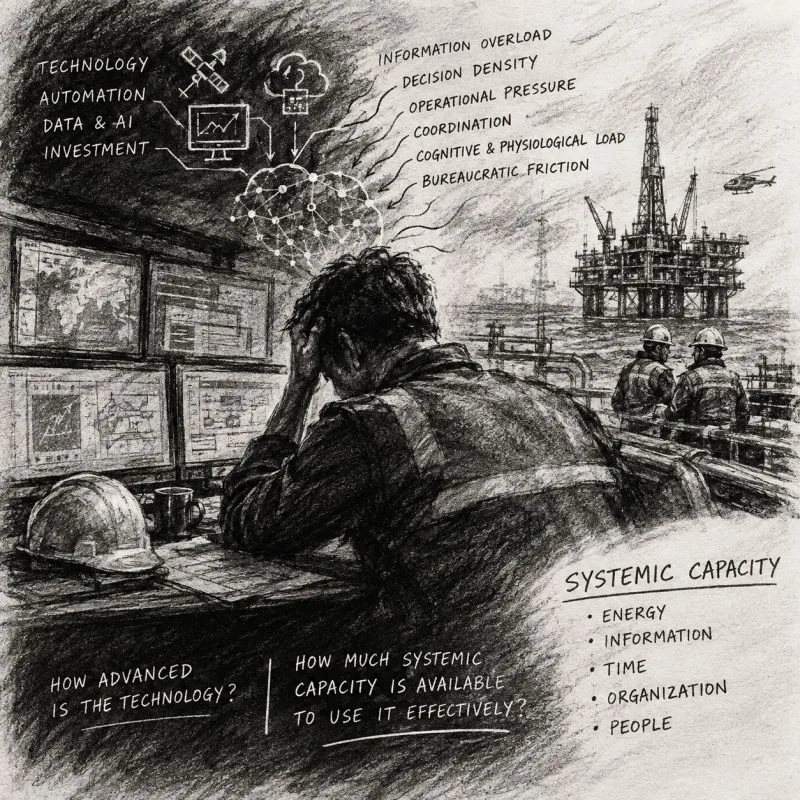
¿Por qué fallan los sistemas de alta ingeniería cuando la tecnología es más avanzada?
En Oil & Gas y otras operaciones complejas, más tecnología no garantiza mejores decisiones: esta pieza estudia la capacidad sistémica, lo que un sistema puede absorber y convertir en acción bajo presión.

NOTA-ECO-003 · Economía 5.0
Frankenstein y el petróleo: ¿por qué Venezuela vuelve a importar geopolíticamente?
Tercera entrega de la serie: tras el paso del capital a la IA y a la concentración financiera, llega el siguiente cuello de botella, el petróleo, y con él Venezuela vuelve al tablero geopolítico.