

Economy 5.0 · OSF-ECO-145
The legacy of KEY: how knowledge transmits itself through time
By Carlos J. Pérez Pulido · ISHEA Institute ·
A transdisciplinary narrative tracing knowledge as a living process, from the first self-replicating molecule to artificial intelligence, through the fractal cycle of TRAM, TED, ROV and TACC.
Preprint — Manuscript deposited on OSF. Not peer-reviewed.
The Legacy of KEY is a transdisciplinary narrative that traces the evolution of knowledge as a living process—from the first self-replicating molecule to the rise of human consciousness and the emergence of artificial intelligence.
It proposes a universal model—KEY—that unites biology, cognition, and civilization under a single principle:
> All life exists to remember.
Through the archetypes TRAM (transmission), TED (tension), ROV (resolution), and TACC (Theodore–Assim–Crea–Check), the book reveals how every leap in communication—from DNA to writing, from printing to the internet—follows a fractal cycle of replication, crisis, and regeneration.
The text blends scientific precision with poetic clarity. It explores how humanity now faces its greatest evolutionary tension: the gap between technological acceleration (TRAM) and biological cognition (TACC).
Its central question is both philosophical and practical:
> Will artificial intelligence replace human thought—or regenerate it?
The answer, the book suggests, depends on how consciously we transmit what we know.
The Legacy of KEY (2025) by Carlos Pérez Pulido is a philosophical-scientific essay that redefines knowledge as a regenerative process rather than a static possession.
It presents a unified theory of information flow across time, describing how every system—biological, cognitive, or social—passes through four fundamental stages:
Cycle Element Function Evolutionary Expression
KEY The living message DNA, memory, idea
TRAM Transmission mechanism Language, writing, media, AI
TED Entropic tension Crisis, overload, mutation
ROV Revolving resolution Adaptation, regeneration, creation
Later, the TACC model (Theodore, Assim, Crea, Check) formalizes how humans process and regenerate knowledge through curiosity, integration, creativity, and validation.
The book culminates in an ethical and educational manifesto:
Human survival depends not on accumulating data but on cultivating minds capable of questioning, connecting, creating, and verifying.
“Every mind that awakens the TACC cycle in another keeps the universe remembering itself.”
🪶 File Mention (in Spanish)
Archivo original: El_Legado_de_KEY_Carlos_Perez_Pulido.pdf
Versión: Final corregida 2025
Idioma original: Español
Descripción: Manuscrito completo con seis capítulos, epílogo y apéndices (A–C).
Incluye índice, nota del autor, referencias y guía práctica del modelo TACC.
Licencia: Creative Commons Attribution–ShareAlike (CC BY-SA 4.0).
In the same room — Economy 5.0

NOTA-ECO-001 · Economy 5.0
What if the variables we use to measure national success were completely backwards?
For decades, progress has been measured through GDP, productivity, growth and energy use. This piece argues those variables may be inverted and asks us to rethink what it means for a country to thrive.
NOTA-ECO-002 · Economy 5.0
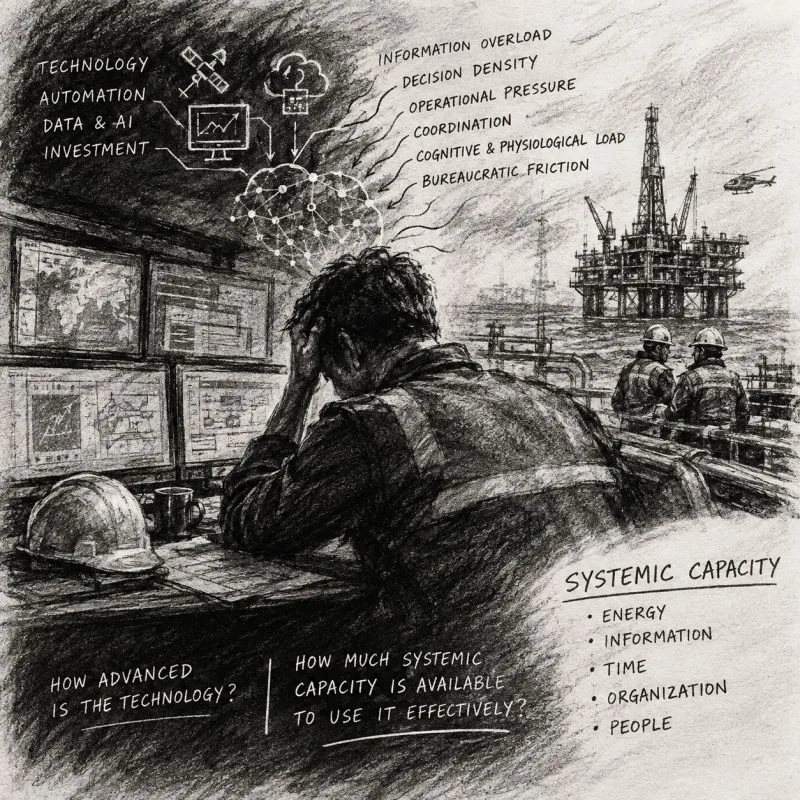
Why do highly engineered systems fail just when technology is most advanced?
In Oil & Gas and other complex operations, more technology does not guarantee better decisions: this piece examines systemic capacity, how much a system can absorb and turn into action under pressure.

NOTA-ECO-003 · Economy 5.0
Frankenstein and Oil: Why Does Venezuela Matter Geopolitically Again?
Third installment of the series: after tracing capital into AI and financial concentration, the next bottleneck comes into view, oil, and with it Venezuela returns to the geopolitical board.