

Economia 5.0 · OSF-ECO-152
L'eredità di KEY: come la conoscenza si trasmette nel tempo
Di Carlos J. Pérez Pulido · ISHEA Institute ·
Racconto transdisciplinare che segue la conoscenza come processo vivo, dalla prima molecola autoreplicante all'intelligenza artificiale, lungo il ciclo frattale TRAM, TED, ROV e TACC.
Preprint — Manoscritto depositato su OSF. Senza revisione paritaria.
Opera originale in inglese.
The Legacy of KEY is a transdisciplinary narrative that traces the evolution of knowledge as a living process—from the first self-replicating molecule to the rise of human consciousness and the emergence of artificial intelligence.
It proposes a universal model—KEY—that unites biology, cognition, and civilization under a single principle:
> All life exists to remember.
Through the archetypes TRAM (transmission), TED (tension), ROV (resolution), and TACC (Theodore–Assim–Crea–Check), the book reveals how every leap in communication—from DNA to writing, from printing to the internet—follows a fractal cycle of replication, crisis, and regeneration.
The text blends scientific precision with poetic clarity. It explores how humanity now faces its greatest evolutionary tension: the gap between technological acceleration (TRAM) and biological cognition (TACC).
Its central question is both philosophical and practical:
> Will artificial intelligence replace human thought—or regenerate it?
The answer, the book suggests, depends on how consciously we transmit what we know.
The Legacy of KEY (2025) by Carlos Pérez Pulido is a philosophical-scientific essay that redefines knowledge as a regenerative process rather than a static possession.
It presents a unified theory of information flow across time, describing how every system—biological, cognitive, or social—passes through four fundamental stages:
Cycle Element Function Evolutionary Expression
KEY The living message DNA, memory, idea
TRAM Transmission mechanism Language, writing, media, AI
TED Entropic tension Crisis, overload, mutation
ROV Revolving resolution Adaptation, regeneration, creation
Later, the TACC model (Theodore, Assim, Crea, Check) formalizes how humans process and regenerate knowledge through curiosity, integration, creativity, and validation.
The book culminates in an ethical and educational manifesto:
Human survival depends not on accumulating data but on cultivating minds capable of questioning, connecting, creating, and verifying.
“Every mind that awakens the TACC cycle in another keeps the universe remembering itself.”
🪶 File Mention (in Spanish)
Archivo original: El_Legado_de_KEY_Carlos_Perez_Pulido.pdf
Versión: Final corregida 2025
Idioma original: Español
Descripción: Manuscrito completo con seis capítulos, epílogo y apéndices (A–C).
Incluye índice, nota del autor, referencias y guía práctica del modelo TACC.
Licencia: Creative Commons Attribution–ShareAlike (CC BY-SA 4.0).
Nella stessa sala — Economia 5.0
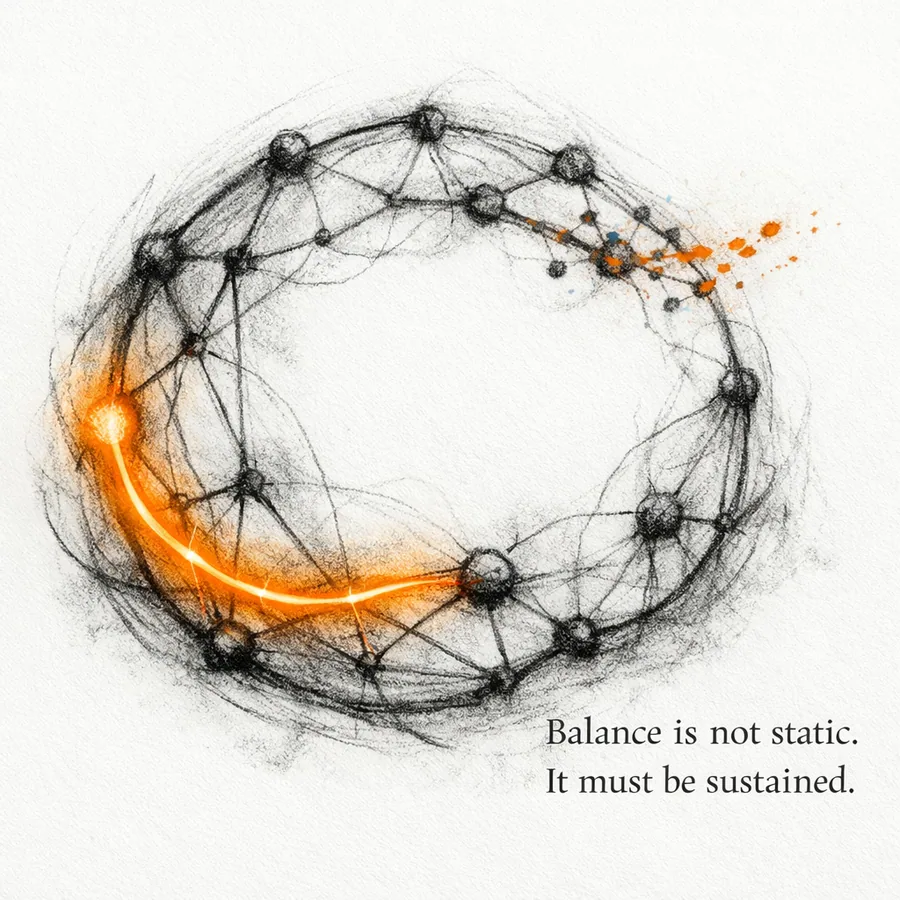
SN-ECO-001 · Economia 5.0
L'economia circolare deve partire dalla progettazione: una prospettiva ISHEA sull'Economy 5.0
L'economia circolare non deve solo recuperare di più, ma progettare per perdere meno. L'Economy 5.0 unisce gemelli digitali, gestione biofisica, design circolare e finanza sostenibile per tutelare il valore sistemico.
SN-ECO-002 · Economia 5.0
Economy 5.0: oltre l'energia e il carbonio, verso la coerenza sistemica
La proposta di ISHEA per Economy 5.0: un quadro economico incentrato sulla persona che, oltre a energia, carbonio ed efficienza, esamina la coerenza sistemica, le capacità umane e la resilienza dei sistemi.
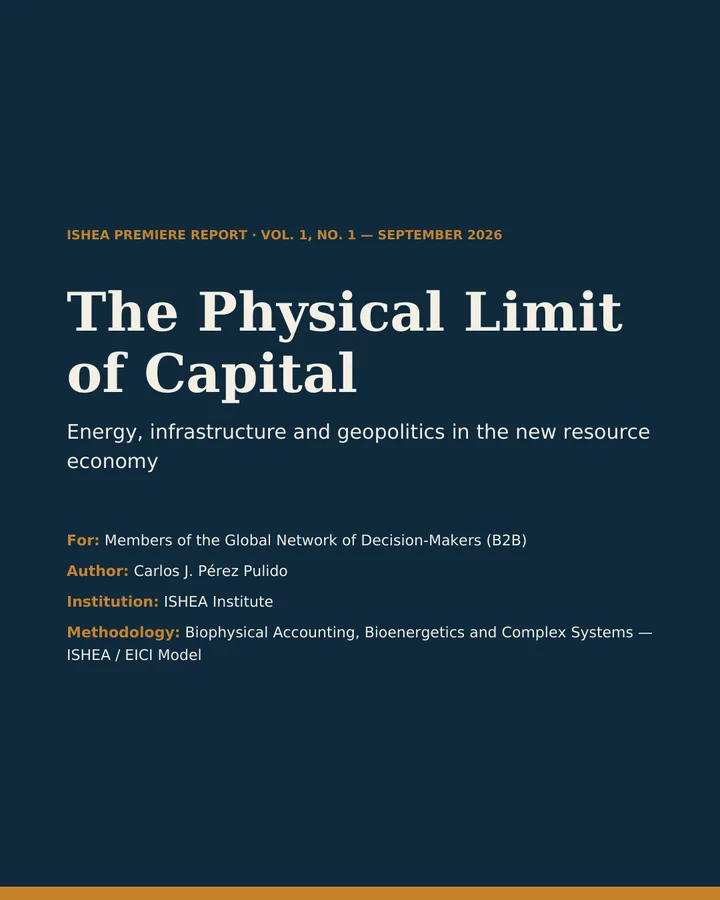
OSF-ECO-003 · Economia 5.0
Il limite fisico del capitale: energia, infrastrutture e geopolitica
Il primo rapporto dell'ISHEA Institute esamina come l'infrastruttura dell'IA, le filiere di energia e minerali e i corridoi marittimi stabiliscano quanto capitale finanziario possa tradursi in economia reale.