

Bioenergética · NOTA-BIO-104
Los herreros dieron paso a los mecánicos: el cambio ya ha empezado
Por Carlos J. Pérez Pulido · ISHEA Institute ·
En 1900 había 21 millones de caballos y herreros prósperos; en 1920 el oficio había desaparecido. La pieza usa ese derrumbe para preguntar qué profesiones viven hoy su propio 1900.
Nota de divulgación — Escrito breve publicado en abierto. Pensamiento en curso, no resultado.
Pieza original en inglés.
⚙️ Blacksmiths gave way to mechanics: Change has already begun – are you ready?
History repeats itself. Always.
1900: 21 million horses, prosperous blacksmiths.
1920: Blacksmiths had disappeared.
Yet what emerged: automotive industry, tire factories, mechanics, gas stations. More jobs, better paid.
📜 The Historical Constant
Every revolution follows the same pattern:
1760-1840: Steam engines → England’s population triples, wages rise 50%
1870-1914: Electricity → US life expectancy 39 → 54 years
1969-2000: Computers → 1 billion people rise out of extreme poverty
*2010-present: AI + Robotics → 97M new jobs vs 85M displaced = +12M net
The numbers don’t lie:
Extreme poverty: 90% (1820) → 8% (2025)
Life expectancy: 32 years (1900) → 73 years (2025)
Global per capita income: $1,100 → $13,000+
⚡ Always Physical Laws: Change is GRADUAL
1. Automobile: 40 years from invention to dominance – needed roads, refineries
2. Electricity: 45 years from light bulb to 50% households – needed plants, grids
3. Internet: 32 years from ARPANET to 50% online – needed fiber, servers
2025 – Energy bottleneck:
AI data centers need 68 GW by 2027
Power plants take 5–15 years vs. data centers 1–2 years
Temporary massive disconnection
> Result: Transition expected in 3–5 years will actually take 10–15 years.
Energy modulates change. Always.
🎯 Knowing the cycles, why not prepare?
#Paradox: 250 years, 4 revolutions, same pattern. Each generation acts surprised.
> The blacksmith of 1900 didn’t see it coming.
The worker of 2025 has no such excuse.
>85M jobs will transform, 97M will emerge. We have 10–15 years.
🚀 Prepare NOW
For Individuals:
✅ Identify if your work is repetitive (high risk)
✅ Invest in automation-proof skills: critical thinking, creativity
✅ Learn to use AI in your profession (human + AI)
✅ Build networks in renewable energy, cybersecurity, data science
For Latin America:
Abundant renewable energy
World-class tech talent
Time to prepare
> But: Don’t export cheap electricity—capture value added. Avoid repeating the copper mistake.
💭 Change Has Already Begun
Difference with the blacksmith of 1900:
He didn’t see change coming. YOU DO.
He didn’t have time. YOU HAVE 10–15 YEARS.
> Blacksmiths gave way to mechanics.
The world doesn’t disappear. It transforms.
And it’s always better on the other side.
But only for those who prepare.
🔑 ISHEA Conclusion:
Change is inevitable. Preparation is optional. What you control is your adaptation and alignment with the system’s flow. That’s the ISHEA vision.
Note: The illustration depicts a futuristic industrial landscape where machines, AI-powered robotics, oil rigs, and automated mining operations coexist. Each machine represents existing technology models:
Autonomous Mining Equipment: Electric and automated drills and trucks
Robotic Manufacturing Lines: Smart assembly and material handling systems
#Technology #FutureOfWork #Progress #Preparation #LatinAmerica #ISHEA
En la misma sala — Bioenergética
NOTA-BIO-001 · Bioenergética
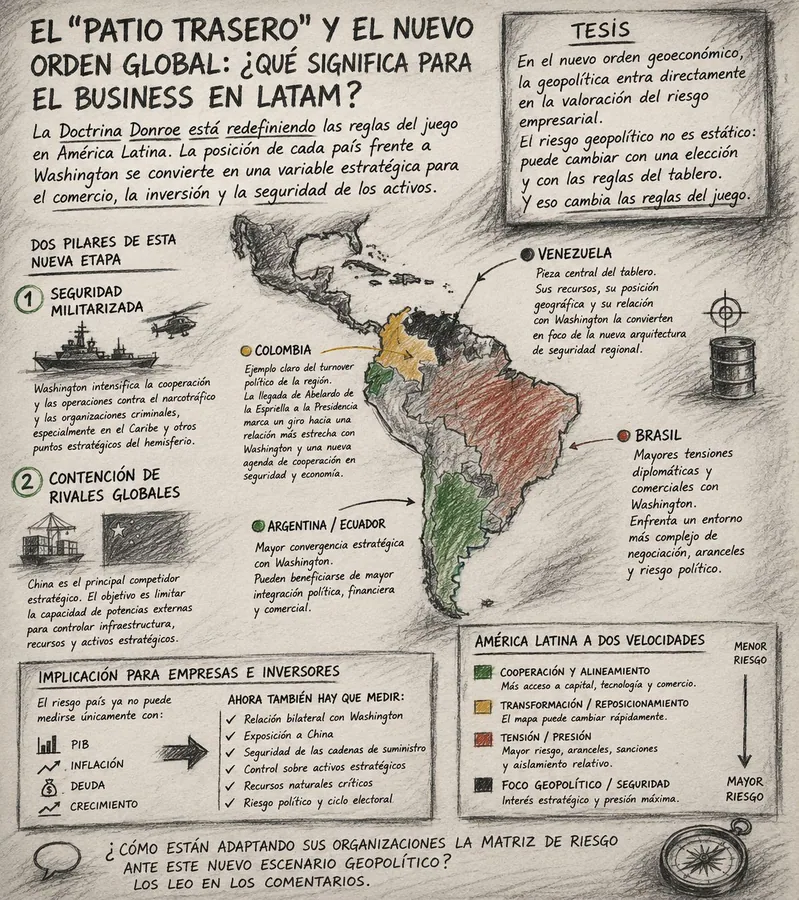
El «patio trasero» y el nuevo orden global: ¿qué significa para el business plan en Latam?
Un análisis de cómo la llamada Doctrina Donroe ha convertido en política explícita la metáfora del «patio trasero» y de lo que ese giro supone para cualquier plan de negocio en América Latina.

NOTA-BIO-002 · Bioenergética
¿Por qué los trabajadores más eficientes se vuelven más lentos a mitad de la jornada?
Para directores de operaciones y gerentes de logística: una lectura bioenergética de por qué los mejores trabajadores pierden productividad a mitad de jornada, un patrón que muchos ven y pocos explican.
NOTA-BIO-003 · Bioenergética
¿Amenaza u oportunidad? La inteligencia artificial y nuestra capacidad creativa
Frente al llamamiento de León XIV a «desarmar la IA», esta pieza sostiene que el riesgo no está en la tecnología, sino en el sistema humano que la usa: bien diseñada, puede liberar capacidad creativa.