

Economía 5.0 · NOTA-ECO-050
Los metales revelan la capa cognitiva de los mercados
Por Carlos J. Pérez Pulido · ISHEA Institute ·
Cobre, oro, litio y acero han dejado de comportarse como materias primas aisladas. Tras la señal del café y los huevos, los metales exponen una capa más profunda de fijación sistémica de precios.
Nota de divulgación — Escrito breve publicado en abierto. Pensamiento en curso, no resultado.
Pieza original en inglés.
🧠 Metals reveal the cognitive layer of markets
If coffee and eggs exposed the first layer of systemic pricing, metals expose something deeper.
Copper, gold, lithium, and steel are no longer behaving as simple commodities driven only by supply and demand.
But:
> "In 1973, an oil embargo changed the price of everything — including products that had nothing to do with oil. Nobody called it systemic then. They called it a crisis. Today, copper, gold and lithium are sending the same signal. And again, most people are looking at the wrong layer."
Their behavior now reflects a multi-layered system:
→ Industrial demand
→ Supply constraints
→ Geopolitical tension
→ Energy transition dynamics
→ Algorithmic and AI-driven expectations
But even this is no longer sufficient to explain price formation.
Because two additional layers are becoming increasingly dominant:
---
1. Expectation & narrative layer
Markets increasingly price the future before it happens.
Not through intuition, but through structured anticipation systems:
• AI-driven forecasting
• Macro scenario modeling
• Risk anticipation frameworks
• Speculative positioning of capital
In this layer, prices are no longer reacting to reality.
They are reacting to modeled futures of reality.
---
2. Cognitive interaction layer (ISHEA perspective)
At a deeper level, markets are not only reacting to information.
They are reacting to collective interpretation of information under uncertainty.
This produces emergent pricing behavior driven by:
• perceived scarcity rather than absolute scarcity
• risk perception rather than measured risk
• security-seeking behavior under stress
• behavioral heuristics at scale
---
🧭 ISHEA Insight
At this level, the market is no longer only an economic mechanism.
It becomes a global coordination system for survival behavior.
A distributed network of billions of agents continuously adjusting decisions based on perceived threats, opportunities, and narrative signals about the future.
Traditional analysis reduces markets to KPIs, aggregates, and equilibrium dynamics.
But this misses the core actor in the system:
Not fully rational.
Not purely economic.
But metabolic in drive and cognitive in structure — a large-scale survival-processing architecture operating in real time.
---
In this sense:
The market is not simply a reflection of the economy.
It is cognition, aggregated into system-level behavior.
"This analysis builds on the ISHEA–KTR framework. OSF: https://lnkd.in/dcR5DvFJ"
---
#Metals #Commodities #GlobalEconomy #SystemThinking #MacroEconomics #CognitiveScience #BehavioralEconomics #SupplyChains #Geopolitics #AI #ISHEA #FutureOfEconomy #Markets
En la misma sala — Economía 5.0

NOTA-ECO-001 · Economía 5.0
¿Y si las variables con las que medimos el éxito de los países estuvieran al revés?
Durante décadas el progreso se ha medido con PIB, productividad, crecimiento y energía. Esta pieza plantea que esas variables podrían estar invertidas y pide repensar qué significa que un país prospere.
NOTA-ECO-002 · Economía 5.0
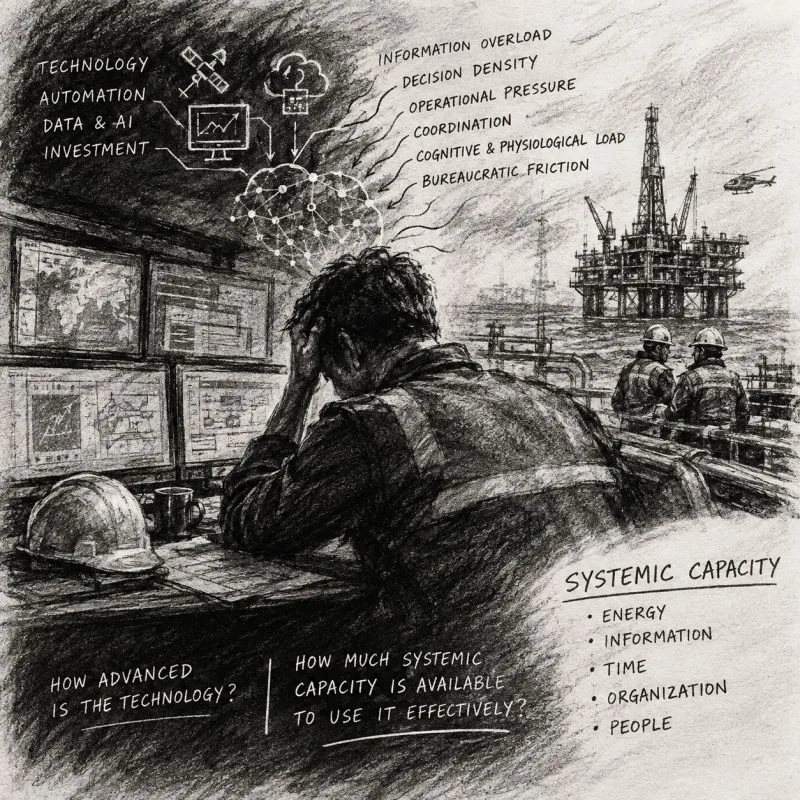
¿Por qué fallan los sistemas de alta ingeniería cuando la tecnología es más avanzada?
En Oil & Gas y otras operaciones complejas, más tecnología no garantiza mejores decisiones: esta pieza estudia la capacidad sistémica, lo que un sistema puede absorber y convertir en acción bajo presión.

NOTA-ECO-003 · Economía 5.0
Frankenstein y el petróleo: ¿por qué Venezuela vuelve a importar geopolíticamente?
Tercera entrega de la serie: tras el paso del capital a la IA y a la concentración financiera, llega el siguiente cuello de botella, el petróleo, y con él Venezuela vuelve al tablero geopolítico.