

Economy 5.0 · NOTA-ECO-050
Metals reveal the cognitive layer of markets
By Carlos J. Pérez Pulido · ISHEA Institute ·
Copper, gold, lithium and steel no longer behave as isolated commodities. After the coffee and eggs signal, metals expose a deeper cognitive layer within systemic pricing.
Note — Short piece published openly. Thinking in progress, not a result.
🧠 Metals reveal the cognitive layer of markets
If coffee and eggs exposed the first layer of systemic pricing, metals expose something deeper.
Copper, gold, lithium, and steel are no longer behaving as simple commodities driven only by supply and demand.
But:
> "In 1973, an oil embargo changed the price of everything — including products that had nothing to do with oil. Nobody called it systemic then. They called it a crisis. Today, copper, gold and lithium are sending the same signal. And again, most people are looking at the wrong layer."
Their behavior now reflects a multi-layered system:
→ Industrial demand
→ Supply constraints
→ Geopolitical tension
→ Energy transition dynamics
→ Algorithmic and AI-driven expectations
But even this is no longer sufficient to explain price formation.
Because two additional layers are becoming increasingly dominant:
---
1. Expectation & narrative layer
Markets increasingly price the future before it happens.
Not through intuition, but through structured anticipation systems:
• AI-driven forecasting
• Macro scenario modeling
• Risk anticipation frameworks
• Speculative positioning of capital
In this layer, prices are no longer reacting to reality.
They are reacting to modeled futures of reality.
---
2. Cognitive interaction layer (ISHEA perspective)
At a deeper level, markets are not only reacting to information.
They are reacting to collective interpretation of information under uncertainty.
This produces emergent pricing behavior driven by:
• perceived scarcity rather than absolute scarcity
• risk perception rather than measured risk
• security-seeking behavior under stress
• behavioral heuristics at scale
---
🧭 ISHEA Insight
At this level, the market is no longer only an economic mechanism.
It becomes a global coordination system for survival behavior.
A distributed network of billions of agents continuously adjusting decisions based on perceived threats, opportunities, and narrative signals about the future.
Traditional analysis reduces markets to KPIs, aggregates, and equilibrium dynamics.
But this misses the core actor in the system:
Not fully rational.
Not purely economic.
But metabolic in drive and cognitive in structure — a large-scale survival-processing architecture operating in real time.
---
In this sense:
The market is not simply a reflection of the economy.
It is cognition, aggregated into system-level behavior.
"This analysis builds on the ISHEA–KTR framework. OSF: https://lnkd.in/dcR5DvFJ"
---
#Metals #Commodities #GlobalEconomy #SystemThinking #MacroEconomics #CognitiveScience #BehavioralEconomics #SupplyChains #Geopolitics #AI #ISHEA #FutureOfEconomy #Markets
In the same room — Economy 5.0

NOTA-ECO-001 · Economy 5.0
What if the variables we use to measure national success were completely backwards?
For decades, progress has been measured through GDP, productivity, growth and energy use. This piece argues those variables may be inverted and asks us to rethink what it means for a country to thrive.
NOTA-ECO-002 · Economy 5.0
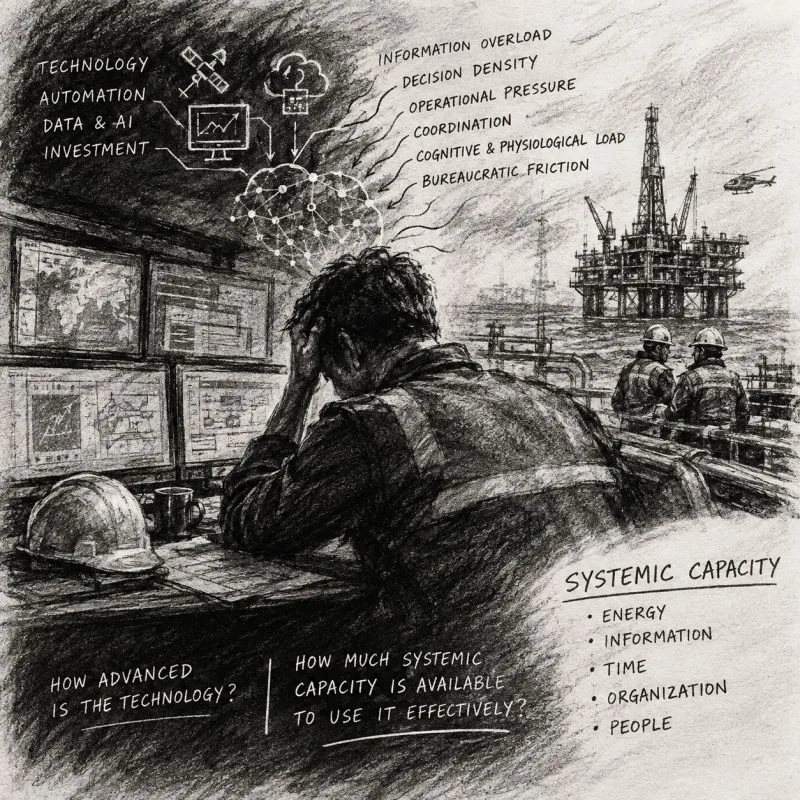
Why do highly engineered systems fail just when technology is most advanced?
In Oil & Gas and other complex operations, more technology does not guarantee better decisions: this piece examines systemic capacity, how much a system can absorb and turn into action under pressure.

NOTA-ECO-003 · Economy 5.0
Frankenstein and Oil: Why Does Venezuela Matter Geopolitically Again?
Third installment of the series: after tracing capital into AI and financial concentration, the next bottleneck comes into view, oil, and with it Venezuela returns to the geopolitical board.