

Cognición colectiva · OSF-COG-004
Modelo de dinámica de estados cognitivos (ICSD): la innovación por estados
Por Carlos J. Pérez Pulido · ISHEA Institute ·
Una teoría de la innovación como transición de fase cognitiva: al unir el criterio EICI con el ciclo TACC, distingue cuatro regímenes internos que una organización puede ocupar antes de innovar.
Preprint — Manuscrito depositado en OSF. Sin revisión por pares.
Pieza original en inglés.
A state-based theoretical framework modeling innovation as a cognitive phase transition. ICSD integrates the EICI coherence criterion and the TACC cycle to identify four internal cognitive regimes — generative coherence (Δ+1), threshold state (CI=0), collapse (Δ−1), and hyperdiffuse — and proposes a complementary internal layer to existing environmental frameworks in organizational innovation theory.
This position paper introduces the Cognitive State Dynamics Model (ICSD), a state-based framework that reconceptualizes innovation as an emergent property of internal cognitive system dynamics. ICSD proposes a framework for understanding innovation not as a linear output process, but as a transition between evolving internal states governed by coherence, entropy, and external constraint pressure.
At the core of ICSD lies the integration of the EICI + TACC architecture. The TACC cycle (Thinking–Assimilation–Creation–Checking), originally developed in Pérez Pulido (2026d), defines the temporal processing dynamics of cognitive states. EICI governs the coupling between external constraint pressure and internal coherence formation.
The framework identifies four cognitive state regimes: Δ+1 (generative coherence), CI=0 (threshold oscillation — the organizational signature of the flat curve), Δ−1 (collapse), and the hyperdiffuse state (entropy-dominated, innovation theatre).
ICSD is intended as a complementary layer rather than an alternative to environmental innovation frameworks. It proposes the internal counterpart to models such as IDEA Flow (El Hadi, 2026), psychological safety theory (Edmondson, 1999), and exploration-exploitation theory (March, 1991) — providing the generative mechanism that explains why enabling conditions work when they work, and why they fail when the internal cognitive state has collapsed.
Keywords: cognitive state dynamics; organizational innovation; EICI; TACC cycle; coherence-entropy balance; metastable generative regime; complex systems; creative cognition.
Author: Carlos J. Pérez Pulido — Founder & Director of Research, ISHEA Institute. ORCID: 0009-0004-1822-4798. OSF Mother Project: 10.17605/OSF.IO/4K9JZ
En la misma sala — Cognición colectiva
NOTA-COG-001 · Cognición colectiva
PISA 2025: ¿qué ocurre cuando aprender demasiado rápido deja de ser aprender?
Una lectura de los resultados de PISA 2025 y de la señal que dejan en el rendimiento de los países de la OCDE: la sospecha de que acelerar el aprendizaje puede terminar vaciándolo de contenido.
NOTA-COG-002 · Cognición colectiva
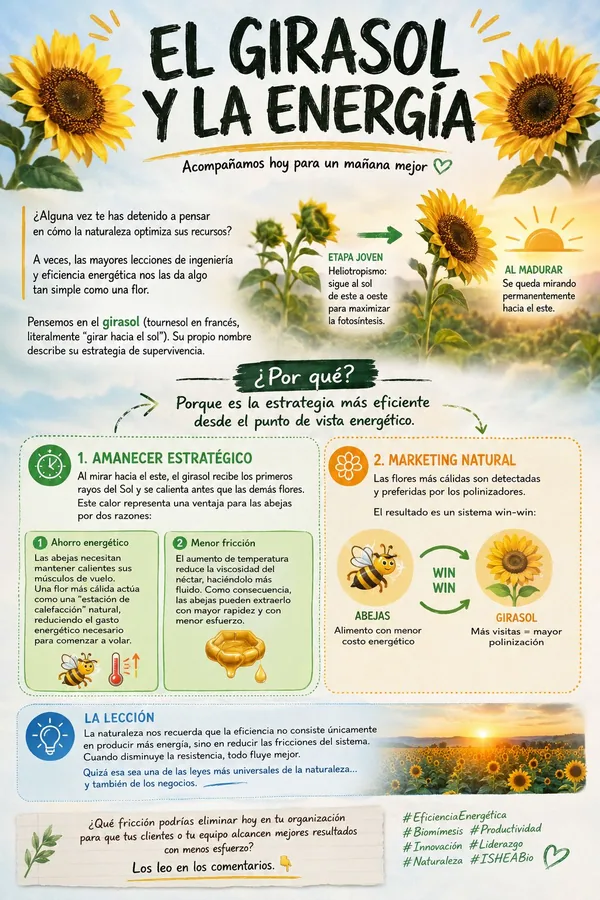
El girasol y la energía
Cómo la naturaleza optimiza sus recursos: el girasol convierte su geometría en una lección de ingeniería y eficiencia energética que la tecnología humana todavía intenta igualar.
OSF-COG-003 · Cognición colectiva
ICSD: dinámica de estados cognitivos (en preparación)
Repositorio en preparación del ICSD, el modelo de dinámica de estados cognitivos; abre el espacio donde se depositarán los materiales del marco EICI + TACC conforme avance la investigación.