

Economía 5.0 · NOTA-ECO-097
Transición y tiempo: las claves del proceso venezolano
Por Carlos J. Pérez Pulido · ISHEA Institute ·
Dos fuerzas gobiernan hoy a Venezuela: la transición y el tiempo. La pieza las separa para explicar por qué, sin ellas, leer el proceso político se vuelve un ejercicio de adivinación.
Nota de divulgación — Escrito breve publicado en abierto. Pensamiento en curso, no resultado.
Pieza original en inglés.
🔑 Transition and Time: The Keys to Venezuela’s Process
Today in Venezuela, two forces shape everything: transition and time
Understanding them isn’t optional—it’s the difference between seeing collapse as an end…or as a phase of systemic reorganization.
🔄 What Is Transition?
Transition is the movement from one state to another.
It doesn’t happen instantly, but through a gradual transformation—where a system sheds one form to reorganize into another.
This is universal:
⚡ Energy transition: energy transforms; it isn’t destroyed.
🌱 Ecological transition: ecosystems recycle matter and energy in interconnected cycles.
🧠 Complex systems: every transition sends ripples—cascading effects that unfold over time.
Intervening without understanding these cycles deepens harm instead of healing it.
🐛 The Caterpillar Metaphor: Cycles, Time, and Perspective
The caterpillar consumes until it becomes a chrysalis.
From the outside, it looks like destruction.
From within, it’s preparation.
Then the butterfly emerges 🦋—
pollinating, regenerating, restoring balance.
Even the chrysalis leaves something behind: silk.
Each phase has its own rhythm. The full cycle is their sum.
And as Einstein reminded us: "time is relative to the observer"⏳.
🔁 Time as Cycles—Not a Straight Line
Seeing time as cycles—not a rigid line—builds resilience.
Every actor lives in a different time:
🐛 For the caterpillar: growth and consumption.
🌿 For the plants: crisis—and unwitting contribution to renewal.
🦋 For the butterfly: emergence; the past dissolved into purpose.
👥 For humanity:
— The caterpillar is a plague
— The chrysalis is raw material
— The butterfly is equilibrium
Each perception shapes—and is shaped by—the observer’s place in the cycle.
🧭 Time Is Relative
Time isn’t absolute.
It depends on where you stand—and what’s at stake.
For some, time is eternal.
For others, strategic.
For many, unbearable.
🇻🇪 Venezuela’s Transition: Multiple Views, Multiple Timelines
There is no single way to understand Venezuela’s transition.
It’s never the same to observe it from:
🏛️ Washington
🏢 Miraflores
🚶 The streets of Venezuela.
Even within the opposition, timelines, priorities, and interpretations diverge deeply.
🧠 Conclusion – ISHEA Vision:
Venezuela is in transition. Not as a political slogan—but as a systemic reality.
The real challenge isn’t to force change, but to:
✔️ Recognize which phase of the cycle we’re in
✔️ Respect the natural timing of the process
✔️ Accept that destruction and regeneration can be two faces of the same transformation
The caterpillar, the chrysalis, and the butterfly are not separate beings.
They are one essence in different states.
🦋 This is not the “butterfly effect”—a random ripple in chaos.
This is structural metamorphosis: a deliberate shift in state, born from necessary dissolution.
#ISHEA #ISHEBio #SystemsThinking #VenezuelaPower 🇻🇪 #Resilience
En la misma sala — Economía 5.0

NOTA-ECO-001 · Economía 5.0
¿Y si las variables con las que medimos el éxito de los países estuvieran al revés?
Durante décadas el progreso se ha medido con PIB, productividad, crecimiento y energía. Esta pieza plantea que esas variables podrían estar invertidas y pide repensar qué significa que un país prospere.
NOTA-ECO-002 · Economía 5.0
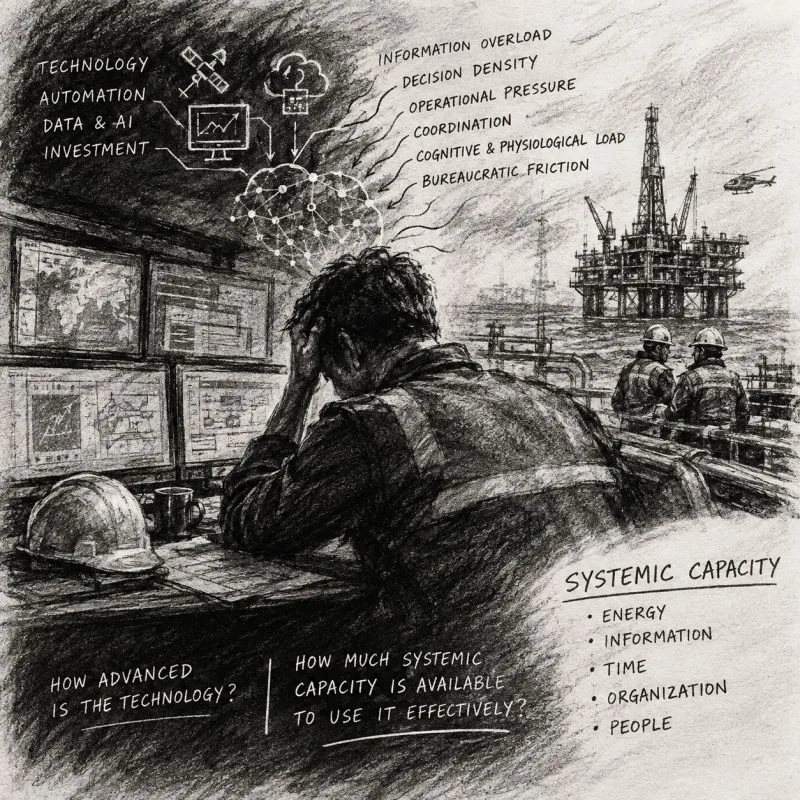
¿Por qué fallan los sistemas de alta ingeniería cuando la tecnología es más avanzada?
En Oil & Gas y otras operaciones complejas, más tecnología no garantiza mejores decisiones: esta pieza estudia la capacidad sistémica, lo que un sistema puede absorber y convertir en acción bajo presión.
NOTA-ECO-003 · Economía 5.0
Frankenstein y el petróleo: ¿por qué Venezuela vuelve a importar geopolíticamente?
Tercera entrega de la serie: tras el paso del capital a la IA y a la concentración financiera, llega el siguiente cuello de botella, el petróleo, y con él Venezuela vuelve al tablero geopolítico.