

Economía 5.0 · NOTA-ECO-095
¿Y si el artículo del MIT sobre el fin de las empresas se quedó corto?
Por Carlos J. Pérez Pulido · ISHEA Institute ·
MIT y Harvard anuncian la Singularidad Coaseana: los agentes de IA harían obsoletas a las empresas al eliminar los costes de transacción. La tesis es certera, pero el diagnóstico se detiene demasiado pronto.
Nota de divulgación — Escrito breve publicado en abierto. Pensamiento en curso, no resultado.
Pieza original en inglés.
🧠 What if the MIT paper on “the end of firms” didn’t go far enough?
MIT/Harvard introduce the Coasean Singularity:
AI agents will make firms obsolete by eliminating transaction costs.
True.
But that framework captures only one of three dimensions of the economic transformation already underway.
⚙️ 1. Transactional Dimension (the visible one)
✅ AI agents reduce transaction costs to near zero.
✅ Firms, as coordinators, lose their raison d’être.
⚠️ The unresolved question:
Who controls the agents?
The user — or the platform?
🏭 2. Material Dimension (the missing one)
The same technologies enabling perfect agents also enable distributed manufacturing.
Example:
Armani designs in Milan.
A micro-factory in São Paulo prints the garment in 30 minutes.
Zero inventory.
Zero transport.
Zero intermediaries.
Firms disappear not only as coordinators — but also as centralized producers.
The real question:
Who owns the digital patterns?
→ Five corporations extracting perpetual royalties?
→ Or open, public, commons-based libraries?
💡 3. Ontological Dimension (the one no one is addressing)
If AI can optimize multidimensional exchanges — ecological value, social impact, time, reputation —
Why do we still need money? 💸
Money emerged because the human brain could not process that level of complexity.
An AI agent can.
Example:
Maria offers 2 hours of design + 5 kWh of solar energy
and receives a shirt + mobility credits.
No money.
Only coherence.
⚖️ Two possible futures
A. Algorithmic Feudalism
→ Monopolies, opaque algorithms, total dependency.
B. Open Commons
→ Open protocols, open-source agents, global cooperation.
There is no middle ground.
Network effects will push us decisively toward one.
⏳ Critical window: 2025–2035
The decisions made this decade will determine which future prevails.
• If we legislate interoperability and invest in digital commons → freedom.
• If we delay → irreversible lock-in.
🚀 ISHEA Proposal – #Economy 5.0
1️⃣ Mandatory interoperability regulation
2️⃣ Public investment in open-source infrastructure
3️⃣ AI cooperatives (10M members = real counter-power)
4️⃣ Municipal pilots for post-monetary economies
5️⃣ A movement for algorithmic sovereignty:
your mind, your agent, your choice
MIT asks: “Will firms disappear?”
I ask: “Who will control the protocols that replace them?”
The first question is technical.
The second is moral, political — and existential.
📄 Full paper: 10.17605/OSF.IO/HDP8W
🧬 ISHEA Institute – Economy 5.0
#FutureOfWork #AI #DigitalEconomy #Innovation #Blockchain #Technology #EconomicFuture #Cooperatives #CoaseanSingularity #ISHEA #Economy50
En la misma sala — Economía 5.0

NOTA-ECO-001 · Economía 5.0
¿Y si las variables con las que medimos el éxito de los países estuvieran al revés?
Durante décadas el progreso se ha medido con PIB, productividad, crecimiento y energía. Esta pieza plantea que esas variables podrían estar invertidas y pide repensar qué significa que un país prospere.
NOTA-ECO-002 · Economía 5.0
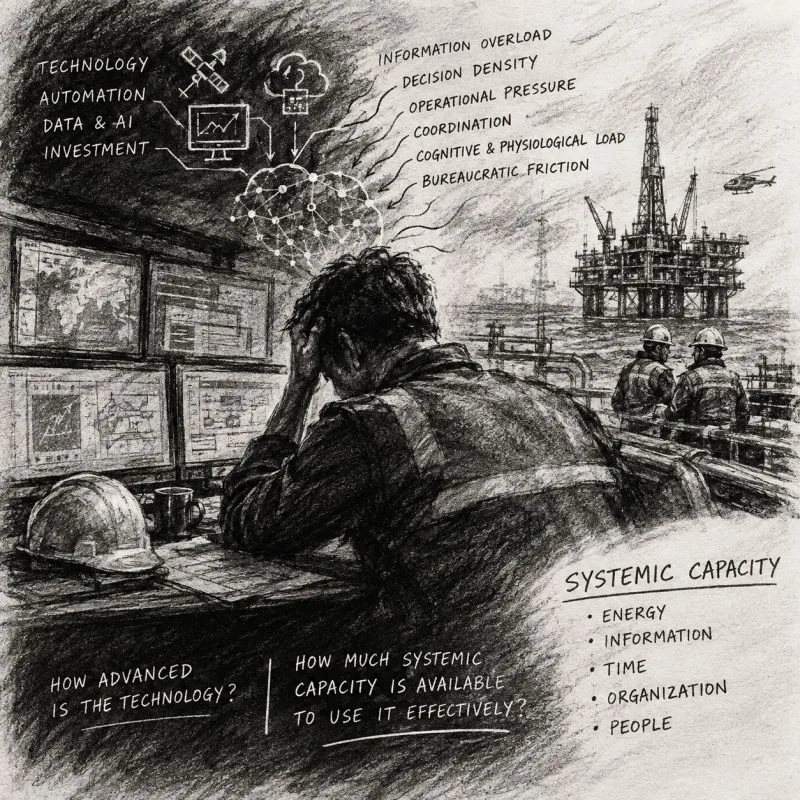
¿Por qué fallan los sistemas de alta ingeniería cuando la tecnología es más avanzada?
En Oil & Gas y otras operaciones complejas, más tecnología no garantiza mejores decisiones: esta pieza estudia la capacidad sistémica, lo que un sistema puede absorber y convertir en acción bajo presión.
NOTA-ECO-003 · Economía 5.0
Frankenstein y el petróleo: ¿por qué Venezuela vuelve a importar geopolíticamente?
Tercera entrega de la serie: tras el paso del capital a la IA y a la concentración financiera, llega el siguiente cuello de botella, el petróleo, y con él Venezuela vuelve al tablero geopolítico.