

Economy 5.0 · NOTA-ECO-095
What if the MIT paper on the end of firms didn't go far enough?
By Carlos J. Pérez Pulido · ISHEA Institute ·
MIT and Harvard propose the Coasean Singularity: AI agents will render firms obsolete by erasing transaction costs. The claim holds, yet the analysis stops short of where the real rupture begins.
Note — Short piece published openly. Thinking in progress, not a result.
🧠 What if the MIT paper on “the end of firms” didn’t go far enough?
MIT/Harvard introduce the Coasean Singularity:
AI agents will make firms obsolete by eliminating transaction costs.
True.
But that framework captures only one of three dimensions of the economic transformation already underway.
⚙️ 1. Transactional Dimension (the visible one)
✅ AI agents reduce transaction costs to near zero.
✅ Firms, as coordinators, lose their raison d’être.
⚠️ The unresolved question:
Who controls the agents?
The user — or the platform?
🏭 2. Material Dimension (the missing one)
The same technologies enabling perfect agents also enable distributed manufacturing.
Example:
Armani designs in Milan.
A micro-factory in São Paulo prints the garment in 30 minutes.
Zero inventory.
Zero transport.
Zero intermediaries.
Firms disappear not only as coordinators — but also as centralized producers.
The real question:
Who owns the digital patterns?
→ Five corporations extracting perpetual royalties?
→ Or open, public, commons-based libraries?
💡 3. Ontological Dimension (the one no one is addressing)
If AI can optimize multidimensional exchanges — ecological value, social impact, time, reputation —
Why do we still need money? 💸
Money emerged because the human brain could not process that level of complexity.
An AI agent can.
Example:
Maria offers 2 hours of design + 5 kWh of solar energy
and receives a shirt + mobility credits.
No money.
Only coherence.
⚖️ Two possible futures
A. Algorithmic Feudalism
→ Monopolies, opaque algorithms, total dependency.
B. Open Commons
→ Open protocols, open-source agents, global cooperation.
There is no middle ground.
Network effects will push us decisively toward one.
⏳ Critical window: 2025–2035
The decisions made this decade will determine which future prevails.
• If we legislate interoperability and invest in digital commons → freedom.
• If we delay → irreversible lock-in.
🚀 ISHEA Proposal – #Economy 5.0
1️⃣ Mandatory interoperability regulation
2️⃣ Public investment in open-source infrastructure
3️⃣ AI cooperatives (10M members = real counter-power)
4️⃣ Municipal pilots for post-monetary economies
5️⃣ A movement for algorithmic sovereignty:
your mind, your agent, your choice
MIT asks: “Will firms disappear?”
I ask: “Who will control the protocols that replace them?”
The first question is technical.
The second is moral, political — and existential.
📄 Full paper: 10.17605/OSF.IO/HDP8W
🧬 ISHEA Institute – Economy 5.0
#FutureOfWork #AI #DigitalEconomy #Innovation #Blockchain #Technology #EconomicFuture #Cooperatives #CoaseanSingularity #ISHEA #Economy50
In the same room — Economy 5.0

NOTA-ECO-001 · Economy 5.0
What if the variables we use to measure national success were completely backwards?
For decades, progress has been measured through GDP, productivity, growth and energy use. This piece argues those variables may be inverted and asks us to rethink what it means for a country to thrive.
NOTA-ECO-002 · Economy 5.0
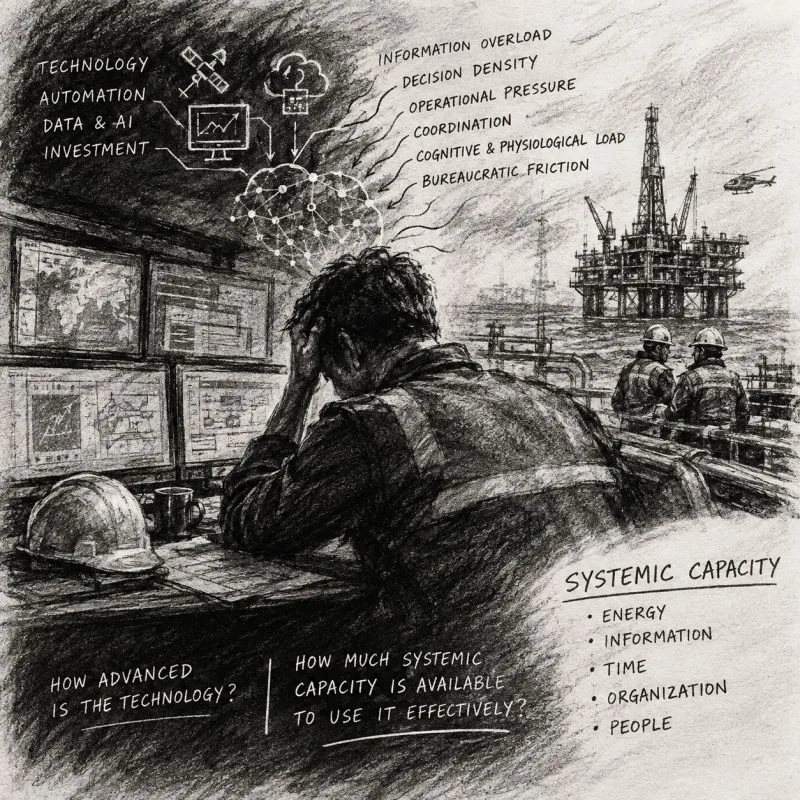
Why do highly engineered systems fail just when technology is most advanced?
In Oil & Gas and other complex operations, more technology does not guarantee better decisions: this piece examines systemic capacity, how much a system can absorb and turn into action under pressure.

NOTA-ECO-003 · Economy 5.0
Frankenstein and Oil: Why Does Venezuela Matter Geopolitically Again?
Third installment of the series: after tracing capital into AI and financial concentration, the next bottleneck comes into view, oil, and with it Venezuela returns to the geopolitical board.