

Sistemas planetarios · OSF-PLA-011
Zona HALO: flujos de energía planetaria y dinámica de los biosistemas
Por Carlos J. Pérez Pulido · ISHEA Institute ·
Capa analítica que cruza observaciones satelitales —protones, ozono, corrientes en chorro— con marcadores bioenergéticos: el flujo de protones emerge como el principal motor de las perturbaciones.
Preprint — Manuscrito depositado en OSF. Sin revisión por pares.
Pieza original en inglés.
The Halo Zone component focuses on the integration of planetary energy flows with solar cycles and biological system responses. It applies the Index to combine satellite observations—including proton and electron fluxes, ozone, and jet streams—with bioenergetic indicators such as intracellular calcium signaling, mitochondrial membrane potential, and ATP production. Proton fluxes are identified as the dominant driver of energy perturbations, with measurable impacts on biological systems. The component emphasizes restoration-aligned strategies and provides fully replicable datasets and methods, forming a core analytical layer (“Halo Zone”) within the parent project.
Wiki: Halo Zone – Integrating Planetary Energy Flows and Biosystem Dynamics
The Halo Zone represents a core analytical layer within the parent project “Analysis of Planetary Energy Flows & Gleissberg Cycle Correlation.” It is designed to integrate multi-scale planetary and biological dynamics, providing a cohesive framework for understanding how solar activity and energetic variability propagate across natural systems. By combining satellite observations of proton and electron fluxes, ozone concentrations, and jet stream dynamics with bioenergetic indicators such as intracellular calcium signaling, mitochondrial membrane potential, and ATP production, the Halo Zone quantifies systemic perturbations and their cascading effects on living systems.
This component applies the Index to map energetic coherence across planetary and biosystem scales. Proton fluxes emerge as the dominant drivers of planetary energy perturbations, while electron flux, atmospheric chemistry, and jet stream variability play secondary but measurable roles. On the biological side, variations in energy availability directly influence cellular and systemic performance, highlighting the critical connection between planetary energetics and biosystem resilience.
The Halo Zone is structured to be fully reproducible and transparent. All datasets, formulas, and computational procedures are openly accessible, enabling independent verification, extension, and integration with complementary research efforts. Its methodology allows for robust sensitivity analyses, identifying the relative influence of each component on the overall system while providing actionable insights for sustainable management of planetary and ecological resources.
By conceptualizing the Halo Zone as an energetic infrastructure layer, the framework emphasizes restoration-aligned strategies over top-down geoengineering approaches. It demonstrates that interventions respecting natural energy flows—rather than imposing artificial control—yield more efficient, durable, and ecologically sound outcomes. This perspective aligns human activities with planetary dynamics, offering a scalable model for guiding long-term sustainability and resilience at multiple scales.
In summary, the Halo Zone bridges planetary-scale energy monitoring and biosystem-level functional dynamics, offering a replicable, evidence-based framework to evaluate environmental perturbations, human impacts, and potential strategies for sustainable interaction with Earth's natural systems.
En la misma sala — Sistemas planetarios
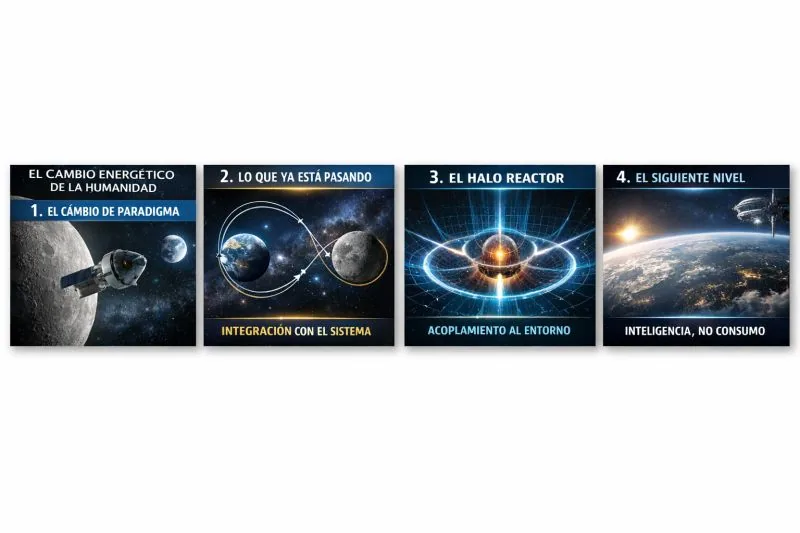
NOTA-PLA-001 · Sistemas planetarios
3/4. El HALO Reactor no es un reactor
Tercera entrega de la serie: el HALO Reactor no quema ni consume combustible. La pieza desmonta la idea clásica de reactor para explicar un sistema que organiza la energía en lugar de gastarla.
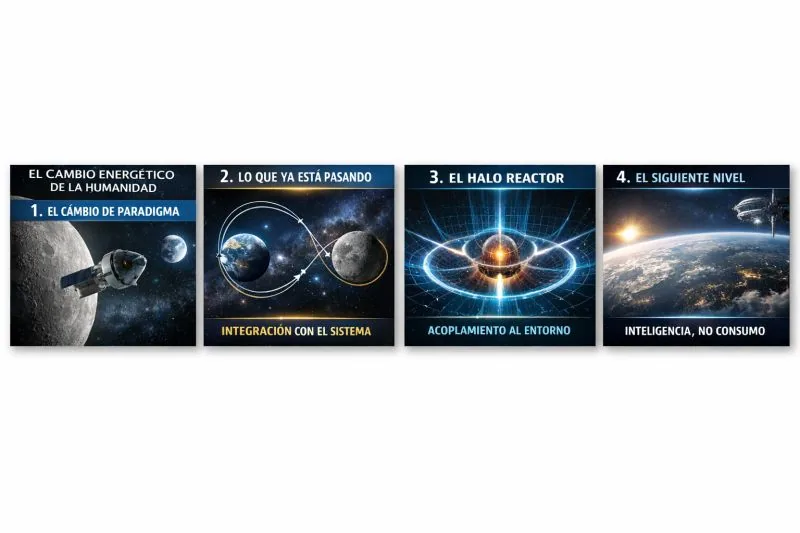
NOTA-PLA-002 · Sistemas planetarios
Energía coherente: de Artemis a HALO
No es una historia sobre cohetes, sino sobre el principio invisible que la naturaleza usa para sostener sistemas complejos y que hoy redefine el diseño de misiones y máquinas.

SN-PLA-003 · Sistemas planetarios
Integración de flujos energéticos planetarios, ciclos solares y dinámica de biosistemas
El índice de flujo energético planetario enlaza ciclos solares, química estratosférica y bioenergética dentro del marco HALO, y tiende un puente reproducible entre la ciencia planetaria y la biológica