

Planetary systems · OSF-PLA-011
HALO Zone: integrating planetary energy flows and biosystem dynamics
By Carlos J. Pérez Pulido · ISHEA Institute ·
An analytical layer pairing satellite observations —proton flux, ozone, jet streams— with bioenergetic markers such as ATP production, identifying proton flux as the dominant driver of perturbation.
Preprint — Manuscript deposited on OSF. Not peer-reviewed.
The Halo Zone component focuses on the integration of planetary energy flows with solar cycles and biological system responses. It applies the Index to combine satellite observations—including proton and electron fluxes, ozone, and jet streams—with bioenergetic indicators such as intracellular calcium signaling, mitochondrial membrane potential, and ATP production. Proton fluxes are identified as the dominant driver of energy perturbations, with measurable impacts on biological systems. The component emphasizes restoration-aligned strategies and provides fully replicable datasets and methods, forming a core analytical layer (“Halo Zone”) within the parent project.
Wiki: Halo Zone – Integrating Planetary Energy Flows and Biosystem Dynamics
The Halo Zone represents a core analytical layer within the parent project “Analysis of Planetary Energy Flows & Gleissberg Cycle Correlation.” It is designed to integrate multi-scale planetary and biological dynamics, providing a cohesive framework for understanding how solar activity and energetic variability propagate across natural systems. By combining satellite observations of proton and electron fluxes, ozone concentrations, and jet stream dynamics with bioenergetic indicators such as intracellular calcium signaling, mitochondrial membrane potential, and ATP production, the Halo Zone quantifies systemic perturbations and their cascading effects on living systems.
This component applies the Index to map energetic coherence across planetary and biosystem scales. Proton fluxes emerge as the dominant drivers of planetary energy perturbations, while electron flux, atmospheric chemistry, and jet stream variability play secondary but measurable roles. On the biological side, variations in energy availability directly influence cellular and systemic performance, highlighting the critical connection between planetary energetics and biosystem resilience.
The Halo Zone is structured to be fully reproducible and transparent. All datasets, formulas, and computational procedures are openly accessible, enabling independent verification, extension, and integration with complementary research efforts. Its methodology allows for robust sensitivity analyses, identifying the relative influence of each component on the overall system while providing actionable insights for sustainable management of planetary and ecological resources.
By conceptualizing the Halo Zone as an energetic infrastructure layer, the framework emphasizes restoration-aligned strategies over top-down geoengineering approaches. It demonstrates that interventions respecting natural energy flows—rather than imposing artificial control—yield more efficient, durable, and ecologically sound outcomes. This perspective aligns human activities with planetary dynamics, offering a scalable model for guiding long-term sustainability and resilience at multiple scales.
In summary, the Halo Zone bridges planetary-scale energy monitoring and biosystem-level functional dynamics, offering a replicable, evidence-based framework to evaluate environmental perturbations, human impacts, and potential strategies for sustainable interaction with Earth's natural systems.
In the same room — Planetary systems
NOTA-PLA-001 · Planetary systems
3/4. The HALO Reactor Is Not a Reactor
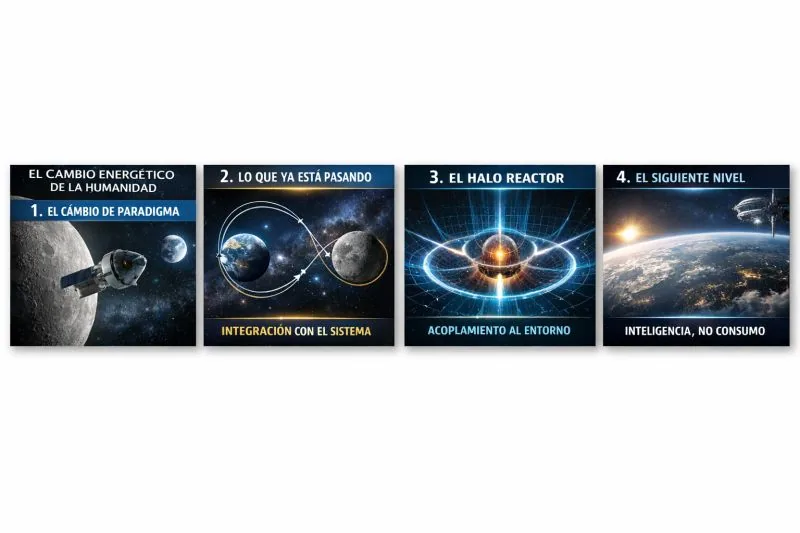
Third instalment of the series: the HALO Reactor neither burns nor consumes fuel. The piece dismantles the classic idea of a reactor to describe a system that organises energy rather than spending it.
NOTA-PLA-002 · Planetary systems
Coherent Energy: From Artemis to HALO
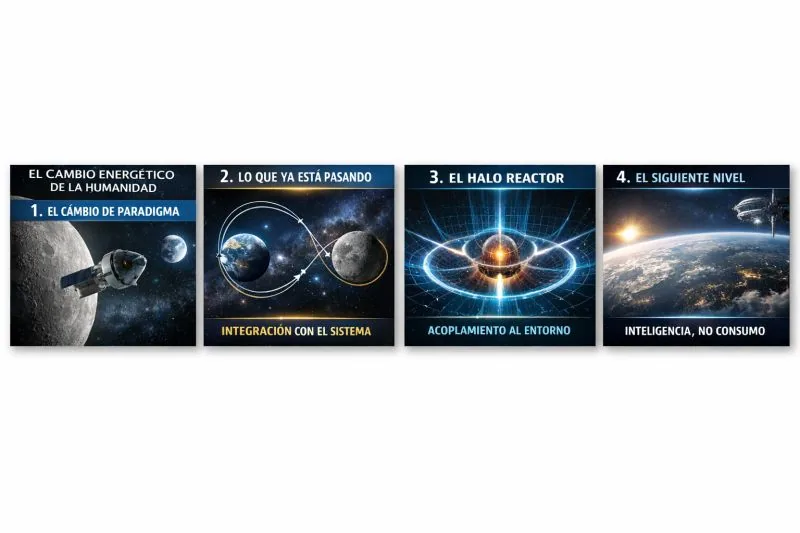
Not a story about rockets, but about the invisible principle nature uses to sustain complex systems, and which is now redefining how missions and machines are designed.

SN-PLA-003 · Planetary systems
Integrating planetary energy flows, solar cycles and biosystem dynamics
The Planetary Energy Flow Index links solar cycles, stratospheric chemistry and bioenergetics inside the HALO framework, offering a reproducible bridge between planetary and biological science