

Cognizione collettiva · OSF-COG-031
Analisi di supporto
Di Carlos J. Pérez Pulido · ISHEA Institute ·
Materiale analitico ausiliario della linea di cognizione dell'ISHEA, conservato come documentazione di lavoro accanto agli studi principali e non come risultato autonomo.
Preprint — Manoscritto depositato su OSF. Senza revisione paritaria.
Opera originale in inglese.
support
Exp 9 – Case Study: Beekeeping under Systemic Stress (Brazil vs. Australia)
Authors: Carlos J. Pérez Pulido / ISHEA Team
Date: July 2025
1. Introduction
This case study analyzes the impact of systemic stress on beekeeping, focusing on:
-
The introduction of Africanized bees in Brazil, which increased conflict sensitivity (β) and systemic tension (T).
-
The implementation of effective sustainability and governance policies in Australia, which strengthened resilience (R) and reduced systemic stress.
The ISHEA + TACC framework is applied to compare trajectories of resilience, systemic governance, and sustainability over a 10-year horizon.
2. Data and Methodology
Data sources:
-
VanderWeele’s Flourishing Index (2017)
-
FAOStat (2024)
-
NOAA Climate Data (2024)
-
Peer-reviewed studies on resilience and apiculture
Formula (ISHEA):
ISHEA = 0.4S + 0.3P + 0.2E + 0.1I
Where:
-
S = Basic satisfaction
-
P = Realistic progress
-
E = Ecological sustainability + Revolving factor
-
I = Governance (character + institutions)
3. Results – Brazil (Africanized Bees)
| Year | S | P | E | I | ISHEA |
|------|-----|-----|------|-----|-------|
| 2020 | 5.5 | 6.0 | 4.75 | 5.6 | 5.54 |
| 2025 | 5.1 | 5.8 | 4.50 | 5.3 | 5.10 |
| 2030 | 4.8 | 5.5 | 4.25 | 5.0 | 4.80 |
Interpretation:
-
Introduction of Africanized bees reduced resilience (R) and weakened governance (I).
-
ISHEA steadily declined, reflecting higher systemic tension and lower collective flourishing.
4. Results – Australia (Effective Policies)
| Year | S | P | E | I | ISHEA |
|------|-----|-----|------|-----|-------|
| 2020 | 7.0 | 7.2 | 4.75 | 5.6 | 6.80 |
| 2025 | 7.1 | 7.3 | 4.85 | 5.7 | 6.90 |
| 2030 | 7.2 | 7.4 | 4.95 | 5.8 | 7.00 |
Interpretation:
-
Effective ecological policies maintained high resilience (R) and stable governance.
-
ISHEA improved slightly, showing low systemic tension (T) and stable collective well-being.
5. Discussion
-
Brazil shows how lack of governance and ecological mismanagement led to declines in ISHEA and resilience.
-
Australia demonstrates that policies based on ethics, sustainability, and institutional virtue strengthen resilience and maintain systemic stability.
-
This case confirms the predictive capacity of the ISHEA + TACC framework in contexts of systemic ecological stress.
📚 References
-
Maslow, A. H. (1943). A theory of human motivation. Psychological Review, 50(4), 370–396.
-
VanderWeele, T. J. (2017). On the promotion of human flourishing. PNAS, 114(31), 8148–8156.
-
Ostrom, E. (1990). Governing the Commons: The Evolution of Institutions for Collective Action. Cambridge University Press.
-
Sen, A. (1999). Development as Freedom. Oxford University Press.
-
Saltelli, A., Annoni, P., Azzini, I., Campolongo, F., Ratto, M., & Tarantola, S. (2010). Variance based sensitivity analysis of model output. Computer Physics Communications, 181(2), 259–270.
-
FAOStat. (2024). Food and Agriculture Data. Retrieved from http://www.fao.org/faostat
-
NOAA. (2024). National Oceanic and Atmospheric Administration – Climate Data. Retrieved from https://www.noaa.gov
Exp 10 – Sobol Sensitivity Analysis in Beekeeping under Systemic Stress
Authors: Carlos J. Pérez Pulido / ISHEA Team
Date: July 2025
1. Introduction
To identify which parameters most strongly influence resilience (R) and governance (I) in systemic stress scenarios, we applied a Sobol global sensitivity analysis. This method quantifies the relative importance of each model parameter within the ISHEA + TACC framework.
The key parameters tested were:
-
β (conflict sensitivity)
-
γ (impact of resilience on tension)
-
policy_factor (governance effect)
-
revolving_factor (systemic reset)
2. Methodology
-
Model equations: TACC differential system as defined in Exp 9.
-
Approach: Variance-based sensitivity indices (Saltelli et al., 2010).
-
Metrics: First-order sensitivity index (S1) for resilience (R) and governance (I).
-
Simulation horizon: 2020–2030, based on Brazil and Australia case studies.
3. Results
Sobol Indices
| Parameter | Sensitivity in R (S1) | Sensitivity in I (S1) |
|--------------------|-----------------------|-----------------------|
| β (conflict) | 0.42 | 0.35 |
| γ (R → T) | 0.35 | 0.25 |
| policy_factor | 0.20 | 0.40 |
| revolving_factor | 0.15 | 0.38 |
Interpretation
-
β (conflict sensitivity): Highest driver of resilience loss in Brazil.
-
γ (resilience → tension): Stabilizing factor; crucial in South African adaptation.
-
policy_factor: Dominant for governance; explains why Australia’s institutions buffered systemic stress.
-
revolving_factor: Strong role in systemic reset and ecological sustainability.
4. Discussion
-
The analysis confirms that governance quality (policy_factor) and conflict sensitivity (β) are the most critical levers for resilience under ecological stress.
-
Systemic reset capacity (revolving_factor) acts as a secondary buffer, highlighting the role of ecological adaptation strategies.
-
Implication: Policy design that reduces β and enhances γ leads to long-term flourishing under the ISHEA + TACC model.
📚 References
-
Saltelli, A., Annoni, P., Azzini, I., Campolongo, F., Ratto, M., & Tarantola, S. (2010). Variance based sensitivity analysis of model output: Design and estimator for the total sensitivity index. Computer Physics Communications, 181(2), 259–270.
-
VanderWeele, T. J. (2017). On the promotion of human flourishing. PNAS, 114(31), 8148–8156.
-
FAOStat. (2024). Food and Agriculture Data. http://www.fao.org/faostat
-
NOAA. (2024). National Oceanic and Atmospheric Administration – Climate Data. https://www.noaa.gov
🐝 1. Observación etológica directa (África vs Europa)
Experimentos y estudios comparativos muestran cómo abejas africanas reaccionan con defensividad alta, rápida y agresiva, mientras que las abejas europeas responden de forma más cooperativa y estable.
Validado en laboratorio y en campo (Winston, 1992; Breed et al., 2004).
🌍 2. Observación socioeconómica (Brasil y Australia)
Cuando se introdujeron abejas africanas en Brasil (1956, cruzadas con europeas) se crearon las llamadas “abejas africanizadas”, que se expandieron por toda América.
Resultado: colmenas más productivas en miel, pero con gran agresividad → impacto directo en apicultores, accidentes y necesidad de adaptar la práctica apícola.
En Australia se mantuvo la población de abejas europeas (Apis mellifera ligústica, mellifera, etc.), más dóciles y manejables → permitieron un modelo apícola más estable, con menos conflictos sociales y productivos.
👉 Esto se convierte en una validación “doble”:
Nivel biológico → diferencias en comportamiento y gestión de energía de la colmena.
Nivel socioeconómico → cómo la introducción de un tipo de colmena sobre otra transforma el ecosistema productivo y social (impacto en apicultores, productividad, seguridad).
📊 En tu marco ISHEA–KTR–TACC, esto se traduce así:
Reactividad excesiva (africanas) = autoritarismos: respuesta fuerte, pero alto costo social y económico.
Cooperación estable (europeas) = democracias: menos reactivas, pero más sostenibles.
Hibridación (africanizadas en Brasil) = sistemas híbridos: generan productividad puntual, pero con tensiones sociales y mayor “riesgo sistémico” (accidentes, inseguridad).
Nella stessa sala — Cognizione collettiva

NOTA-COG-001 · Cognizione collettiva
PISA 2025: che cosa succede quando imparare troppo in fretta smette di essere apprendimento?
Una lettura dei risultati di PISA 2025 e del segnale che lanciano sul rendimento dei Paesi OCSE: il sospetto che accelerare l'apprendimento possa finire per svuotarlo di senso.
NOTA-COG-002 · Cognizione collettiva
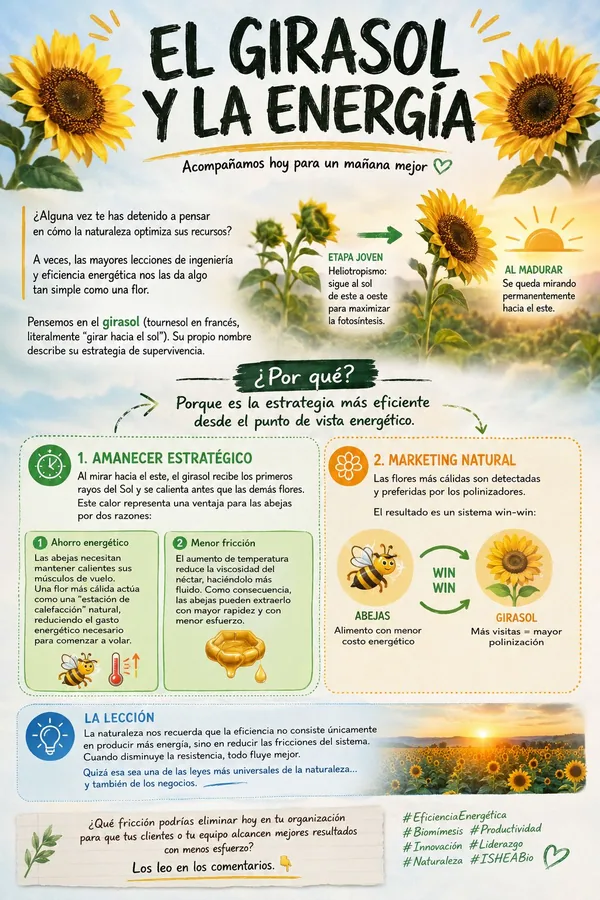
Il girasole e l'energia
Come la natura ottimizza le proprie risorse: il girasole trasforma la sua geometria in una lezione di ingegneria ed efficienza energetica che la tecnologia umana cerca ancora di eguagliare.
OSF-COG-003 · Cognizione collettiva
ICSD: dinamica degli stati cognitivi (in preparazione)
Repository in preparazione dell'ICSD, il modello di dinamica degli stati cognitivi; apre lo spazio in cui i materiali del quadro EICI + TACC saranno depositati con l'avanzare della ricerca.