

Bioenergetica · NOTA-BIO-050
Il cervello umano si è evoluto per controllo, non per geni nuovi
Di Carlos J. Pérez Pulido · ISHEA Institute ·
Uno studio recente di Li et al. (2025) individua due momenti della nostra storia evolutiva in cui fu la regolazione, non la novità genetica, a ridefinire le capacità del cervello.
Nota divulgativa — Testo breve pubblicato in aperto. Pensiero in corso, non risultato.
Opera originale in inglese.
🧠 The human brain did not evolve through new genes. It evolved through a new control system.
A recent study (Li et al., 2025 — Quantitative Biology, Wiley) identified two moments in our evolutionary history where genetic control shifted abruptly. Not the genes themselves — but how they activate. When. With what intensity. In response to what.
Memory, language, emotion, social cognition. All shaped by those two transitions.
Not a hardware mutation.
A reconfiguration of the control system.
This invites a question that from biophysical systems science we find fundamental:
What determines when a biological system makes a qualitative leap?
Not the quantity of its components. But the coherence between available energy, integrated information, and structural friction.
This is a logic that appears in physics, in biology, in cognitive systems. And one we propose to formalize under the ISHEA Δ±1 framework.
The work of Li et al. is, from that perspective, a valuable point of convergence.
📄 DOI: 10.1002/qub2.88
🔗 ISHEA Institute | OSF: https://lnkd.in/ecCE5A8P
#Biophysics #Neuroscience #CognitiveEvolution #ComplexSystems #Epigenetics #ISHEA #SystemsBiology
Nella stessa sala — Bioenergetica
NOTA-BIO-001 · Bioenergetica
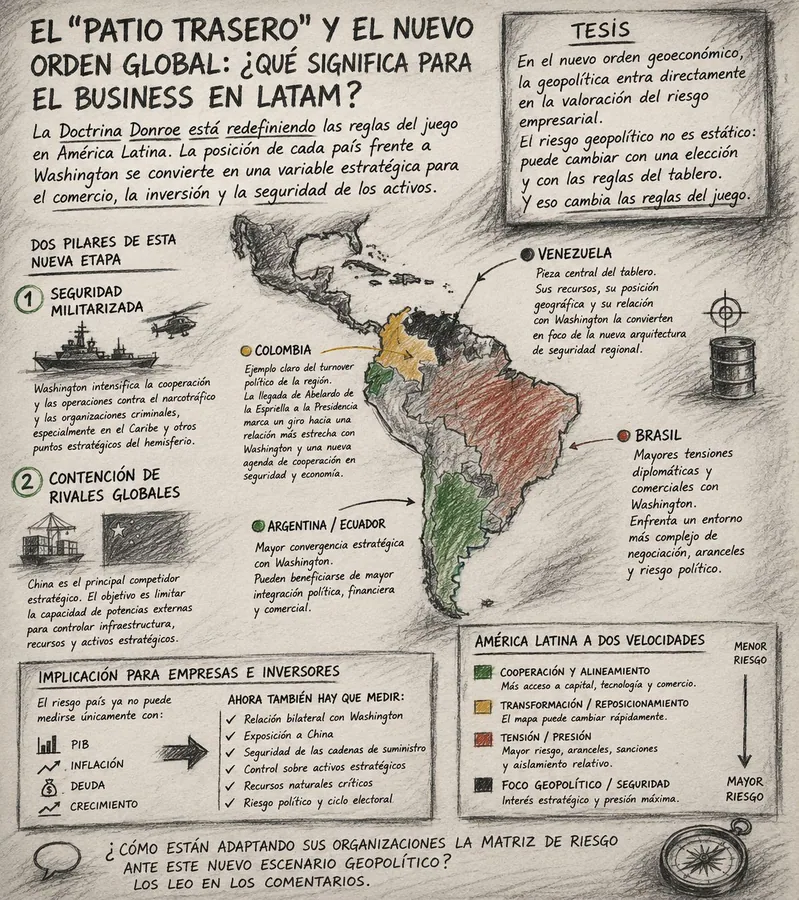
Il «cortile di casa» e il nuovo ordine globale: cosa significa per il business plan in LatAm?
Un'analisi di come la cosiddetta Dottrina Donroe abbia trasformato in politica esplicita la metafora del «cortile di casa» e di ciò che questa svolta comporta per ogni business plan in America Latina.

NOTA-BIO-002 · Bioenergetica
Perché i lavoratori più efficienti rallentano a metà giornata?
Per direttori operativi e responsabili della logistica: una lettura bioenergetica del perché i lavoratori migliori perdono produttività a metà giornata, un fenomeno che molti notano e pochi spiegano.

NOTA-BIO-003 · Bioenergetica
Minaccia o opportunità? L’intelligenza artificiale e la nostra capacità creativa
Di fronte all’appello di Leone XIV a «disarmare l’IA», questo testo sostiene che il rischio non sta nella tecnologia ma nel sistema umano che la usa: ben progettata, può liberare capacità creativa.