

Bioenergética · NOTA-BIO-050
El cerebro humano evolucionó por control, no por genes nuevos
Por Carlos J. Pérez Pulido · ISHEA Institute ·
Versión en inglés del análisis de Li et al. (2025): dos momentos evolutivos clave muestran que lo decisivo no fue añadir genes, sino cambiar el sistema que regula su actividad.
Nota de divulgación — Escrito breve publicado en abierto. Pensamiento en curso, no resultado.
Pieza original en inglés.
🧠 The human brain did not evolve through new genes. It evolved through a new control system.
A recent study (Li et al., 2025 — Quantitative Biology, Wiley) identified two moments in our evolutionary history where genetic control shifted abruptly. Not the genes themselves — but how they activate. When. With what intensity. In response to what.
Memory, language, emotion, social cognition. All shaped by those two transitions.
Not a hardware mutation.
A reconfiguration of the control system.
This invites a question that from biophysical systems science we find fundamental:
What determines when a biological system makes a qualitative leap?
Not the quantity of its components. But the coherence between available energy, integrated information, and structural friction.
This is a logic that appears in physics, in biology, in cognitive systems. And one we propose to formalize under the ISHEA Δ±1 framework.
The work of Li et al. is, from that perspective, a valuable point of convergence.
📄 DOI: 10.1002/qub2.88
🔗 ISHEA Institute | OSF: https://lnkd.in/ecCE5A8P
#Biophysics #Neuroscience #CognitiveEvolution #ComplexSystems #Epigenetics #ISHEA #SystemsBiology
En la misma sala — Bioenergética
NOTA-BIO-001 · Bioenergética
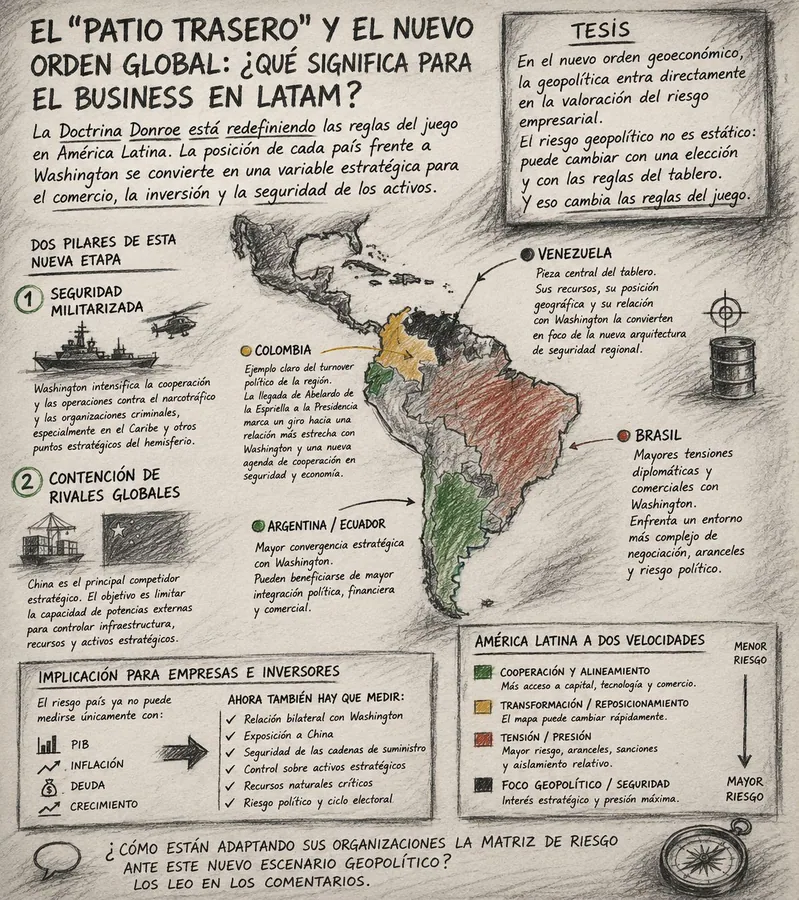
El «patio trasero» y el nuevo orden global: ¿qué significa para el business plan en Latam?
Un análisis de cómo la llamada Doctrina Donroe ha convertido en política explícita la metáfora del «patio trasero» y de lo que ese giro supone para cualquier plan de negocio en América Latina.

NOTA-BIO-002 · Bioenergética
¿Por qué los trabajadores más eficientes se vuelven más lentos a mitad de la jornada?
Para directores de operaciones y gerentes de logística: una lectura bioenergética de por qué los mejores trabajadores pierden productividad a mitad de jornada, un patrón que muchos ven y pocos explican.

NOTA-BIO-003 · Bioenergética
¿Amenaza u oportunidad? La inteligencia artificial y nuestra capacidad creativa
Frente al llamamiento de León XIV a «desarmar la IA», esta pieza sostiene que el riesgo no está en la tecnología, sino en el sistema humano que la usa: bien diseñada, puede liberar capacidad creativa.