

Bioenergetics · NOTA-BIO-051
E-Cigarettes Are Not Less Harmful, Only Different and More Complex
By Carlos J. Pérez Pulido · ISHEA Institute ·
The human body is built to breathe oxygen, and altering what enters the lungs shifts the whole respiratory balance. Vaping does not reduce harm: it relocates it and hides it from measurement.
Note — Short piece published openly. Thinking in progress, not a result.
🚬 E-CIGARETTES ARE NOT “LESS HARMFUL.” THEY’RE DIFFERENT… AND MORE COMPLEX.
Our bodies are designed to breathe oxygen.
Altering this component creates an imbalance that, sooner or later, takes a toll.
For years, the debate was simple:
👉 Is it better than a traditional cigarette?
New evidence says something different:
👉 We’ve been asking the wrong question.
In a recent article in Nature Communities,
Ardie Barry Sailis (University of Malaya) shows that e-cigarettes:
🔬 WHAT SCIENCE IS REVEALING
Damage mitochondrial DNA
Increase oxidative stress
Reduce cellular energy production (ATP)
Alter the respiratory barrier
It’s not just nicotine or direct toxicity.
👉 It’s a cellular energy system disorder.
And most importantly:
> It’s not just nicotine.
Aerosols contain:
→ Aldehydes (e.g., formaldehyde)
→ Metals from heating coils
→ Flavor compounds with active biological effects
A variable, cumulative, poorly controlled chemical load.
⚠️ THE FLAW IN THE CURRENT MODEL
The dominant narrative says: “It’s less harmful.”
Evidence points to something deeper:
👉 A distinct type of damage
👉 Potentially harder to model
Because it doesn’t target a single organ.
It affects the system’s ability to generate energy and maintain balance.
⚡ ISHEA PERSPECTIVE
From a biophysical systems view:
When stress exceeds a threshold:
Mitochondria lose efficiency
The system enters a new dysfunctional equilibrium
Recovery is no longer guaranteed
👉 The problem may no longer be reversible in classical terms.
This is not traditional toxicology.
It’s progressive energetic collapse dynamics.
🧠 THE REAL QUESTION
> When does adaptation end… and structural deterioration begin?
That’s the line we’re still not measuring correctly.
🎯 CONCLUSION
We are not facing a “safer” product.
We are facing an exposure system that reconfigures your energy, which is:
More complex
More variable
Harder to predict
🚬 Risk is not just in what you inhale…
⚡ It’s in how it reconfigures your energy system.
📚 Based on recent literature on:
Mitochondrial damage & DNA repair
Aerosol chemical composition
Cellular dysfunction from e-cigarettes
🔬 + ISHEA Framework (Two-Level Bioenergetic)
https://lnkd.in/ecCE5A8P
#ISHEA #Biophysics #CognitiveEnergy #Health #Epidemiology #Vape #ISHEABIO #ECigarettes #SystemThinking #MedicineOfTheFuture 🚀
Note: Picture is referential for privacy reasons.
https://lnkd.in/eg8QuWtZ
In the same room — Bioenergetics
OSF-BIO-001 · Bioenergetics
Milestone Report: From Nature Conference Poster to the Two-Level Bioenergetic Coherence Model
Technical report and visual archive tracing one year of the ISHEA Δ±1 framework: from a 2025 Nature Conference poster in South Korea to its computational formalization with NAD+, ROS and ATP.
OSF-BIO-002 · Bioenergetics
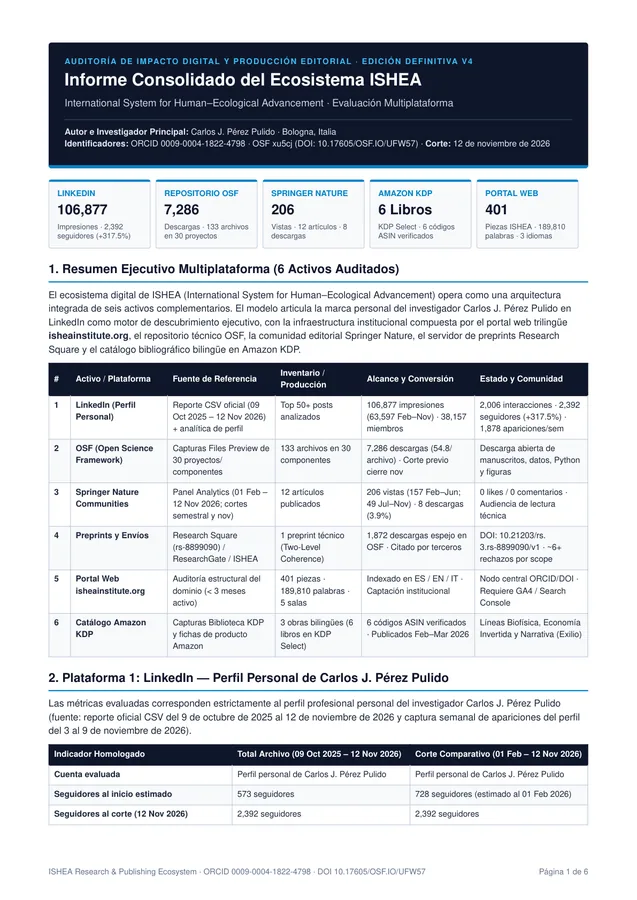
Multiplatform Performance Audit and Ecosystem Maturity Benchmark of ISHEA (2025–2026)
Report v4.1 measuring the reach of six ISHEA dissemination channels, from LinkedIn to OSF, with 106,877 impressions and 7,286 downloads. It shows how far its open-science infrastructure has matured.
NOTA-BIO-003 · Bioenergetics
The Nobel, optogenetics and a question I want to test
Carlos J. Pérez Pulido reflects on the 2026 Nobel Prize in Physiology or Medicine, awarded to Deisseroth, Hegemann and Nagel for optogenetics, and poses a question he intends to put to the test.