

Bioenergetics · OSF-BIO-115
ISHEA Bio: a bioenergetic-informational model of neuronal ionic signaling
By Carlos J. Pérez Pulido · ISHEA Institute ·
An in silico validation in which cytosolic calcium carries the information while sodium and potassium supply the energy: the same signal yields plasticity or excitotoxic collapse, depending on reserves.
Preprint — Manuscript deposited on OSF. Not peer-reviewed.
OSF Project Description: ISHEA Bio – Bioenergetic-Informational Neuronal Model
Title: ISHEA Bio: In Silico Validation of Neuronal Bioenergetic-Informational Dynamics
Abstract:
The ISHEA Bio model provides a quantitative framework linking neuronal bioelectricity, intracellular signaling, and metabolism. This in silico study demonstrates that functional neuronal information is encoded in cytosolic calcium (Ca²⁺) dynamics, while sodium (Na⁺) and potassium (K⁺) serve as energy substrates. Simulations under physiological and stress conditions reveal that the same neuronal signals can produce plasticity in healthy neurons or excitotoxic collapse in energetically compromised cells. The framework is fully reproducible with public data and includes parametric sensitivity and small network propagation analyses. This OSF project serves as a permanent record of the model, results, and replicability protocols for high-impact neuroscience research.
Keywords: Neuronal signaling, Calcium dynamics, Bioenergetics, CaMKII, Excitotoxicity, In silico modeling, ISHEA, Reproducible neuroscience, Network simulations
Components / Files:
-
Protocols and Methods: Detailed description of the ISHEA in silico protocol, including equations, parameter tables, and simulation workflow.
-
Results: Tables and figures showing physiological and stress scenarios, parametric sensitivity, and basic network simulations.
-
Replicability Annex: Step-by-step instructions, variable definitions, units, and example Python scripts for independent replication.
-
Infographics: Visual representations of Ca²⁺ vs CaMKII* dynamics, with healthy vs stressed neurons.
-
Documentation: Summary PDF ready for preprint submission, including introduction, discussion, and conclusions.
Notes / Use Cases:
This project can be cited as a persistent reference for the ISHEA model.
Provides reproducible workflows suitable for teaching, preprints, and high-impact publications.
Publicly accessible data allows independent verification of results.
Citation:
> Pérez Pulido, C. (2025). ISHEA Bio: In Silico Validation of Neuronal Bioenergetic-Informational Dynamics. OSF. DOI: 10.17605/OSF.IO/B7XHE
ISHEA Bio: Bioenergetic-Informational Model of Ionic Signaling in Neurons
Overview
ISHEA Bio is a computational, in silico model that integrates neuronal ionic dynamics with bioenergetics. It formalizes the roles of sodium (Na⁺) and potassium (K⁺) as energy substrates and calcium (Ca²⁺) as the primary informational mediator via CaMKII activation. The model allows researchers to explore how energy availability conditions functional neuronal signaling and vulnerability to excitotoxicity.
Contents
Simulation Protocols: Physiological and stress scenarios.
Results: Single neuron and small network simulations, parametric sensitivity analysis.
Replicability Annex: Variables, units, equations, and step-by-step Python implementation.
Figures: Graphs illustrating Ca²⁺ vs. CaMKII* dynamics, ATP/NADH levels, and network propagation of stress.
Key Features
Fully reproducible with public data and standard Python libraries (numpy, matplotlib).
Demonstrates how bioenergetic state modulates information encoding.
Highlights propagatable excitotoxicity phenomena relevant for neurodegeneration studies.
Suitable for educational, research, and preprint dissemination.
Keywords: Neuronal signaling, Calcium dynamics, Bioenergetics, CaMKII, ISHEA, Excitotoxicity, In silico modeling, Reproducible science
In the same room — Bioenergetics
NOTA-BIO-001 · Bioenergetics
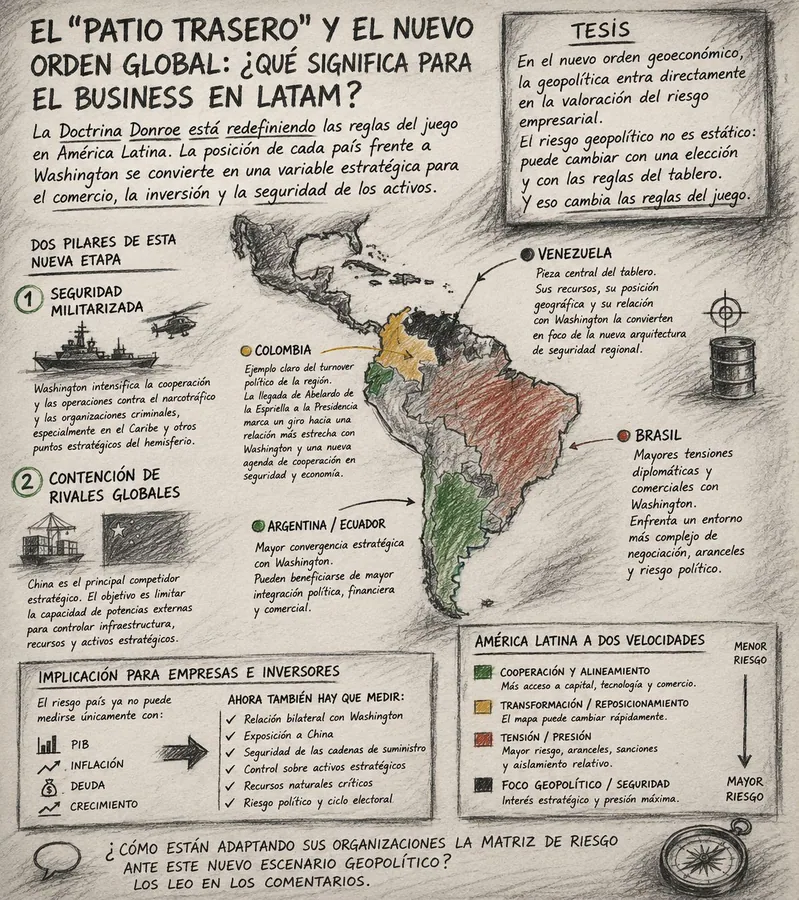
The “Backyard” and the New Global Order: What Does It Mean for the Business Plan in LatAm?
An analysis of how the so-called Donroe Doctrine has turned the “backyard” metaphor into explicit policy, and what that shift means for any business plan built for Latin America.

NOTA-BIO-002 · Bioenergetics
Why do the most efficient workers slow down midway through the workday?
For operations directors and logistics managers: a bioenergetic reading of why top performers lose productivity midway through the workday, a pattern many see and few explain.

NOTA-BIO-003 · Bioenergetics
Threat or opportunity? Artificial intelligence and our creative capacity
Responding to Pope Leo XIV’s call to “disarm AI”, this piece argues that the risk lies not in the technology but in the human system using it: well designed, AI can free up creative capacity.