

Bioenergetics · OSF-BIO-135
ISHEA-Bio: bioenergetic flow of cellular resilience (ATP–FOXP–cortisol–EVs)
By Carlos J. Pérez Pulido · ISHEA Institute ·
The regenerative cycle of the ISHEA-Bio model: ATP feeds the FOXP2/FOXP3 complex, cortisol introduces controlled tension, and extracellular vesicles carry coherence or dysfunction through the body.
Preprint — Manuscript deposited on OSF. Not peer-reviewed.
Original piece in Spanish.
This diagram represents the core regenerative cycle of the ISHEA-Bio model, integrating molecular and systemic dynamics that sustain resilience.
Energy (ATP) flows toward the FOXP2/FOXP3 transcriptional complex, which mediates the equilibrium between cognition (FOXP2) and regulation (FOXP3). Cortisol introduces controlled tension, challenging the system’s capacity for reorganization.
Extracellular vesicles (EVs) then act as vectors of coherence, transmitting either regenerative (+R, green) or dysfunctional (–R, red) information throughout the organism.
At the base lies the Δ+1 loop, symbolizing the universal process of variation, tension, reorganization, verification, and higher-order emergence — the bioenergetic grammar of life defined by ISHEA.
🧬 ISHEA-Bio: Bioenergetic Flow Diagram (ATP–FOXP–Cortisol–EVs–Δ+1)
(ISHEA-Bio: Diagrama de flujo bioenergético – ATP–FOXP–Cortisol–EVs–Δ+1)
Overview / Descripción general
The ISHEA-Bio Bioenergetic Flow Diagram illustrates the central regenerative mechanism proposed by the ISHEA Institute (International System for Human–Ecological Advancement).
It integrates findings from molecular biology, bioenergetics, neuropsychology, and information theory to represent how energy, meaning, and resilience interact within living systems.
The diagram demonstrates that biological coherence — the ability of an organism to maintain internal order under stress — depends on a dynamic balance between ATP availability, FOXP transcriptional regulation, cortisol modulation, and extracellular vesicle (EV) communication.
These four components operate as nodes of a self-regenerative loop known as the Δ+1 Cycle, the core mathematical and philosophical foundation of ISHEA.
Structural Components / Componentes estructurales
- ATP Gradient – The Source of Order
EN:
ATP (adenosine triphosphate) represents not only metabolic energy but the informational “currency” of biological order. Within ISHEA-Bio, ATP symbolizes the energetic potential that enables systems to self-organize, adapt, and regenerate.
When ATP production drops, entropy increases, and the system’s capacity for coherence declines — marking the transition from resilience (+R) to dysfunction (–R).
ES:
El ATP (adenosín trifosfato) representa no solo energía metabólica, sino la “moneda informacional” del orden biológico. En ISHEA-Bio, el ATP simboliza el potencial energético que permite al sistema autoorganizarse, adaptarse y regenerarse.
Cuando la producción de ATP disminuye, aumenta la entropía y la capacidad del sistema para mantener coherencia se reduce, marcando la transición de resiliencia (+R) a disfunción (–R).
- FOXP2 / FOXP3 Axis – Cognitive and Regulatory Symmetry
EN:
The FOXP transcription factors act as molecular interpreters of energy. FOXP2 is associated with language, cognition, and neural plasticity, while FOXP3 governs immune tolerance and systemic regulation.
Their equilibrium embodies the Knowledge Transfer Revolving (KTR) mechanism of ISHEA: cognition (FOXP2) produces meaning, and regulation (FOXP3) verifies it through tolerance and coherence.
Together, they act as the biological analogue of the CHECK operator, which determines whether energy becomes structured knowledge or chaotic noise.
ES:
Los factores de transcripción FOXP actúan como intérpretes moleculares de la energía. FOXP2 se asocia con el lenguaje, la cognición y la plasticidad neuronal, mientras FOXP3 regula la tolerancia inmunológica y la estabilidad sistémica.
Su equilibrio representa el mecanismo de Transferencia Revolvente de Conocimiento (KTR) del modelo ISHEA: la cognición (FOXP2) genera significado y la regulación (FOXP3) lo verifica mediante tolerancia y coherencia.
Juntos actúan como el análogo biológico del operador CHECK, que determina si la energía se convierte en conocimiento estructurado o en ruido caótico.
- Cortisol – The Tension Variable
EN:
Cortisol, a glucocorticoid hormone, introduces controlled tension into the system.
In optimal doses, it triggers reorganization and adaptive learning; in excess, it erodes ATP synthesis and disrupts FOXP coherence.
In ISHEA-Bio, cortisol represents the entropic challenge necessary to test and verify the integrity of the Δ+1 regenerative loop.
ES:
El cortisol, hormona glucocorticoide, introduce tensión controlada en el sistema.
En dosis óptimas, estimula la reorganización y el aprendizaje adaptativo; en exceso, deteriora la síntesis de ATP y rompe la coherencia FOXP.
En ISHEA-Bio, el cortisol representa el reto entrópico necesario para poner a prueba y verificar la integridad del ciclo regenerativo Δ+1.
- Extracellular Vesicles (EVs) – Vectors of Coherence
EN:
Extracellular vesicles (EVs) are microscopic carriers that transport RNA, proteins, and signaling molecules between cells.
In ISHEA-Bio, they function as vectors of coherence: when bioenergetic balance is positive (+R), EVs carry regenerative messages that enhance resilience; when balance is negative (–R), they propagate dysfunction across tissues and systems.
ES:
Las vesículas extracelulares (EVs) son transportadores microscópicos que trasladan ARN, proteínas y señales entre células.
En ISHEA-Bio, funcionan como vectores de coherencia: cuando el equilibrio bioenergético es positivo (+R), las EVs transportan mensajes regenerativos que fortalecen la resiliencia; cuando el equilibrio es negativo (–R), propagan la disfunción a través de tejidos y sistemas.
- Δ+1 Cycle – The Regenerative Loop
EN:
At the base of the diagram lies the Δ+1 Cycle, which represents the universal grammar of life proposed by the ISHEA framework:
Variation (Δ) → Tension → Reorganization (+1) → Verification (CHECK) → Higher-Order Emergence (Gₙ → Gₙ₊₁).
Each iteration of this cycle transforms entropy into structure, ensuring that disorder is reorganized into knowledge and adaptation.
When the CHECK operator fails (due to energy depletion or regulatory imbalance), the cycle breaks and dysfunction spreads.
ES:
En la base del diagrama se encuentra el Ciclo Δ+1, que representa la gramática universal de la vida propuesta por ISHEA:
Variación (Δ) → Tensión → Reorganización (+1) → Verificación (CHECK) → Emergencia de un orden superior (Gₙ → Gₙ₊₁).
Cada iteración de este ciclo transforma la entropía en estructura, garantizando que el desorden se reorganice en conocimiento y adaptación.
Cuando el operador CHECK falla (por agotamiento energético o desbalance regulatorio), el ciclo se rompe y la disfunción se propaga.
Scientific Significance / Significado científico
EN:
The ISHEA-Bio diagram is considered the first visual synthesis connecting cellular bioenergetics, gene regulation, hormonal tension, and systemic communication under a single regenerative model.
It extends concepts from Schrödinger, Prigogine, and Bak–Sneppen to formulate a unified principle of resilience — measurable at molecular, cognitive, and societal levels.
The model provides a quantitative framework for analyzing adaptation, disease, learning, and sustainability through one mathematical law of order:
R = \frac{ATP^{+} \times FOXP^{+}}{Cortisol^{–}} + EV_{trans}(ΔR)
ES:
El diagrama ISHEA-Bio se considera la primera síntesis visual que conecta bioenergética celular, regulación génica, tensión hormonal y comunicación sistémica bajo un único modelo regenerativo.
Extiende los conceptos de Schrödinger, Prigogine y Bak–Sneppen para formular un principio unificado de resiliencia, medible a nivel molecular, cognitivo y social.
El modelo ofrece un marco cuantitativo para analizar la adaptación, la enfermedad, el aprendizaje y la sostenibilidad mediante una única ley matemática del orden:
R = \frac{ATP^{+} \times FOXP^{+}}{Cortisol^{–}} + EV_{trans}(ΔR)
References / Referencias
Schrödinger, E. (1944). What is Life?
Prigogine, I. (1977). Self-Organization in Nonequilibrium Systems.
Bak, P. & Sneppen, K. (1993). Punctuated Equilibrium and Criticality.
ISHEA Institute (2025). Δ+1–KTR–R–CHECK Bioenergetic Framework.
GEO GSE141318 Dataset – FOXP2/FOXP3 cortisol regulation.
ExoCarta v7.1 – Extracellular Vesicle Proteome Database.
In the same room — Bioenergetics
NOTA-BIO-001 · Bioenergetics
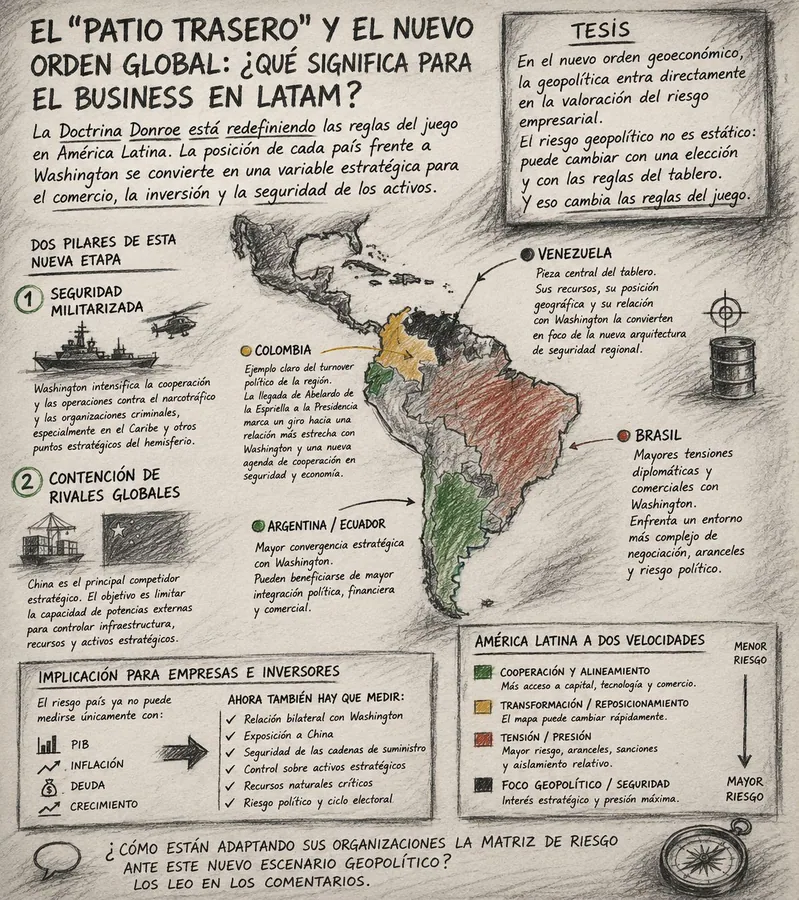
The “Backyard” and the New Global Order: What Does It Mean for the Business Plan in LatAm?
An analysis of how the so-called Donroe Doctrine has turned the “backyard” metaphor into explicit policy, and what that shift means for any business plan built for Latin America.

NOTA-BIO-002 · Bioenergetics
Why do the most efficient workers slow down midway through the workday?
For operations directors and logistics managers: a bioenergetic reading of why top performers lose productivity midway through the workday, a pattern many see and few explain.
NOTA-BIO-003 · Bioenergetics
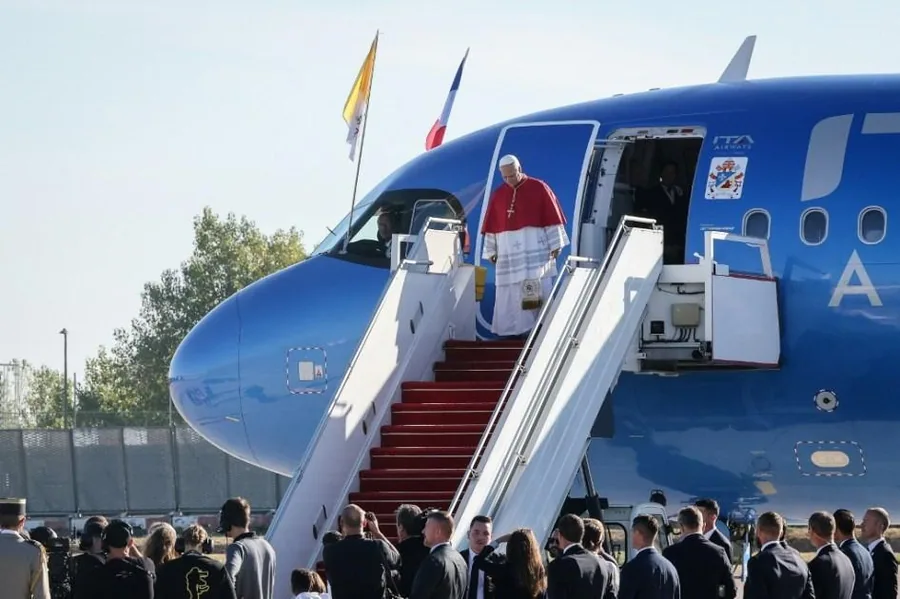
Threat or opportunity? Artificial intelligence and our creative capacity
Responding to Pope Leo XIV’s call to “disarm AI”, this piece argues that the risk lies not in the technology but in the human system using it: well designed, AI can free up creative capacity.