

Bioenergetics · OSF-BIO-144
ISHEA–TACC as a translational bridge: from autism to neurodegeneration
By Carlos J. Pérez Pulido · ISHEA Institute ·
A framework translating ISHEA–TACC theory into neurological practice, proposing a shared axis of bioenergetic coherence between autism and neurodegenerative disease.
Preprint — Manuscript deposited on OSF. Not peer-reviewed.
🧠 ISHEA-TACC Framework as a Translational Bridge for Neurological Disorders: From Autism to Neurodegeneration
Author: Carlos J. Pérez Pulido
Institution: ISHEA Bio Institute
Date: October 2025
Contact: isheainstitute.org@gmail.com
Executive Summary
The ISHEA-TACC Model (Knowledge → Transfer → Assimilation → Creative Action → Coherence & Resilience) provides an integrative framework to analyze the interaction between mitochondrial energetic dysfunction (ATP), FOXP/FOXP2 transcription factors, and cortisol-mediated neuroendocrine signaling.
This approach suggests that many neurological disorders — from autism to dementia — share a common causal axis: a breakdown in bioenergetic flow and adaptive plasticity within the nervous system.
The ISHEA-TACC hypothesis posits that the brain does not deteriorate solely from structural damage, but from a failure in cellular knowledge translation — when energy (ATP) can no longer sustain the informational coherence regulated by FOX genes and cortisol homeostasis.
- Global Context
According to the World Health Organization (WHO) 2025 report:
More than one-third of the global population suffers from a neurological disorder, accounting for over 11 million deaths annually.
Most prevalent disorders include:
Stroke
Alzheimer’s disease and dementias
Migraines
Diabetic neuropathy
Meningitis
Idiopathic epilepsy
Autism spectrum disorders (ASD)
The WHO calls for new scientific policies emphasizing integrative prevention and diagnostics.
- ISHEA-TACC Model Foundation
Based on recent findings, the model proposes that:
FOXP2 and FOXO1/3 regulate genes connecting synaptic plasticity and energy metabolism.
Mitochondrial ATP acts as a biochemical language signaling cellular energy state to the nucleus.
Chronic cortisol exposure disrupts this energy-information interpretation and impairs neuronal maturation.
A simultaneous alteration in these three levels — transcriptional, energetic, and endocrine — leads to sensory, cognitive, and motor integration failures.
- Cross-Pathology Application
Neurological Disorder (WHO 2025) ISHEA-TACC Evidence Proposed Mechanism of Impact
Autism Spectrum Disorder (ASD) High FOXP2 + ATP + Cortisol disruption → tactile hypersensitivity, sensory desynchronization
Alzheimer’s / Dementias High FOXO + mitochondria + chronic stress → loss of plasticity and synaptic connectivity
Stroke / Post-ischemia Medium-High Energy restoration + cortisol regulation enhances neuronal recovery
Migraines Medium Mitochondrial energy control reduces cortical hyperexcitability
Idiopathic Epilepsy Medium Altered FOX-GABA + ATP → inhibitory/excitatory imbalance
Diabetic Neuropathy Medium Chronic cortisol + oxidative stress → axonal damage reversible with mitochondrial support
Neonatal Encephalopathy / Prematurity High (preventive) Maternal cortisol modulation + mitochondrial nutrition reduces neural injury risk
- Summary of Methodology (Core Validation Set)
A dataset of 36 representative genes was analyzed across three domains:
-
FOXP/FOX family – transcriptional regulators of neurodevelopment
-
Mitochondrial (OXPHOS) genes – ATP production and transport
-
Synaptic plasticity genes – BDNF, SHANK3, RELN, GABRB3, NLGN4X
Results:
5 out of 6 biological convergence criteria were positive (pathway, energy, regulation, network, plasticity).
FOXP2 emerged as a molecular hub connecting energy metabolism and synaptic expression.
The single partially negative criterion related to non-energetic maternal transmission (-R), interpreted as epigenetic inheritance of reduced energy assimilation, possibly linked to elevated gestational cortisol.
- Clinical Implications
The model predicts that restoring the ATP ↔ FOXP ↔ Cortisol axis may partially reverse sensory and cognitive alterations.
Suggested interventions:
Nicotinamide Riboside + CoQ10 → mitochondrial rescue
Circadian regulation + diaphragmatic breathing → cortisol balance
Rhythmic tactile stimulation → reactivation of the FOXP2–BDNF pathway
- Conclusion
Convergent evidence supports that multiple neurological disorders share a systemic defect in energy–information transfer.
The ISHEA-TACC framework provides a unified model for designing integrated strategies in prevention, diagnosis, and therapy.
-
Key References
-
Kaestner K.H. et al. (2000). Unified nomenclature for the winged helix/forkhead transcription factors. Genes & Development, 14(2): 142–146.
-
Frye R.E. et al. (2016). Mitochondrial dysfunction in autism spectrum disorders: a systematic review and meta-analysis. Molecular Autism, 7(1): 55.
-
Picard M. & McEwen B.S. (2018). Psychological stress and mitochondria: a systematic review. Psychosomatic Medicine, 80(2): 141–153.
-
McEwen B.S. (2020). The neurobiology of resilience and stress. Nature Reviews Neuroscience, 21(10): 607–617.
-
Gandal M.J. et al. (2022). Transcriptomic convergence across autism, schizophrenia, and bipolar disorder. Science, 367(6483): eaat8127.
Title: ISHEA Bioenergetic Model: Cortisol as a Metabolic Competitor and Restoration of Resilience via Non-Pharmacological Interventions
Authors: ISHEA Bio Collective / Carlos Pérez Pulido
Date: September 25, 2025
Keywords: cortisol, ATP, dopamine, serotonin, bioenergetics, resilience, non-pharmacological intervention, HRV, ISHEA
Type of Record: Model and Scientific Protocol Preregistration
- Background and Rationale Cortisol is conceptualized as a metabolic competitor that depletes ATP and inhibits the synthesis of nitrogenous neurotransmitters. This interference compromises human resilience, motivating the development of non-pharmacological interventions that restore bioenergetic balance.
- Central Hypothesis Cortisol acts as a metabolic competitor by consuming ATP and blocking the synthesis of nitrogenous neurotransmitters, thereby reducing human resilience. The model integrates key bioenergetic components, including ATP, amino acid precursors (tyrosine and tryptophan), and regulation of the hypothalamic–hippocampal–adrenal (HHA) axis.
- Methods / Intervention Protocol
Breathing: 4-7-8 techniques and diaphragmatic breathing exercises.
Light Exposure: Morning sunlight to regulate circadian rhythms.
Dietary Support: Foods rich in tyrosine and tryptophan, supplemented with healthy fats to support neurotransmitter synthesis.
Movement & Sleep: Regular aerobic exercise and restorative sleep routines.
Software / Tools:
Heart rate variability (HRV) monitors (wearable sensors)
Voice analysis software for stress and bioenergetic monitoring
Sleep tracking applications
- Variables / Proxies
Primary: HRV metrics, sleep quality measures, voice stress indicators
Secondary: Behavioral measures of resilience and subjective stress ratings
- Data Analysis / Mapping
Real-time monitoring using physiological proxies
Mapping cortisol activity against bioenergetic state
Correlation of intervention protocols with changes in resilience indicators
- Expected Outcomes
Reduction in cortisol-mediated ATP depletion
Restoration of nitrogenous neurotransmitter synthesis
Improvement in physiological and psychological resilience indicators
- Wiki / Conceptual Overview ISHEA Bioenergetic Model is designed to understand and modulate human resilience by tracking the metabolic impact of cortisol. It combines biochemical theory, physiological proxies, and behavioral interventions to provide a holistic framework. Key points include:
Cortisol as a Metabolic Competitor: Blocks neurotransmitter synthesis and consumes ATP.
Integration of Bioenergetic Components: ATP, amino acid precursors, and HHA axis regulation.
Non-Pharmacological Interventions: Breathing, light exposure, diet, movement, and sleep.
Physiological Monitoring: HRV, voice stress analysis, and sleep tracking provide real-time feedback.
Applications: Enhancing resilience, reducing stress impact, and guiding behavioral interventions.
This Wiki section serves as a central reference for researchers and practitioners applying the ISHEA model.
ISHEA Bioenergetic Model: Cortisol as a Metabolic Competitor and Restoration of Resilience via Non-Pharmacological Interventions
Authors: ISHEA Bio Collective / Carlos Pérez Pulido
Date: September 25, 2025
Keywords: cortisol, ATP, dopamine, serotonin, bioenergetics, resilience, non-pharmacological intervention, HRV, ISHEA
Type of Record: Model and Scientific Protocol Preregistration
Abstract
This preregistration establishes the authorship of the ISHEA bioenergetic model, which conceptualizes cortisol as a metabolic competitor that depletes ATP and inhibits the synthesis of nitrogenous neurotransmitters. The model proposes non-pharmacological interventions aimed at restoring human resilience. It includes a theoretical framework, evidence from physiological proxies, and a detailed intervention guide.
Central Hypothesis
Cortisol acts as a metabolic competitor by consuming ATP and blocking the synthesis of nitrogenous neurotransmitters, thereby compromising human resilience. The model integrates key bioenergetic components, including ATP, amino acid precursors (tyrosine and tryptophan), and regulation of the hypothalamic–hippocampal–adrenal (HHA) axis.
Non-Pharmacological Intervention Protocols
-
Breathing: Implementation of 4-7-8 breathing techniques and diaphragmatic breathing exercises.
-
Light Exposure: Morning exposure to natural sunlight to regulate circadian rhythms.
-
Dietary Support: Intake of foods rich in tyrosine and tryptophan, along with healthy fats, to support neurotransmitter synthesis.
-
Movement and Sleep: Regular aerobic exercise combined with restorative sleep protocols.
Physiological Proxies
Non-invasive physiological indicators are used to monitor bioenergetic state and guide interventions in real time. These include heart rate variability (HRV), voice pattern analysis, and sleep quality metrics.
Modelo Bioenergético ISHEA: Cortisol como Competidor Metabólico
y Restauración de Resiliencia mediante Intervenciones No
Farmacológicas
Autores: ISHEA Bio Collective / Carlos Pérez Pulido
Fecha: 25 de septiembre de 2025
Palabras clave: cortisol, ATP, dopamina, serotonina, bioenergética, resiliencia, intervención no
farmacológica, HRV, ISHEA
Tipo de registro: Preregistro de modelo y protocolo científico
Resumen
Este registro establece la autoría del modelo ISHEA, que conceptualiza al cortisol como un
competidor metabólico que consume ATP y bloquea la síntesis de neurotransmisores nitrogenados,
proponiendo un protocolo no farmacológico para restaurar la resiliencia. Incluye un marco teórico,
evidencia de proxies fisiológicos y guía de intervención.
Hipótesis Central
El cortisol devora ATP y bloquea la síntesis de neurotransmisores nitrogenados, afectando la
resiliencia humana. Este modelo integra ATP, precursores aminoacídicos (tirosina y triptófano) y la
regulación del eje HHA.
Protocolos de Intervención No Farmacológica
1. Respiración: técnicas 4-7-8 y respiración diafragmática.
2. Luz: exposición solar matutina.
3. Dieta: alimentos ricos en tirosina/triptófano y grasas saludables.
4. Movimiento: ejercicio aeróbico y sueño reparador.
Proxies Fisiológicos
Se incluyen HRV, patrones de voz y sueño como indicadores no invasivos del estado bioenergético
y guía de intervención en tiempo real.
In the same room — Bioenergetics
NOTA-BIO-001 · Bioenergetics
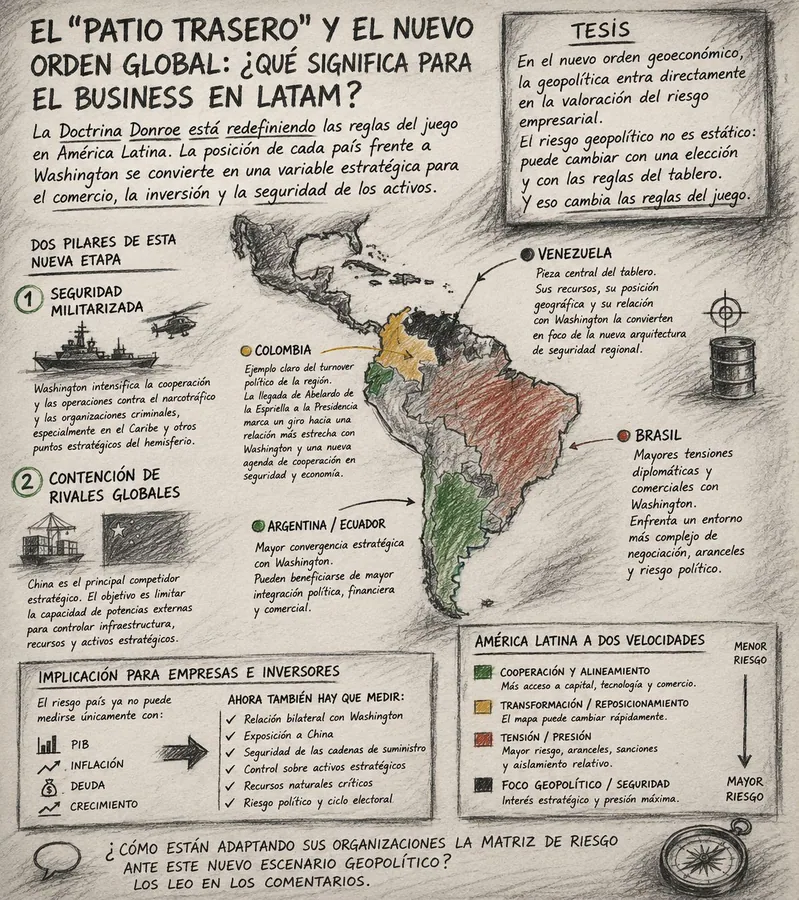
The “Backyard” and the New Global Order: What Does It Mean for the Business Plan in LatAm?
An analysis of how the so-called Donroe Doctrine has turned the “backyard” metaphor into explicit policy, and what that shift means for any business plan built for Latin America.

NOTA-BIO-002 · Bioenergetics
Why do the most efficient workers slow down midway through the workday?
For operations directors and logistics managers: a bioenergetic reading of why top performers lose productivity midway through the workday, a pattern many see and few explain.

NOTA-BIO-003 · Bioenergetics
Threat or opportunity? Artificial intelligence and our creative capacity
Responding to Pope Leo XIV’s call to “disarm AI”, this piece argues that the risk lies not in the technology but in the human system using it: well designed, AI can free up creative capacity.