

Bioenergetics · NOTA-BIO-095
The 7 Deadly Sins Aren't Moral Failures. They're Misaligned Metabolism
By Carlos J. Pérez Pulido · ISHEA Institute ·
A metabolic rereading of the classical vices: pleasure circuits built for scarcity, now running on round-the-clock stimulation. The body rewards the excess long before it presents the bill.
Note — Short piece published openly. Thinking in progress, not a result.
🔥 The 7 Deadly Sins Aren’t Moral Failures. They’re Misaligned Metabolism.
(And your body rewards them… until they destroy you.)
Imagine this:
Your brain was not designed for Instagram.
Not for 24/7 supermarkets.
Not for infinite scrolling, processed sugar, or endless digital comparison.
It was designed for:
• Scarcity
• Real danger
• Small tribes
• Uncertain survival
So what we call “sins” today are ancient survival circuits… running in a modern environment that removed their natural brakes.
Let’s decode them biologically:
🧠 Gluttony
Not weakness.
It’s dopamine + insulin + ghrelin shouting:
“CALORIES = LIFE.”
In a famine environment, this saves you.
In a supermarket civilization, it becomes metabolic chaos.
🔥 Anger
Not evil.
It’s adrenaline + amygdala activation saying:
“DEFEND. NOW.”
In the wild, it protected your tribe.
Online, it fuels outrage addiction.
💸 Greed
Not moral corruption.
It’s cortisol whispering:
“What if tomorrow there’s nothing?”
Scarcity memory coded into stress biology.
❤️ Lust
Not impurity.
It’s dopamine + testosterone + oxytocin driving reproductive success.
In ancestral settings: pair bonding and survival.
In hyper-stimulated media: compulsive reward loops.
👑 Pride
Not arrogance by default.
It’s serotonin + status signaling.
Status meant protection, access, hierarchy stability.
Today it becomes identity fragility and ego inflation.
😴 Sloth
Not laziness.
Often insulin resistance, mitochondrial inefficiency, low ATP, chronic inflammation.
The brain says:
“Energy is scarce. Conserve.”
We call it lack of discipline.
😏 Envy
Not malice.
It’s social pain processed in the anterior cingulate cortex — the same network as physical pain.
Status comparison activates threat detection.
Social media turns that into chronic stress biology.
The real problem?
In the past: Impulse → Action → Satiety → Balance
Today: Impulse → Stimulation → More stimulation → Addiction / Exhaustion / Inflammation
The impulses aren’t broken.
The environment is dysregulated.
True virtue is not repression.
It’s metabolic coherence.
It’s restoring alignment between:
• Dopamine and satiety
• Cortisol and safety
• Insulin and energy
• Status circuits and real belonging
At ISHEA we call it:
> Biology as the foundation of conscious freedom.
Because you cannot free yourself from a circuit you don’t understand.
And until you realize:
• Your “laziness” may be metabolic dysfunction
• Your “anger” may be chronic stress overload
• Your “envy” may be social threat misfiring
• Your “gluttony” may be hormonal dysregulation
…you will keep fighting biology with guilt.
21st-century ethics cannot be built on shame.
They must be built on neuroscience, bioenergetics, and metabolic literacy.
Conscious freedom begins with biological awareness.
#Bioenergetics #AppliedNeuroscience #MetabolicCoherence #ISHEA #ISHEABIO #BiologicalSelfAwareness #ConsciousFreedom #CarlosJPerezPulido
In the same room — Bioenergetics
NOTA-BIO-001 · Bioenergetics
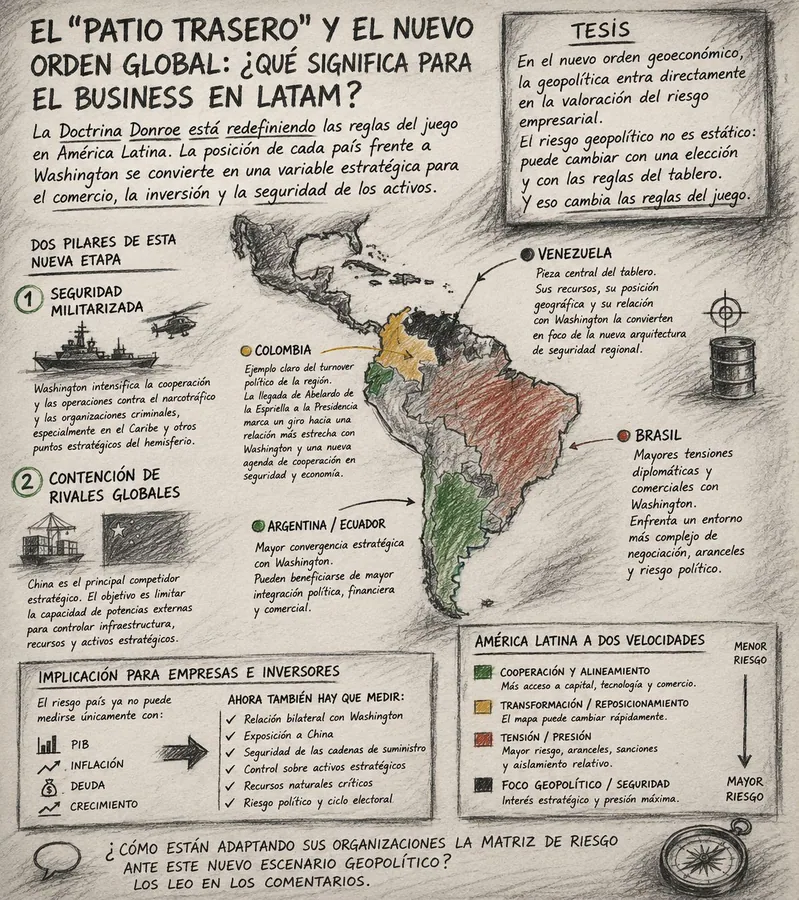
The “Backyard” and the New Global Order: What Does It Mean for the Business Plan in LatAm?
An analysis of how the so-called Donroe Doctrine has turned the “backyard” metaphor into explicit policy, and what that shift means for any business plan built for Latin America.

NOTA-BIO-002 · Bioenergetics
Why do the most efficient workers slow down midway through the workday?
For operations directors and logistics managers: a bioenergetic reading of why top performers lose productivity midway through the workday, a pattern many see and few explain.
NOTA-BIO-003 · Bioenergetics
Threat or opportunity? Artificial intelligence and our creative capacity
Responding to Pope Leo XIV’s call to “disarm AI”, this piece argues that the risk lies not in the technology but in the human system using it: well designed, AI can free up creative capacity.