

Bioenergetics · NOTA-BIO-031
The Invisible Environment of Performance: Sound, Light and Friction (4/4)
By Carlos J. Pérez Pulido · ISHEA Institute ·
Fourth part of the warehouse series: the environment — sound, light, friction — does not accompany the work, it governs it, and sets the energy cost of every shift.
Note — Short piece published openly. Thinking in progress, not a result.
Original piece in Spanish.
4/4🧠🎧 EL ENTORNO INVISIBLE DEL RENDIMIENTO
(sonido, luz y fricción en sistemas productivos)
🏭 En el warehouse no solo observé tareas.
Observé algo más importante:
el entorno está gestionando el cuerpo más de lo que creemos.
No el “manager”.
No el “objetivo”.
El entorno físico inmediato.
---
1. EL RENDIMIENTO NO ES SOLO VOLUNTAD ⚡
Si el sistema nervioso está en modo operativo, el rendimiento no depende de motivación.
Depende del estado fisiológico disponible en ese momento.
Y ese estado no es interno únicamente.
Se modula desde afuera.
---
2. EL CUERPO RESPONDE A PATRONES, NO A ÓRDENES 🔄
En tareas repetitivas:
→ el sistema motor busca estabilidad
→ reduce decisiones conscientes
→ automatiza ejecución
Esto significa algo clave:
la calidad del entorno determina la calidad de la automatización.
---
3. EL SONIDO ES UNA VARIABLE NO GESTIONADA 🎧
En la mayoría de sistemas productivos:
→ el sonido se considera ruido de fondo
→ no una herramienta operativa
Pero en realidad:
patrones rítmicos externos pueden sincronizar el sistema motor y reducir fricción de ejecución.
No es motivación.
Es sincronización sensorimotora.
---
4. LA LUZ Y EL TIEMPO TAMBIÉN “PROGRAMAN” EL CUERPO 💡
El cuerpo no solo trabaja:
→ interpreta ciclos de luz
→ adapta alertas internas
→ regula fatiga según entorno
El resultado:
el ambiente actúa como un sistema de control silencioso del rendimiento.
---
5. EL ERROR DEL MANAGEMENT TRADICIONAL ⚠️
Se optimiza:
→ KPI
→ presión
→ estructura de tareas
Pero se ignora:
→ estado fisiológico
→ fricción sensorial
→ coherencia del entorno
Resultado:
sistemas que exigen rendimiento sin modular el sistema que lo produce.
---
6. HACIA UN MODELO MÁS PRECISO 🧠
Si aceptamos que:
rendimiento = función del estado del sistema nervioso + entorno + carga de tarea
entonces:
el entorno deja de ser contexto y se convierte en variable de control.
---
🔁 EXTENSIÓN DEL MARCO
Aprender → Automatizar → Ejecutar → Modular entorno → Optimizar estado
El sistema deja de ser lineal.
Se convierte en ecológico.
---
💡 PREGUNTA ABIERTA
Si el entorno ya regula energía, atención y fatiga sin que lo gestionemos conscientemente…
¿cuánto de la productividad real es decisión… y cuánto es diseño ambiental no intencional?
---
“La eficiencia no solo depende de cómo trabajas.
Depende de en qué sistema estás trabajando.”
— Biophysical Management · ISHEA Framework C.J. Perez Pulido
#BiophysicalManagement #ISHEA #Productividad #NeurocienciaAplicada #Management #WorkSystems 🚀
In the same room — Bioenergetics
NOTA-BIO-001 · Bioenergetics
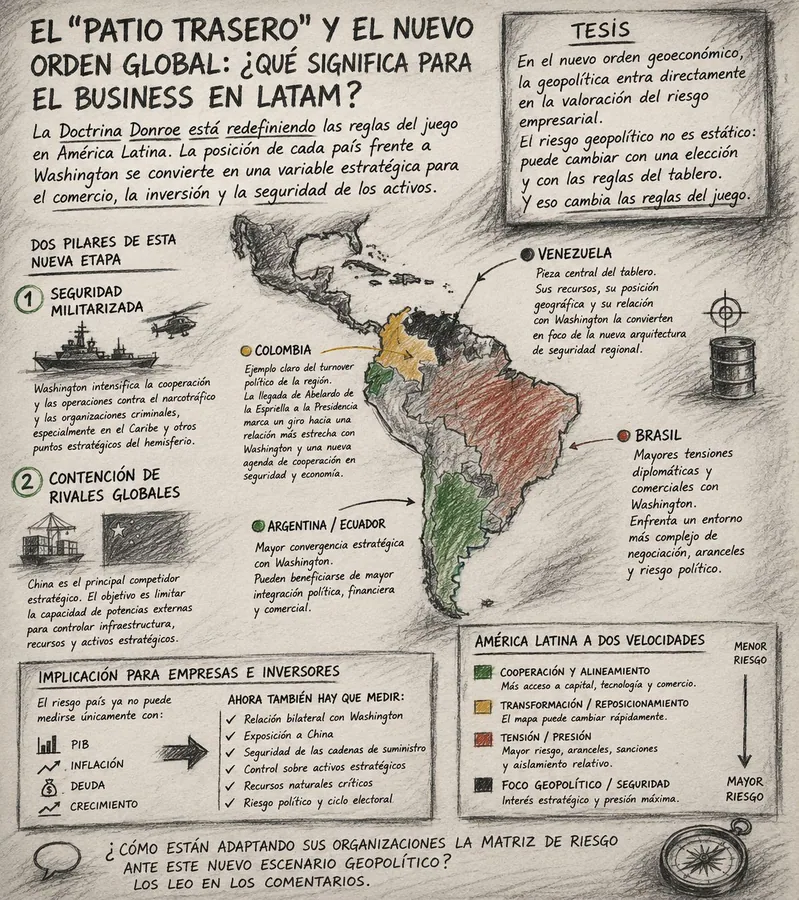
The “Backyard” and the New Global Order: What Does It Mean for the Business Plan in LatAm?
An analysis of how the so-called Donroe Doctrine has turned the “backyard” metaphor into explicit policy, and what that shift means for any business plan built for Latin America.

NOTA-BIO-002 · Bioenergetics
Why do the most efficient workers slow down midway through the workday?
For operations directors and logistics managers: a bioenergetic reading of why top performers lose productivity midway through the workday, a pattern many see and few explain.

NOTA-BIO-003 · Bioenergetics
Threat or opportunity? Artificial intelligence and our creative capacity
Responding to Pope Leo XIV’s call to “disarm AI”, this piece argues that the risk lies not in the technology but in the human system using it: well designed, AI can free up creative capacity.