

Coherence · OSF-COH-038
Time as a helical emergent variable: a framework for universal coherence across scales
By Carlos J. Pérez Pulido · ISHEA Institute ·
A formal proposal in which time is not a fundamental dimension but the longitudinal projection of helical energetic cycles, observed from quantum periodicity to non-closed galactic orbits.
Preprint — Manuscript deposited on OSF. Not peer-reviewed.
This manuscript proposes a physically consistent and mathematically explicit model in which time is not a fundamental dimension but an emergent property arising from helical energetic cycles observable across quantum, biological, geophysical, and astrophysical systems.
The model demonstrates that oscillatory processes in nature do not evolve linearly but follow three-dimensional helical trajectories whose longitudinal projection is interpreted by observers as “time.” This reinterpretation provides a unified framework compatible with relativity, quantum periodicity, nonlinear biological rhythms, and Gaia DR3 astrophysical data showing helical stellar motion and non-closed galactic orbits.
The manuscript offers:
a formal definition of time as a projection of helicoidal evolution,
a mathematical formulation using a non-temporal internal parameter,
multiscale empirical evidence from quantum oscillations, protein helices, climate resonance, and galactic structure,
and a theoretical integration that resolves the conceptual tension between relativity, quantum mechanics, and thermodynamic irreversibility.
The work contributes a coherent and testable physical framework that redefines the role of time in modern physics and proposes a universal geometric principle underlying natural evolution.
“The Helical Time of the Universe”
Public Scientific Edition — ISHEA Institute (2025)
Author: Carlos J. Pérez Pulido
DOI: 10.17605/OSF.IO/VPMJR
- Overview
This project presents a new scientific framework in which time is not a fundamental dimension of the universe but an emergent property arising from helical energetic cycles.
Across nature—quantum systems, biological structures, climate patterns, and galaxies—oscillations never evolve linearly. They follow three-dimensional helices, and the human perception of linear time is simply the projection of those helices onto a one-dimensional axis.
This model offers a unified interpretation consistent with:
relativity,
quantum periodicity,
nonlinear biological rhythms,
geophysical resonances, and
the Gaia DR3 catalog of galactic motion.
It proposes a physically coherent way to define time as a structural consequence of energy dynamics.
- Scientific Statement
Time = the observable projection of a real helical energetic evolution.
This means:
Cycles in nature do not repeat in closed loops.
Each oscillation advances in space, forming a spiral.
The longitudinal advancement of that spiral is interpreted as “time.”
The geometry of time is emergent, not fundamental.
This resolves the long-standing gap between relativity (which measures time), quantum mechanics (which avoids time), and thermodynamics (which assigns directionality to time).
- Multiscale Evidence
The helical pattern appears across natural systems:
Quantum Scale
spin precession
Rabi oscillations
wave-packet modulation
Biological Scale
DNA helices
protein folding
circadian rhythms
neural oscillations
heart-rate variability
Geophysical Scale
atmospheric vortices
climatic quasi-periodic cycles
Schumann resonance modes
Astrophysical Scale
galactic spiral arms
non-closed stellar orbits
halo structures (Gaia DR3)
The recurrence of helices across scales strengthens the proposed framework.
- Core Physical Model (Public-Safe Summary)
A system’s evolution can be represented as:
oscillation (cyclic component)
variation of amplitude (energetic modulation)
longitudinal advancement (directional evolution)
Together, these produce:
a helical trajectory in phase space.
The “time” observed by humans is simply the projection of that helix onto one dimension.
Thus:
Time ≠ fundamental axis
Time = emergent coordinate
Time depends on the energetic structure of the system
Time can accelerate or slow according to energetic conditions
- HALO Integration (Public Version)
HALO describes the coherent equilibrium state of a system.
In this model:
HALO = 0 → perfect coherence
small fluctuations → stable oscillatory evolution
reorganizing jumps → new helical structures
The distance from HALO determines the experienced tempo of the system.
This provides a physical basis for:
time dilation,
biological time perception,
stability vs instability in dynamical systems.
- Purpose of This OSF Project
This repository provides:
the public-safe scientific document
supporting descriptions
theoretical overview
multiscale empirical basis
references for peer review
stable DOI for citation and archival
It is designed for physicists, cosmologists, biologists, philosophers of science, and interdisciplinary researchers interested in the foundations of time and coherence.
- Citation
Pérez Pulido, C. J. (2025).
The Helical Time of the Universe — Public Scientific Edition.
ISHEA Institute. DOI: 10.17605/OSF.IO/VPMJR.
- Contact
ISHEA Institute – Universal Coherence Division
📧 ISHEAInstitute.org@gmail.com
In the same room — Coherence
NOTA-COH-001 · Coherence
Narrative Is Not Trust: Without Trust, Narrative Loses Its Power
A warning to the corporate and political world: storytelling cannot make up for a weak architecture. Without the structural trust that sustains it, any narrative loses its power.
NOTA-COH-002 · Coherence
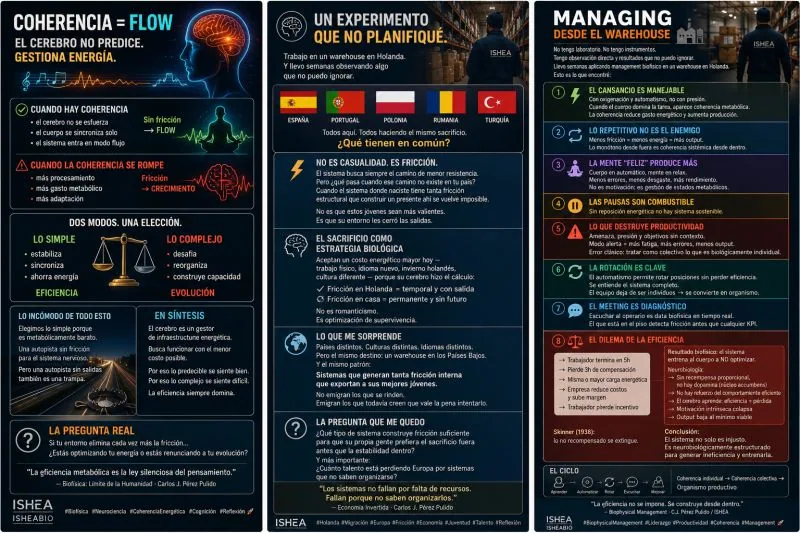
Managing from the Warehouse: Biophysical Management Without a Lab (3/4)
No instruments, no laboratory, only direct observation: weeks of applying biophysical management on a logistics floor, with results too consistent to ignore.
NOTA-COH-003 · Coherence
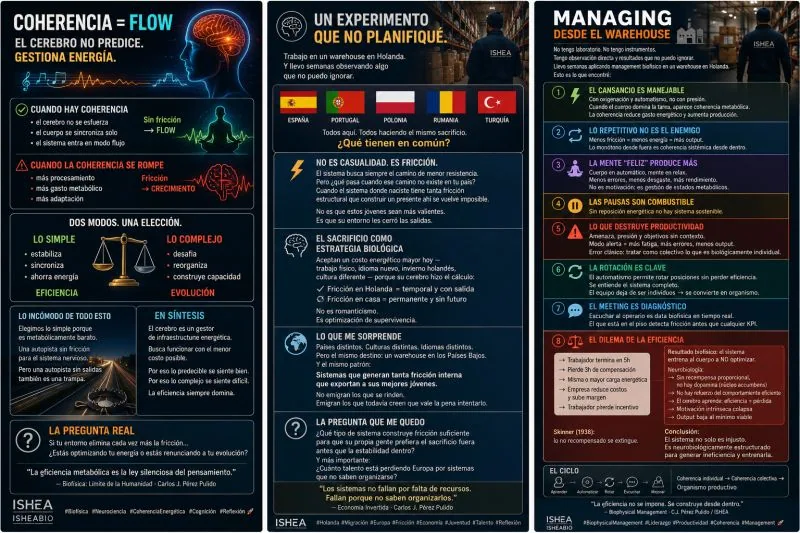
The Response Is Not Cultural, It Is Biological (1/4)
The body follows the rhythm before the mind decides. The starting point of the series: our response to the environment is explained by biology, not by culture.