

Economía 5.0 · NOTA-ECO-039
La nueva era de los creadores trata en realidad del tiempo
Por Carlos J. Pérez Pulido · ISHEA Institute ·
Crear, inventar e innovar no son lo mismo: la creación empieza en la observación y la curiosidad. La pieza separa los tres verbos y muestra que lo que de verdad está en juego es el tiempo.
Nota de divulgación — Escrito breve publicado en abierto. Pensamiento en curso, no resultado.
Pieza original en inglés.
🧠 The New Era of Creators Is Actually About Time
We often use creation, invention, and innovation as if they meant the same thing. They are not.
Creation begins with observation and curiosity.
It asks: Why? How? What if? It expands the boundaries of knowledge without knowing where the answer will lead.
Invention comes later.
It takes those discoveries and transforms them into practical solutions with clear objectives, measurable outcomes, and real-world applications.
This distinction matters more than ever.
For centuries, humanity's greatest advances started with people who simply observed and questioned the world. They were not trying to build a product—they were trying to understand reality. Those acts of creation eventually opened the door to inventions that changed civilization.
Today, generative AI is compressing the time required to produce content, code, and designs. As production becomes nearly instantaneous, execution alone is no longer a competitive advantage.
The scarce resource is no longer information.
The scarce resource is human time—and, more importantly, how we invest our cognitive time.
In this new era:
- Creation requires time to explore.
- Invention requires time to converge.
- Innovation requires time to be adopted and create value.
Perhaps the next competitive advantage will not belong to those who produce the most, but to those who ask the questions that nobody else thought to ask.
The future belongs not only to faster creators, but to deeper thinkers.
#ArtificialIntelligence #Creativity #Innovation #FutureOfWork #Leadership #CognitiveScience #TimeEconomy #ISHEA #carlosjperezpulido #kmodel
En la misma sala — Economía 5.0

NOTA-ECO-001 · Economía 5.0
¿Y si las variables con las que medimos el éxito de los países estuvieran al revés?
Durante décadas el progreso se ha medido con PIB, productividad, crecimiento y energía. Esta pieza plantea que esas variables podrían estar invertidas y pide repensar qué significa que un país prospere.
NOTA-ECO-002 · Economía 5.0
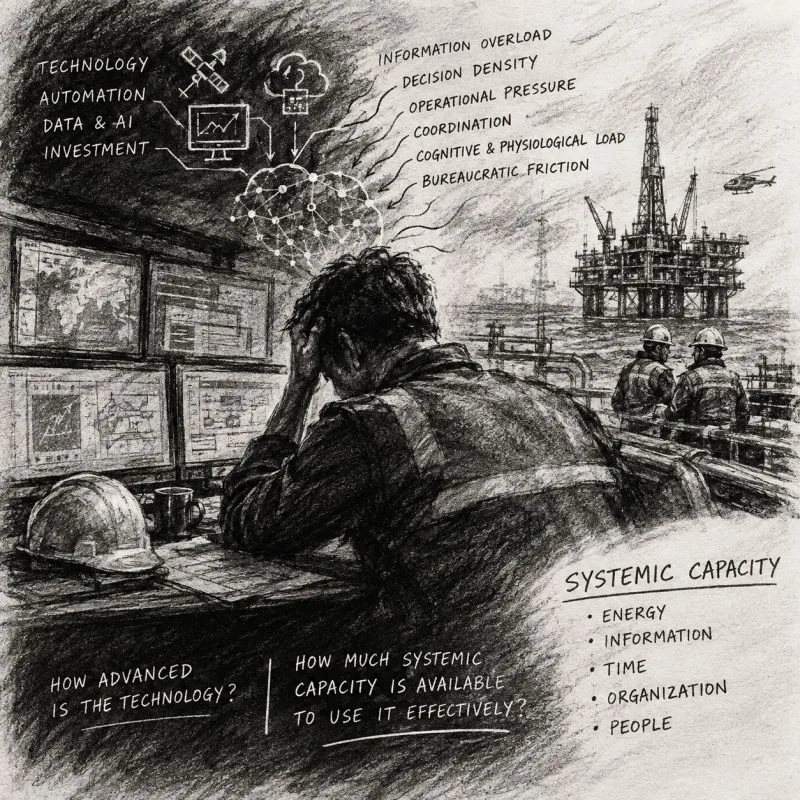
¿Por qué fallan los sistemas de alta ingeniería cuando la tecnología es más avanzada?
En Oil & Gas y otras operaciones complejas, más tecnología no garantiza mejores decisiones: esta pieza estudia la capacidad sistémica, lo que un sistema puede absorber y convertir en acción bajo presión.

NOTA-ECO-003 · Economía 5.0
Frankenstein y el petróleo: ¿por qué Venezuela vuelve a importar geopolíticamente?
Tercera entrega de la serie: tras el paso del capital a la IA y a la concentración financiera, llega el siguiente cuello de botella, el petróleo, y con él Venezuela vuelve al tablero geopolítico.