

Economy 5.0 · NOTA-ECO-039
The New Era of Creators Is Actually About Time
By Carlos J. Pérez Pulido · ISHEA Institute ·
Creation, invention and innovation are not the same thing: creation begins in observation and curiosity. The piece separates the three and shows that what is really at stake is time.
Note — Short piece published openly. Thinking in progress, not a result.
🧠 The New Era of Creators Is Actually About Time
We often use creation, invention, and innovation as if they meant the same thing. They are not.
Creation begins with observation and curiosity.
It asks: Why? How? What if? It expands the boundaries of knowledge without knowing where the answer will lead.
Invention comes later.
It takes those discoveries and transforms them into practical solutions with clear objectives, measurable outcomes, and real-world applications.
This distinction matters more than ever.
For centuries, humanity's greatest advances started with people who simply observed and questioned the world. They were not trying to build a product—they were trying to understand reality. Those acts of creation eventually opened the door to inventions that changed civilization.
Today, generative AI is compressing the time required to produce content, code, and designs. As production becomes nearly instantaneous, execution alone is no longer a competitive advantage.
The scarce resource is no longer information.
The scarce resource is human time—and, more importantly, how we invest our cognitive time.
In this new era:
- Creation requires time to explore.
- Invention requires time to converge.
- Innovation requires time to be adopted and create value.
Perhaps the next competitive advantage will not belong to those who produce the most, but to those who ask the questions that nobody else thought to ask.
The future belongs not only to faster creators, but to deeper thinkers.
#ArtificialIntelligence #Creativity #Innovation #FutureOfWork #Leadership #CognitiveScience #TimeEconomy #ISHEA #carlosjperezpulido #kmodel
In the same room — Economy 5.0

NOTA-ECO-001 · Economy 5.0
What if the variables we use to measure national success were completely backwards?
For decades, progress has been measured through GDP, productivity, growth and energy use. This piece argues those variables may be inverted and asks us to rethink what it means for a country to thrive.
NOTA-ECO-002 · Economy 5.0
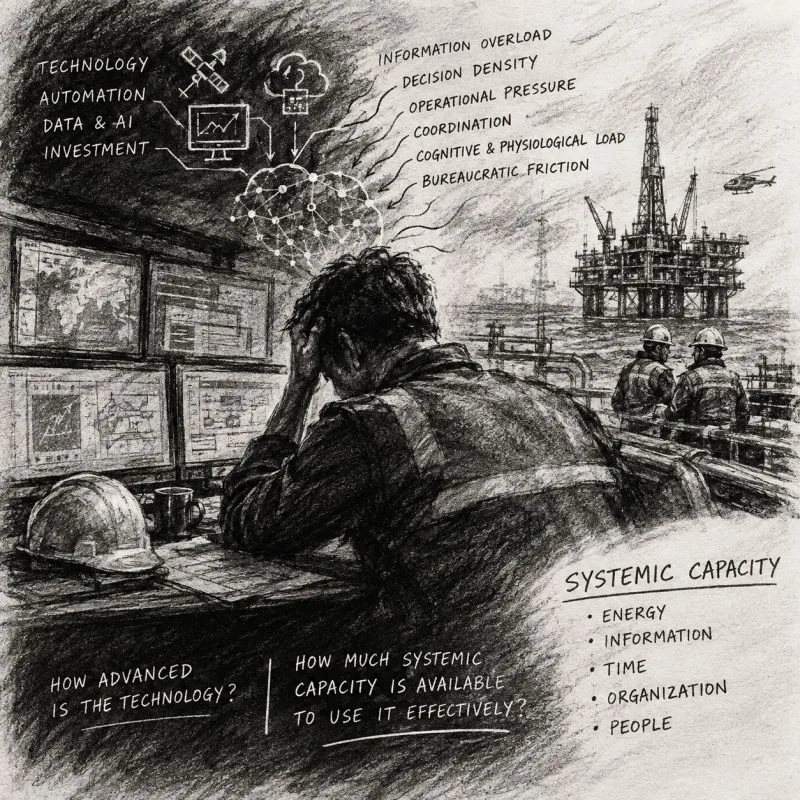
Why do highly engineered systems fail just when technology is most advanced?
In Oil & Gas and other complex operations, more technology does not guarantee better decisions: this piece examines systemic capacity, how much a system can absorb and turn into action under pressure.

NOTA-ECO-003 · Economy 5.0
Frankenstein and Oil: Why Does Venezuela Matter Geopolitically Again?
Third installment of the series: after tracing capital into AI and financial concentration, the next bottleneck comes into view, oil, and with it Venezuela returns to the geopolitical board.