

Economía 5.0 · NOTA-ECO-040
El retorno petrolero de Venezuela: no es un auge, es un reinicio
Por Carlos J. Pérez Pulido · ISHEA Institute ·
Un alza del 25 % en la producción petrolera venezolana luce bien sobre el papel. La pieza formula la pregunta difícil: no cuánto creció, sino por qué, y qué revela sobre la capacidad real del país.
Nota de divulgación — Escrito breve publicado en abierto. Pensamiento en curso, no resultado.
Pieza original en inglés.
Venezuela’s Oil Comeback: It’s not a boom. It’s a restart.
The recent ~25% increase in Venezuela’s oil production looks impressive on paper.
But the key question is not how much it grew — it’s why it grew.
Because the evidence points to something very different from a structural expansion.
This is not a wave of new capacity.
It is a system coming back online.
Three forces explain most of the rebound:
🔄 Reactivation of shut-in production
Idle wells and previously constrained fields being restarted.
🚢 Logistics unblocking
Storage constraints and export bottlenecks easing, allowing crude to actually leave the system.
🧪 Commercial normalization
Improved access to diluents and export channels enabling heavy crude to move again.
⚙️ Targeted operational support
Selective rehabilitation of existing infrastructure (including JV activity with international operators).
The distinction is critical:
Recovering suppressed capacity is not the same as creating new capacity.
One can happen in months.
The other takes years and billions in sustained investment.
So what we are seeing is not a structural oil boom.
It is an operational rebound of a stressed system returning toward equilibrium.
And that raises the real question:
👉 How much of this recovery is actually sustainable once the “idle capacity” is fully exhausted?
Because after the restart phase… growth becomes much harder.
#Venezuela #OilMarkets #Energy #OPEC #Macroeconomics #Geopolitics #EnergyTransition
En la misma sala — Economía 5.0

NOTA-ECO-001 · Economía 5.0
¿Y si las variables con las que medimos el éxito de los países estuvieran al revés?
Durante décadas el progreso se ha medido con PIB, productividad, crecimiento y energía. Esta pieza plantea que esas variables podrían estar invertidas y pide repensar qué significa que un país prospere.
NOTA-ECO-002 · Economía 5.0
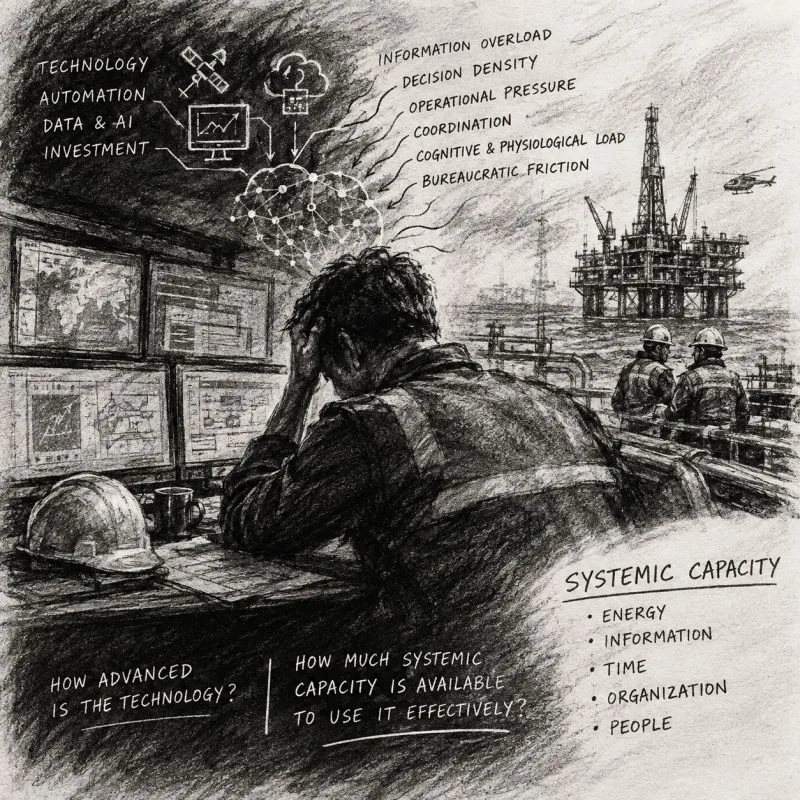
¿Por qué fallan los sistemas de alta ingeniería cuando la tecnología es más avanzada?
En Oil & Gas y otras operaciones complejas, más tecnología no garantiza mejores decisiones: esta pieza estudia la capacidad sistémica, lo que un sistema puede absorber y convertir en acción bajo presión.

NOTA-ECO-003 · Economía 5.0
Frankenstein y el petróleo: ¿por qué Venezuela vuelve a importar geopolíticamente?
Tercera entrega de la serie: tras el paso del capital a la IA y a la concentración financiera, llega el siguiente cuello de botella, el petróleo, y con él Venezuela vuelve al tablero geopolítico.